
The United States continues to champion stablecoin innovation to lead the global crypto industry.
The United States government has intensified its strategy to establish a clear legal framework to boost the digital asset ecosystem. At the heart of this debate are the stablecoins, assets linked to fiat currencies that seek to offer stability and efficiency in global transactions.
According to the statements of Patrick Witt, executive director of the Presidential Advisory Council for Digital Assets, the goal is to ensure that regulations foster technological growth without imposing the administrative burdens of traditional banking.
President Donald Trump The administration has endorsed this view, emphasizing that passing specific laws, such as the CLARITY Act, is a priority for maintaining economic competitiveness against foreign powers. The administration maintains that regulatory clarity will attract capital and talent, ensuring the country is at the epicenter of the next evolution of the international financial system.
Trade with regulated stablecoins nowStablecoins under scrutiny: the debate over their true financial nature
The debate about the nature of stablecoins has generated conflicting positions between the crypto sector and banking institutions.
Patrick Witt has been emphatic in pointing out that digital assets that offer returns should not automatically be categorized as bank deposits. According to him, the key lies in reserve management. While traditional banks operate under a fractional-reserve system—where they lend out depositors' money—the GENIUS Act, which was passed in the middle of last year, explicitly prohibits stablecoin issuers from lending out the assets backing their tokens.
The technical distinction that Witt refers to is fundamental to the legal architecture that the White House is proposing for the cryptocurrency industry.
Witt argument On social media, the message is that paying interest on balances isn't what defines a bank, but rather the remortgage of funds. By prohibiting the use of reserves for lending activities, stablecoins maintain a distinct risk profile. According to reports from the Advisory Council, this structure allows users to benefit from the efficiency of blockchain networks without the systemic risks associated with conventional commercial banking. The approach aims to protect consumers through complete transparency of reserves, ensuring that each token in circulation is backed 1:1 by liquid and secure assets.
Join Bit2Me and trade crypto todayTrump urges passage of the CLARITY Act
President Donald Trump has directly intervened in the discussion, linking cryptocurrency regulation to national security and economic prosperity.
In official communications, the US president urged Congress to expedite the passage of the Clarity Act, a bill designed to regulate the digital asset market. Trump stated that US citizens should be able to profit from their capital through the new financial tools available in the crypto market.
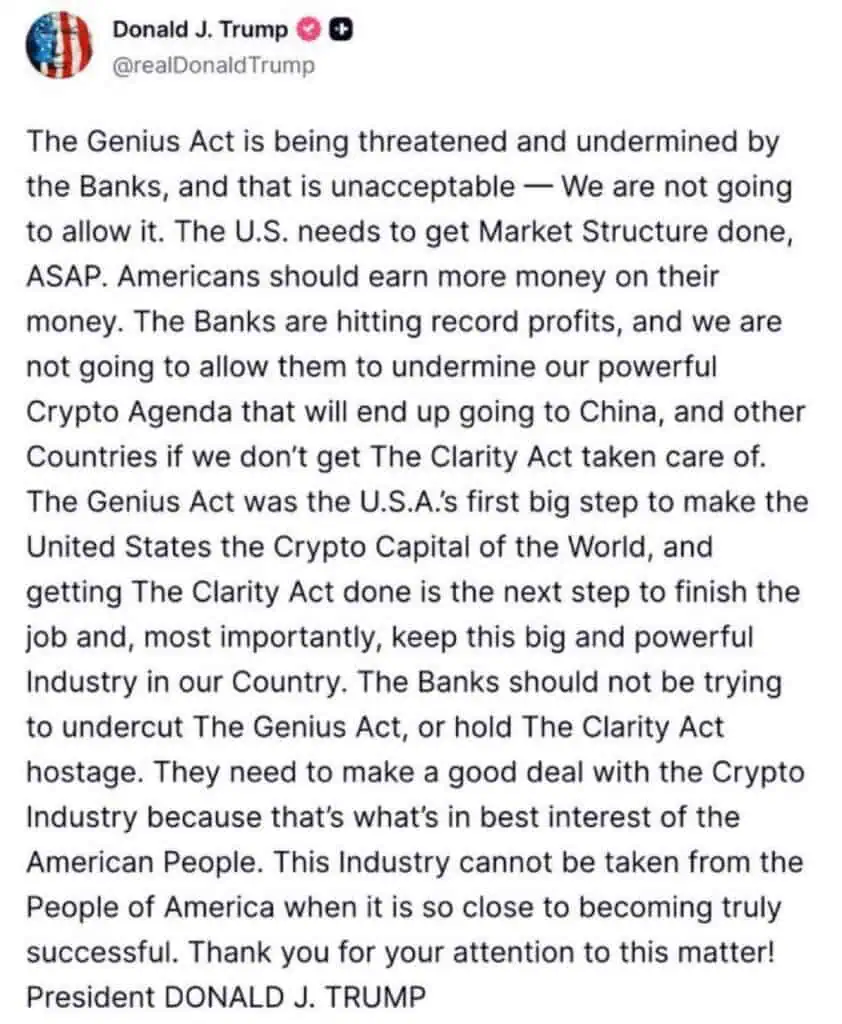
According to the president's statements, the delay in creating a solid and comprehensive regulatory framework for crypto assets represents a risk of capital flight.
Trump warned that if the country does not resolve its internal legislative differences, the industry will seek more favorable jurisdictions, specifically mentioning China as a competitor that could capitalize on American indecision.
The White House's view is that the cryptocurrency sector is not a threat to the dollar, but rather a technological extension that can strengthen the US currency in the digital environment. The urgency expressed by the White House seeks to unblock negotiations in the Senate Banking Committee, where traditional financial institutions have requested stricter regulations for returns linked to digital currencies.
Buy Bitcoin and digital assets on Bit2MeWashington seeks to lead the new digital financial architecture
The United States' regulatory stance reflects a global race to control 21st-century financial infrastructure. The government considers stablecoins issued by private companies, under appropriate federal oversight, preferable to central bank digital currencies controlled by foreign states. Statements from presidential advisors indicate that the potential of these currencies lies in their ability to reduce transaction costs and increase the speed of settlement in international trade.
According to analysts at the Presidential Council, integrating stablecoins into the formal economy could increase the efficiency of the national payments system by 30% over the next decade.
The administration seeks to enable technology companies to innovate without the friction of regulations designed for the last century. Therefore, by advocating for the autonomy of crypto platforms against capital and liquidity requirements from banks, the US is pursuing a hybrid model that combines legal certainty with technological freedom. The ultimate goal is to establish a regulatory standard that can be replicated by other nations, ensuring that the rules of the global crypto game are written according to the principles of transparency and open markets championed by Washington.
 Certificate
Main Cryptocurrencies Course
Basic levelBit2Me Academy brings you a new course in which you will learn everything you need about the most important cryptocurrencies that exist today.