
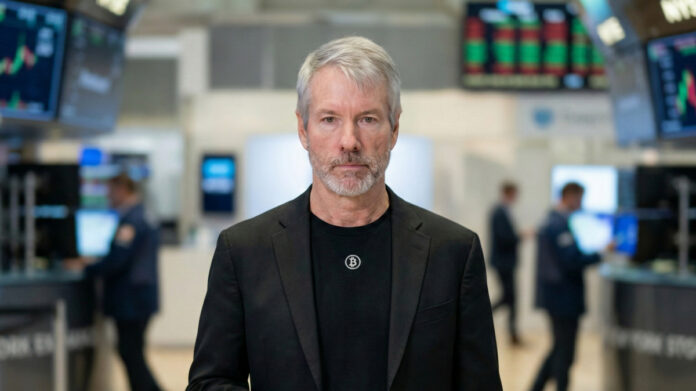
Strategy CEO Michael Saylor has redefined the meaning of digital credit. He also emphasized that Bitcoin remains the global store of value and that networks like Solana are now defined as transportation infrastructure.
During the recent conference Bitcoin for Corporations 2026, held within the framework of the event Strategy WorldMichael Saylor, executive chairman of MicroStrategy, presented a significant evolution in his digital asset thesis.
After years of focusing exclusively on Bitcoin as a store of value, Saylor has now outlined a layered financial structure where smart contract networks and traditional brokerage platforms play a complementary role as distribution infrastructure. His new vision does not represent a reversal of his stance on Bitcoin, but rather a technical expansion into the global credit market.
Saylor introduced the concept of "Digital Credit" as the final product that corporations and markets can consume, using Bitcoin as the base collateral or "Digital Capital" that backs the entire system.
Buy Solana today at Bit2MeThe role of altcoins: From competitors to "distribution rails"
During his presentation, Michael Saylor captured the industry's attention by directly mentioning Solana y Ethereum within its corporate strategy. Contrary to what many expected, it did not present them as competitors to Bitcoin, but as functional networks intended to serve as distribution channels for financial software built on digital capital.
Saylor explained that, in order for digital credit to grow and operate programmatically, it needs infrastructures capable of tokenizing assets and executing smart contractsAccording to his view, Bitcoin represents the base capital, the stable and protected value, while networks like Solana and Ethereum act as the systems that facilitate its movement within the digital economy.
Under this model, Saylor compared the role of the market's leading altcoins, Ethereum and Solana, with that of traditional platforms such as the NASDAQ or the London Stock Exchange, highlighting that these They function as technological channels for issuing, trading, and settling financial instrumentsThus, capital remains safe and static in Bitcoin, but its potential circulates through high-performance blockchain networks that enable the expansion of global credit.
Join Bit2Me and trade cryptocurrenciesSolana gains strength after public support from the co-founder of Strategy
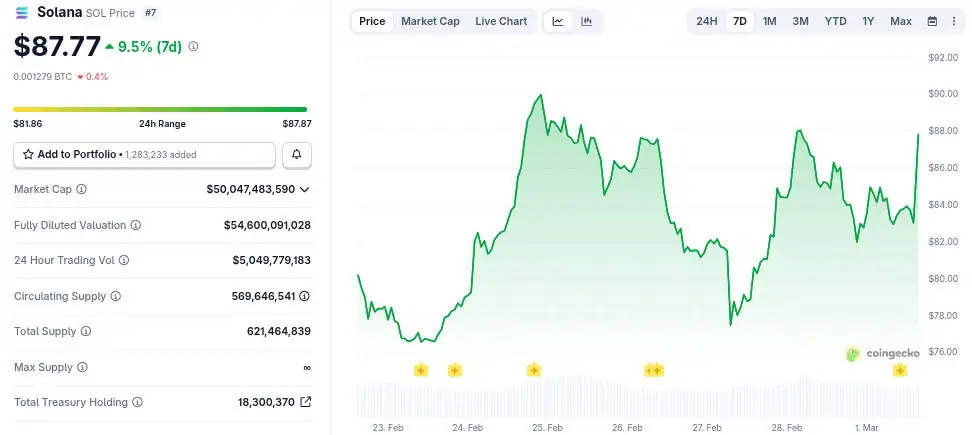
The repercussions were quickly felt in the market. According to CoinMarketCap data, Solana (SOL) traded near $90, registering a 13% increase after Saylor's announcement. Its market capitalization rose to $50.700 billion, while daily trading volume exceeded $5.000 billion, a clear sign of the renewed interest it generated among investors following the statements by Michael Saylor, co-founder of Strategy.
According to experts, the crypto community perceived Saylor's recent comments as significant validation for the Solana ecosystem. By acknowledging the infrastructure value of other blockchains, Saylor helps to reduce the narrative of confrontation between assets, fostering an ecosystem of interoperability.
While Bitcoin retains its role as the dominant digital asset, like digital gold, Saylor's vision opens up space for a more pluralistic narrative within the crypto market. In this narrative, Solana and Ethereum are positioned as two of the most favorable infrastructures for developing innovation in smart financial products and programmable lending models.
Access Bitcoin, the global store of valueCredit as code: Saylor's vision of the financial future
Michael Saylor focused his presentation on the performance of Strategy's equity instrument, the STRC perpetual preferred shares, highlighting them as a concrete example of how a digital asset can withstand market volatility and offer a more stable haven for investors.
The company's founder explained that the increase in STRC's dividend, adjusted to 11,5% annually, is aimed at maintaining its par value at $100. This type of adjustment, he noted, demonstrates how digital instruments can adapt to market conditions without relying on traditional credit mechanisms.
Within a vision he called “Credit as Code,” Saylor proposed a financial model where loans and performance products are managed through automated methods on the blockchain. Instead of manual processes or banking intermediaries, he proposed systems governed by programmed rules that dynamically adjust variables such as yield, risk, and collateral.
This approach allows for the definition of precise parameters using metrics such as BTC Rating, which measures collateral coverage, or BTC Risk, which calculates the probability of liquidation. By integrating these criteria into networks like Solana, Saylor argued that it is possible to develop financial products that are more agile, transparent, and resilient than those of the global credit system, whose scale is estimated at $300 trillion.
According to their vision, programmable digital credit not only optimizes operational efficiency, but also redefines how assets can generate value in the modern economy.
Access crypto with confidence: trade on Bit2Me