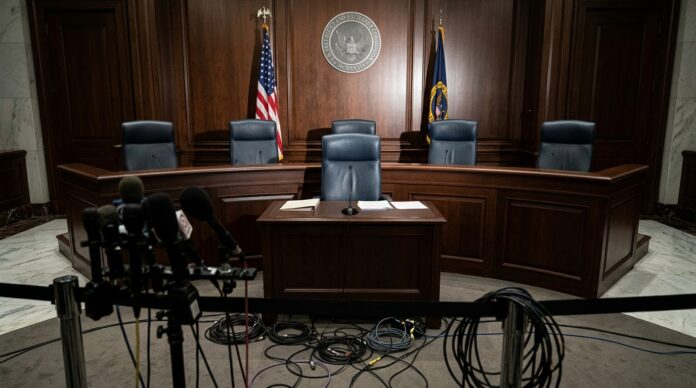
A regulatory change to the internal requirements of the U.S. Securities and Exchange Commission (SEC) allows a single commissioner to approve rules affecting the digital asset sector. With the recent departure of key members and the lack of appointments to the agency, decision-making for a market valued at over $3 trillion is now concentrated in just two leaders.
This technical restructuring of administrative procedures aims to prevent operational paralysis by facilitating the creation of regulatory frameworks without relying on comprehensive legislation passed by Congress. The measure redefines the balance of power in Washington as the industry closely monitors every move made by federal regulators.
Modification of quorum and decision-making power
The US regulatory body approved an internal rule on September 30, which came into effect on October 2, whereby modified its quorum requirements to promote regulatory flexibilityWith this administrative change, the number of commissioners needed to validate formal resolutions is reduced, allowing a single person to adopt regulations when the other members present must abstain or are disqualified due to a conflict of interest.
Historically designed to operate with a panel of five commissioners confirmed by the Senate, the agency's leadership is operating at a bare minimum following Commissioner Hester Peirce's formal departure on October 2. Currently, the agency is led by only two members: Chairman Paul Atkins and Commissioner Mark Uyeda. If either of them recuses themselves from a particular case, the remaining commissioner has the legal authority to set regulatory precedents for the U.S. financial markets.
This exceptional mechanism grants unprecedented leeway to the entity's leadership. Supervisory decisions encompassing more than 1 million operators and participants in the financial ecosystem now depend on a minimal structure, a stark contrast to the usual guarantees of administrative collegiality in federal agencies.
Legislative vacuum and the agencies' response
The speed with which supervisory agencies are acting stems from the lack of progress on comprehensive market structure legislation in the U.S. Congress, such as the well-known CLARITY Act. Faced with this parliamentary gridlock during the period leading up to the renewal of Congress, both the SEC and the Commodity Futures Trading Commission (CFTC) have opted to design regulatory frameworks based on their existing powers. To understand how these institutional disputes affect the market, you can explore the following: Market analysis on Bit2Me News on jurisdictional tensions in Washington.
In August, the SEC introduced a proposal to establish a safe harbor that would prevent certain tokens from being automatically classified as investment contracts under traditional law. Meanwhile, the CFTC faces a similar technical shortage, with only Michael Selig as commissioner and chairman, whose term has been confirmed since December 2025. In October, Selig confirmed his agency's intention to oversee platforms through direct regulatory proposals, while Atkins indicated on October 2nd that new regulatory initiatives for digital assets would be launched in the near future.
The total volume of transactions and derivatives linked to these markets, which exceeds 95.000 billion in accumulated operations during periods of greater institutional volatility, reflects the urgency of providing certainty to platforms and users in the face of prolonged legal gaps.
Implications for industry and the administrative debate
The ability to issue regulations through direct administrative decrees has generated mixed opinions among legal experts, industry associations, and consumer rights advocates. On the one hand, a fast-track process avoids the complete freezing of key files, allowing for the resolution of authorization requests for physically backed financial products or the definition of accounting guidelines applicable to qualified custodians. On the other hand, the possibility of a single individual determining the course of financial policy raises questions about the strength of democratic checks and balances.
The precedent of modifying quorum rules also raises questions about the long-term stability of regulations passed under this system. Several experts suggest that resolutions issued by a single commissioner could be challenged in federal court, arguing that they violate the U.S. Administrative Procedure Act (APA). If the courts find that these measures lack the collegial support that Congress intended when creating the agency, the sector could face further waves of litigation.
Technical debate and comparison with European regulations
The quorum requirement has generated disagreement within the international legal and financial community. While analysts warn that an excessive concentration of power allows a single official to approve binding guidelines for multi-billion-dollar markets, Mark Uyeda publicly defended the measure on October 5, asserting that the consumer protection mission remains unchanged and that the rule simply prevents institutional gridlock.
This regulatory approach based on emergency guidelines or agency agreements contrasts sharply with the European Union model. In Europe, the comprehensive framework MiCA Regulation It establishes harmonized, transparent, and predictable standards for all Crypto Asset Service Providers (CASPs). For decision-makers Learn crypto concepts at Bit2Me AcademyThe legal certainty offered by community legislation approved by elected parliaments makes a substantial difference compared to US administrative discretion.
The European framework does not depend on the temporary composition or the fortuitous disqualification of individual commissioners, but on a consolidated legislative code that covers everything from asset issuance to equity reserve standards and the prevention of market abuse.
FAQ
What exactly does the SEC's new quorum rule change?
The rule establishes that, in the event of disqualifications or justified absences among the few commissioners in office, a single commissioner may constitute a sufficient legal quorum to approve binding measures and resolutions on the markets under his jurisdiction.
Does this decision affect cryptocurrency users in Europe?
Not directly in its daily operations, since activity in the European Union is governed by MiCA. However, it can influence global liquidity and trends by defining how US companies and protocols operate.
Why isn't the United States Congress intervening?
The US legislature is debating various proposals on the market structure of digital assets, but partisan disagreements and parliamentary schedules have delayed a vote on a final law, leaving room for supervisory agencies.
Can a future court overturn rules approved by a single commissioner?
There is a possibility that market participants may challenge these resolutions in court under the Administrative Procedure Act, arguing that they violate the collegial principle with which the original agency was designed.
The temporary concentration of regulatory power in the SEC highlights the urgency of establishing clear rules for the digital asset ecosystem in the world's major economies.
Faced with the uncertainty stemming from changes in US regulators, environments with unified frameworks like MiCA solidify Europe as a standard of stability and protection for managing your portfolio with confidence.
Investing in cryptoassets is not fully regulated, may not be suitable for retail investors due to high volatility and there is a risk of losing all invested amounts.
Generative artificial intelligence tools were used to create this article.