

The tokenization of real assets is transforming Wall Street and opening up multi-billion dollar opportunities in emerging markets through the use of blockchain technology.
This year, the narrative of the real world assets known as RWA It has managed to mobilize unprecedented volumes of capital by allowing traditional instruments to be integrated into decentralized digital networks.
This digitization of values allows assets that were previously slow to process or difficult to divide to now circulate with greater agility in markets that operate without interruption.
According to data analyzed by specialists in the sector, the financial infrastructure is migrating towards more efficient protocols available to optimize capital formation in regions that have historically been off the radar of major investors.
Enter Bit2Me and access digital assetsThe awakening of a new digital financial architecture
Tokenization essentially involves issuing a digital token on a blockchain, which represents ownership or economic rights over physical or financial assets. This technological system eliminates the need for multiple intermediary entities and reduces the administrative costs associated with issuing securities in traditional markets.
According to reports from international financial consulting firms, the adoption of this format responds to the need to provide immediate liquidity to sectors that have historically operated with administrative hurdles. Thanks to smart contracts, transactions are executed automatically under rules that guarantee regulatory compliance, which increases participant confidence and simplifies operational management.
Large corporations favor established public networks that combine security, liquidity, and a proven track record. Ethereum excels in this area by holding the largest total value locked in real-world assets. Its open structure allows administrators to integrate tokens with various digital finance platforms, thereby expanding access to and the utility of tokenized assets.
Create your account and trade cryptocurrenciesTreasury bonds are leading the institutional adoption of blockchain
Over the past year, the testing phase has given way to a new reality in the financial system. The world's largest banks and traditional institutions have begun issuing assets directly on digital infrastructures. These are no longer mere technological trials, but rather operations that move billions of dollars through blockchains open to public scrutiny. This transparency allows regulators to track every transfer in real time and maintain an inviolable record of asset ownership.
In this context, US Treasury bonds have taken the lead in the tokenized market. Their volume exceeds $10.000 billion, a figure that reflects the appetite of institutional investors for digital assets backed by secure instruments.
Companies like BlackRock, with its BUIDL fund, and franklin templetonThrough their FOBXX product, they have set the course by managing hundreds of millions directly on the blockchain, consolidating a more agile and verifiable financial model.
Sovereign debt has become the preferred vehicle for testing the efficiency of this new digital infrastructure due to its liquidity and low risk. However, the movement extends beyond the public sector. The €300 million bond issued by Siemens demonstrates that large corporations also rely on this technology to manage their most sensitive financing. Each new step confirms that the integration between traditional finance and blockchain networks is advancing decisively and irreversibly.
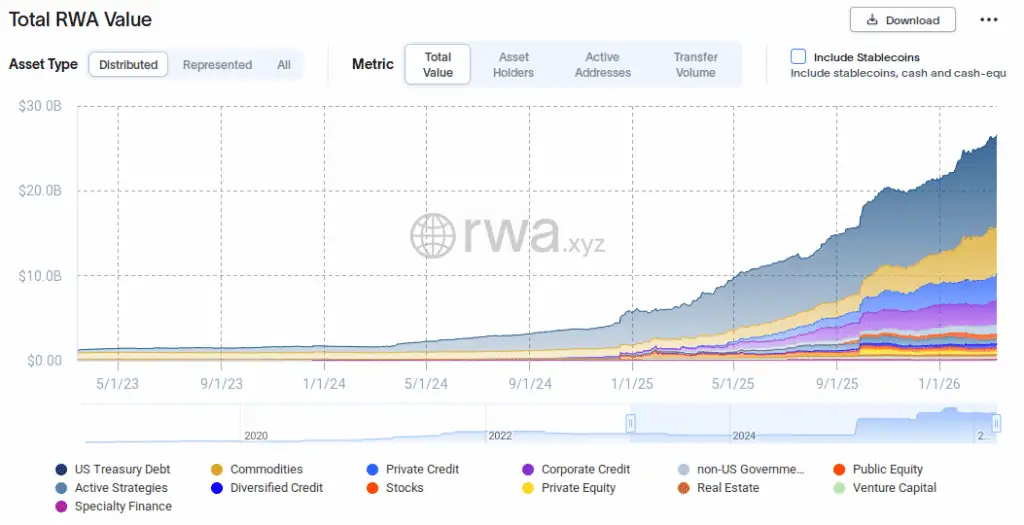
Source: rwaxyz
Towards a $10 trillion global market
Projections for the end of this decade are extremely optimistic, placing the RWA tokenized asset market at around $3 trillion by 2030. However, the total potential is much greater considering that regions like Latin America, Southeast Asia, and the Gulf countries have more than $10 trillion in capitalization disconnected from modern digital infrastructure.
On the other hand, recent regulatory developments are beginning to mark a turning point. In Europe, clear regulatory frameworks such as the MiCA Regulation offer a solid foundation for crypto assets, while the United States, Singapore, and the United Arab Emirates are promoting regulations that are attracting projects with a long-term vision. With clearer rules, thousands of initiatives are finding new opportunities to access financing and gain legitimacy within the global financial system.
The future points to a more open and balanced model, where blockchain technology not only accelerates transactions but also paves the way for a fairer distribution of wealth. As these platforms solidify their legal and technical foundation, tokenization could become the definitive bridge between traditional markets and the new digital ecosystem.
 Certificate
Blockchain Course
Basic levelTake this course where we explain blockchain in a clear, simple and concise way so that you have a very clear idea of what this new technology consists of.