

Researchers analyze the threat of quantum computing to cryptography and propose solutions to protect decentralized networks like Bitcoin.
Developers and researchers in the crypto community continue to focus on advancing quantum computing to address growing concerns related to the structural security of decentralized networks like Bitcoin and Ethereum.
The central point of the debate is the vulnerability of digital signatures that validate asset ownership, given the imminent arrival of quantum processors with the mathematical capacity to break current cryptography. In the case of Bitcoin, specifically, the risk lies with older addresses that keep their public keys exposed in the public ledger.
Various specialists are evaluating the implementation of improvements to the blockchain protocol architecture to prevent the potential theft of private keys. Current discussions range from engineering updates to debates on ecosystem neutrality, seeking to guarantee network protection without compromising its fundamental principles.
Trade Bitcoin on Bit2MeBitcoin: The Hidden Risk in Old Addresses in the Quantum Era
In the early years of the Bitcoin network, transactions were structured in a format called Pay-to-Public-Key, P2PKIn that model, public keys were stored directly on the blockchain, visible to anyone examining the records. Over time, addresses evolved into a more secure system where the key is hidden using a cryptographic hash until the owner decides to move the funds. However, when older formats are used or the same address is used repeatedly, the exposed keys remain permanently accessible.
Cybersecurity researchers involved in the project Project Eleven They estimate that there are more than 6.9 million bitcoins held in addresses with visible public keys. Within that total, around one million BTC would correspond to wallets belonging to the first users of the network. If a quantum computer were able to run the Shor's algorithmThis would allow them to derive private keys from the public keys of these old wallets and, consequently, take control of the funds associated with those keys. According to current market valuations, these assets at risk represent an amount exceeding $440.000 billion at current prices.
However, despite how alarming this figure seems, the technical community has clarified that the vulnerability is not related to mining or the system of Proof of Work based SHA-256Although Grover's quantum algorithm could, in theory, accelerate brute-force attacks, the energy and resources required to achieve this make it impractical today. Therefore, the real threat lies in the digital signature scheme based on elliptic curve cryptography, which could be compromised when quantum computing reaches a sufficient level of maturity.
Access secure Bitcoin from hereBIP 360 and the battle to preserve the essence of Bitcoin
Amid discussions about the future of digital security, the possibility that quantum computers could crack public-key cryptography has Bitcoin developers on high alert. While some are working on preventative solutions, others are assessing the risks of altering the principles that underpin the network. Among the most analyzed proposals is the BIP-360, an experimental design that introduces a new output structure called Pay-to-Merkle-Root. Its objective is to prevent the exposure of the keys used in transaction signatures and to create the basis so that, in the future, the system can adopt post-quantum signature schemes without compromising its operation.
However, this technical line of defense has opened a much deeper discussion about the protocol's governance and the very definition of its neutrality. Some developers argue that, in the face of a potential quantum decryption threat, a soft fork should be implemented to force vulnerable funds to migrate to more secure locations.
Some are even proposing a deadline that would invalidate coins not transferred in time from addresses vulnerable to this technological advancement. Underlying this idea is the concern that if quantum-capable actors gain access to inactive wallets, it would lead to a concentration of capital that could disrupt the network's economic equilibrium and jeopardize its stability.
At the opposite extreme, a significant portion of the technical community argues that imposing such measures would undermine the very foundations that have sustained the network since its inception. They believe that no change should compromise the system's immutability or alter the direct relationship between a private key and the control of an asset. From this perspective, updates should be presented as optional tools, not imposed obligations. This group also maintains that if technological advancements were to allow access to certain dormant funds, the initial impact would be absorbed by the market itself, leaving intact the principle of key sovereignty that defines the essence of Bitcoin.
Create your account and buy BTC todayA challenge still far off for the crypto ecosystem
While the debate about the risks of quantum computing progresses in development forums and conferences, recent technical analyses place this threat at a distant time horizon, mitigating alarms about an immediate or harmful impact in the short term.
A comprehensive report published by analysts at digital asset investment firm CoinShares concludes that blockchain infrastructure maintains high resilience against current technological advancements, ensuring that user funds remain secure under present conditions.
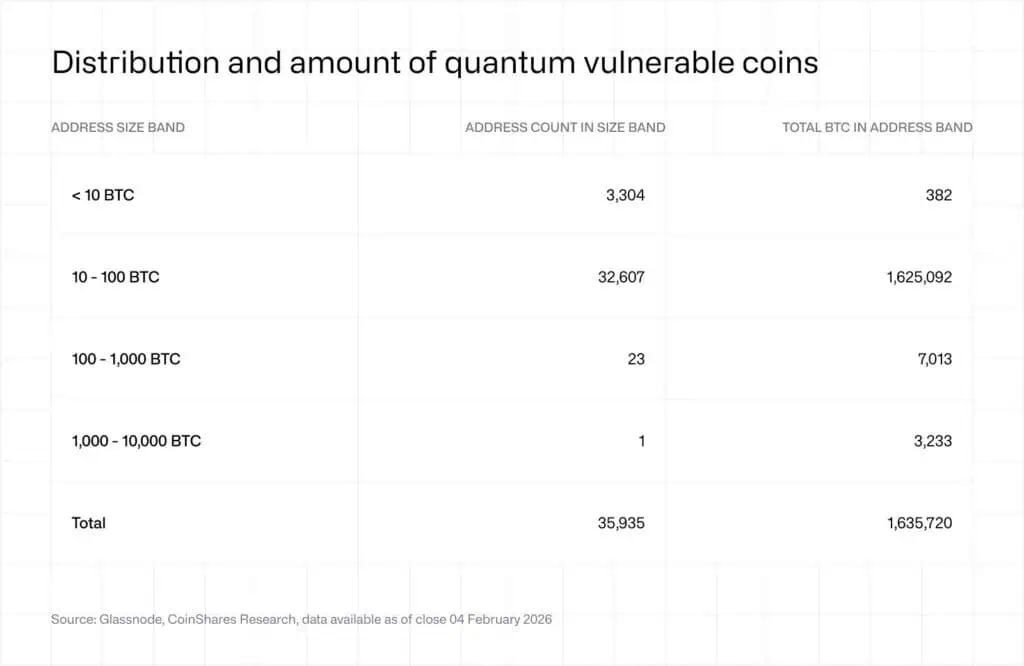
According to Valid identity document According to CoinShares, the practical risk of quantum computing is significantly lower than projected by the most pessimistic current theoretical estimates. Of the 1.700.000 to 6.900.000 million assets flagged as potentially vulnerable, analysts identified only about 10.200 BTC coins concentrated in addresses large enough to economically justify the immense operational cost of a quantum cyberattack. These high-risk coins represent less than 0,1% of the total supply and are valued at approximately $719.000.000 million.
The remaining exposed Bitcoin is fragmented across more than 32.600 small wallets, averaging 50 units of value each. Since an attacker would need to reverse engineer each address individually, carrying out a massive theft would be extremely slow, logistically unfeasible, and economically inefficient with the hardware of the coming decades.
Furthermore, the firm's technical report highlights the enormous existing engineering gap. Breaking the network's digital signature scheme within 24 hours would require a system equipped with millions of highly stable and fault-tolerant physical qubits. Currently, the most advanced experimental quantum equipment operates with a mere 105⁵ qubits of processing power. This means that the required power is thousands of times greater than the maximum capacity currently available in technology laboratories.
The researchers' central conclusion is that quantum computing represents an engineering challenge projected for the 2030s, not an imminent crisis in the short term. The decentralized nature of the Bitcoin protocol provides the necessary timeframe for developers. Plan, test, and roll out software updates progressivelyIn this way, the community is making progress in building efficient structural solutions that guarantee the viability of the ecosystem in the coming decades, without resorting to hasty measures that alter its original design.
Go to Bit2Me and buy bitcoins