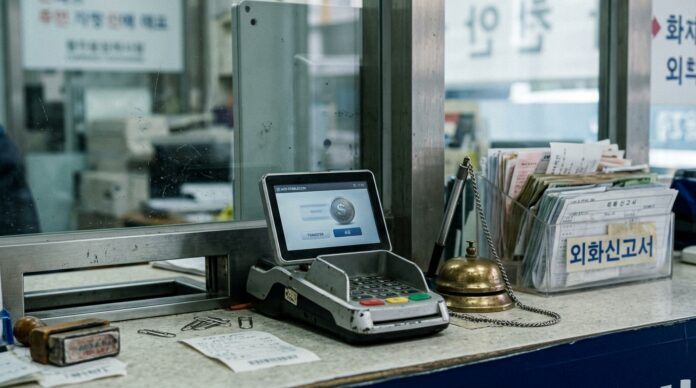
The Bank of Korea has formally notified the National Assembly that it will draft an amendment to the Foreign Exchange Transactions Act before the end of the year. The institutional aim is to classify stablecoins as means of payment, subjecting their cross-border movements to strict exchange controls and preventing undeclared transactions that circumvent traditional banking channels.
This regulatory initiative coincides with a period of intense negotiations in Seoul, where the future Basic Law on Digital Assets and the debate on the entry into force of the tax on crypto profits scheduled for January 1, 2027, are taking place.
Control of capital flows as a central focus
The proposal submitted on October 22 by the South Korean monetary authority does not seek to equate digital assets with legal tender in local businesses. According to the documentation presented to legislators, The Bank of Korea plans to draft a reform of the foreign exchange law this year with the technical objective of classifying stablecoins under the legal regime of means of payment subject to mandatory declaration.
Under the current foreign exchange legislation in the Asian country, a means of payment does not automatically imply sovereign liquidity, but rather an instrument whose transfer abroad requires traceability and mandatory registration in the state's exchange networks. Financial authorities have identified that the use of non-custodial private wallets, transaction mixing services, and settlement outside the traditional banking system create loopholes that weaken traditional foreign exchange control mechanisms.
In practice, linking fiat-backed stablecoin transfers to the requirements applicable to ordinary bank transfers to New York aims to limit unauthorized capital outflows. For those managing self-custodial portfolios in South Korea, the measure strengthens the infrastructure that has historically generated international price arbitrage, consolidating a preventative regulatory framework while broader regulations are being approved.
The Basic Law on Digital Assets and regulatory coordination
The foreign exchange bill is not operating in isolation within Seoul's timeline. It is progressing in parallel with the development of the so-called Basic Law on Digital Assets, legislation that includes the granting of operating licenses for intermediaries, the technical framework for issuing currency-linked assets, and preliminary guidelines for the subsequent processing of spot exchange-traded funds.
The Chairman of the Financial Services Commission (FSC), Lee Eog-weon, stated in Parliament that government consultations are in their final stages to expedite the draft legislation as quickly as possible. The central bank will work directly with various ministries to ensure that the interim regulatory gap is not exploited while the law is being implemented. You can find the details of these global regulatory developments at [link to relevant documentation]. Bit2Me Academy, where the convergence of monetary policies with blockchain traceability standards is analyzed.
This approach mirrors the custody, transparency, and verification policies implemented in the European Union through the MiCA Regulation. By defining the responsibilities for issuing and reporting transactions, both jurisdictions aim to precisely delineate which platforms are authorized to manage cross-border payments without compromising the territory's exchange rate stability.
The 2027 tax debate and parliamentary pressure
The legal framework for cross-border assets coincides with a fiscal crossroads of considerable public importance. The national tax on income from crypto assets remains scheduled to take effect on January 1, 2027, after having undergone three formal postponements due to legislative disagreements regarding the order of implementation.
Various sectors of parliament have raised the question of whether it is appropriate to implement a specific tax before the law formally defining the legal nature of these assets is ratified. Economic authorities at the FSC acknowledge that the tax scheme must take market circumstances into account, while prominent members of the parliamentary opposition are calling for a final review of the timeline.
Public concern has resulted in two citizen-initiated bills that garnered over 50.000 certified signatures, the threshold that compels the National Assembly to debate either their repeal or an additional two-year extension. Meanwhile, the National Tax Service is maintaining its schedule to submit the corresponding drafts before the end of October, attempting to establish the tax assessment bases while awaiting the Assembly's decision.
Implications for the international market and crypto trading
Tightening foreign exchange regulations in developed economies often directly impacts international liquidity flows. If you wish to diversify or better understand how to manage market positions within a secure and transparent regulatory environment in Europe, you can explore alternatives such as buy Bitcoin through platforms that fully comply with EU financial regulations.
Stable assets continue to play a key role in digital settlement operations worldwide. However, as central banks intensify their reporting requirements on outbound transfers, users of decentralized infrastructure face increasing demands regarding the origin and destination of their funds, eliminating the information asymmetry that exists between the banking system and crypto protocols.
The South Korean experience illustrates how foreign exchange trading oversight tools are gradually adapting to blockchain mechanisms. Rather than prohibiting digital instruments, governments are opting to integrate them into official foreign exchange information registries to ensure effective control over monetary policy.
FAQ
What does it mean for a stablecoin to be considered a means of payment under South Korean foreign exchange law?
This means that the stablecoin is technically classified as an exchange instrument whose international shipments must be registered with the central bank and banking intermediaries, assimilating its control to that of a conventional fiat currency international transfer.
Will this amendment allow stablecoins to be used as legal tender in stores?
No. The technical proposal is limited to the cross-border framework and currency controls. The term "medium of payment" corresponds to a legal definition geared towards tax and anti-money laundering oversight, without granting it legal tender status within the domestic economy.
When is the cryptocurrency tax scheduled to come into effect in South Korea?
The legislative calendar sets the implementation of the tax for January 1, 2027, after having been postponed three times, although parliament and tax authorities continue to evaluate citizen requests to review or postpone it.
The Bank of Korea's initiative confirms the global trend of aligning stablecoin operations with regulatory standards applicable to cross-border currency transfers. As monetary authorities refine their reporting systems, transaction traceability is becoming a structural requirement of the financial ecosystem.
The outcome of the legislative process in Seoul will offer relevant references on how to balance the development of the digital economy with the preservation of sovereign exchange controls and fiscal certainty.
Investing in cryptoassets is not fully regulated, may not be suitable for retail investors due to high volatility and there is a risk of losing all invested amounts.
Generative artificial intelligence tools were used to create this article.