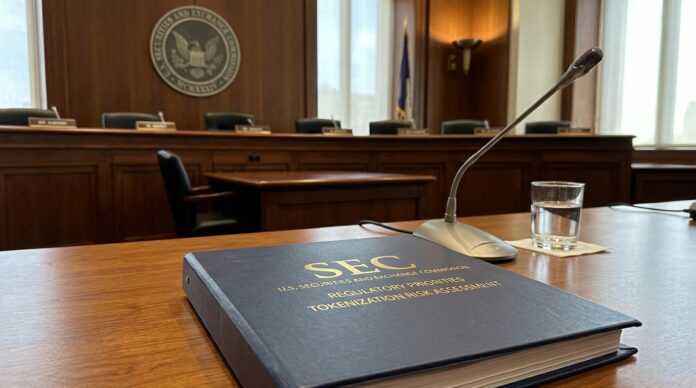
The U.S. Securities and Exchange Commission (SEC) has identified the tokenization of financial assets and marketable securities as a priority emerging risk area in its institutional oversight plan, focusing directly on operational resilience and traditional market infrastructure.
This regulatory move coincides with a stage of increasing integration between traditional finance and distributed ledger technology, placing technical scrutiny at the center of the global institutional debate.
Tokenization in the SEC's supervisory priorities
The US regulator has formalized its interest in distributed ledger-based market infrastructure. In its recent strategic supervisory report, The SEC included asset tokenization as a priority area of attention in its operational reviews. In this way, the supervisory body places the digital representation of financial instruments under the same framework of technical oversight as quantum computing, artificial intelligence, and extended stock market trading sessions.
Unlike previous exercises in which the concept was not explicitly included as a separate focus of systemic scrutiny, the regulator is now decisively addressing the operational security of key market participants. The Examinations Division will focus its Systems Compliance and Integrity (SCI) Regulation reviews on assessing whether the platforms and entities that process these assets have the necessary computing capacity, technical redundancy, and controls to prevent critical security disruptions or breaches.
The institutional adoption of tokenized instruments has progressed from experimental phases to large-scale deployments, justifying preventive intervention by regulatory bodies. For a more in-depth look at the sector's regulatory background, you can review the analyses on International financial regulation in Bit2Me News, where the interaction between traditional legislation and decentralized digital ecosystems is analyzed.
Critical infrastructure and risks in clearinghouses
The SEC's assessment is not limited to asset issuance but delves into the entities responsible for clearing, settlement, and custody. The agency has identified tokenization as one of the high-risk areas within central clearing agencies, placing it on par with default management, securities lending, and standard operational risks. The adoption of blockchain-based ledgers raises questions about the reliability of settlements and interoperability with existing systems.
To understand the essential concepts of how real-world assets are represented by smart contracts, you can consult the training guide of Bit2Me AcademyClearing entities must ensure that asset programmability does not introduce unforeseen dependencies during times of high volatility or liquidity stress in secondary markets.
Interoperability between different distributed ledger networks and traditional ledgers presents a major technological challenge. If a smart contract has logical vulnerabilities or errors in its data oracles, atomic settlement can be compromised, generating cascading accounting discrepancies throughout the custodian entities participating in the settlement network.
The institutional shift: absence of the independent crypto sector
A key detail in the examination priorities document is the continued absence of general crypto assets as a separate inspection category. For the second year in a row, the agency has omitted a dedicated section specifically for retail wallets or cryptocurrency exchanges within its overall framework, a section that used to be prominently featured in previous years.
This reorientation reflects the shift in focus of the US regulator from retail trading to structural adoption by Wall Street. By channeling resources toward the tokenization of stocks, Treasury bonds, and traditional money market funds, the commission seeks to respond to significant institutional initiatives that aim to offer tokenized versions of dozens of stocks listed on the US market.
The migration of institutional capital into real-world assets represented on blockchain continues to expand rapidly. You can explore the impact of this trend in specialized articles on tokenization of real-world assets (RWA), where the efficiency and liquidity opportunities introduced by distributed technology in instruments such as sovereign debt and investment funds are examined.
The application of Regulation SCI to blockchain technology
Regulation SCI was originally designed to ensure that financial markets have systems with sufficient capacity, resilience, and technical security to operate without catastrophic failures. By extending this scrutiny to the networks that support tokenized securities, the SEC imposes stringent industry standards on infrastructures that often originated in open or permissioned environments.
Entities subject to this control must demonstrate that they have business continuity and disaster recovery plans in place for network forks, severe block congestion, or distributed denial-of-service (DDoS) attacks. Furthermore, the governance of codebase updates is audited: any modification to consensus rules or issuance contracts must be supported by formal testing and mathematical verification procedures.
This level of technical rigor underscores that tokenization is no longer perceived as a marginal novelty, but as a critical functional layer of the financial system. Institutional operators wishing to provide services on these architectures must prepare for comprehensive system audits that certify their 24/7 operational availability.
Regulatory context: the contrast with MiCA in the European Union
While the United States uses its review powers under existing regulations such as Regulation SCI, the European Union has developed a structured and harmonized legal framework through the MiCA Regulation and the DLT Pilot Scheme. Within the EU, the issuance and trading of financial instruments on decentralized networks has specific mechanisms that define the liability of depositaries, technical suitability, and transparency for market participants.
In Spain, platforms like Bit2Me operate in accordance with the compliance standards required by the MiCA framework, promoting an audited and transparent ecosystem. The convergence between traditional assets and decentralized ecosystems demands protocols that mitigate counterparty risk and guarantee asset segregation at all times, avoiding friction between different international jurisdictions and ensuring user protection in regulated environments.
FAQ
Why does the SEC consider tokenization a priority risk area?
The SEC considers tokenization a priority risk due to the potential impact that technical failures, code errors in smart contracts, or cybersecurity problems in blockchain networks could have on critical market infrastructure, especially in clearinghouses and settlement systems regulated under Regulation SCI.
Does this decision directly affect spot cryptocurrency trading?
Not directly. The announced oversight focuses on the tokenization of conventional securities and clearing entities, leaving cryptocurrencies out of the categories of independent examination within the US regulator's priority focus.
What does Regulation SCI require of tokenized securities operators?
It requires maintaining robust computer systems with high operational resilience, documented contingency plans for disasters or network interruptions, periodic capacity testing, and strict response protocols to technical vulnerabilities in software and distributed accounting networks.
What is the difference between the American and European approaches?
The United States applies pre-existing regulations through continuous technical supervision of systemic infrastructures, while the European Union implements the structured framework of MiCA together with the DLT Pilot Regime, establishing clear and specific rules for issuing and trading tokenized securities in an audited manner.
The formal inclusion of tokenization in the SEC's supervisory guidelines confirms that distributed ledgers are now an integral part of the traditional financial system's agenda. Technical scrutiny of their infrastructure represents an inevitable step toward the institutional maturity of the markets.
As blockchain technology converges with stock market operations, operational transparency and rigorous compliance will be crucial to building trust among global participants.
Investing in cryptoassets is not fully regulated, may not be suitable for retail investors due to high volatility and there is a risk of losing all invested amounts.
Generative artificial intelligence tools were used to create this article.