
GameStop has not sold its Bitcoin reserve, but has used it as collateral in a covered call strategy.
Earlier this year, movements on the Bitcoin blockchain showed the transfer of almost all of GameStop's BTC digital treasury to an institutional custody and lending platform. This movement of funds initially sparked rumors about a possible cryptocurrency liquidation by the company. However, official documents filed in its recent financial report reveal that it has not sold its bitcoins, but rather used them in a financial technique called "selling call options." covered calls.
The documents confirm that GameStop maintains its financial exposure to Bitcoin, giving a strategic twist to the management of its funds.
To understand the context, it is essential to remember that the video game retailer He originally acquired 4.710 BTC in May 2025using approximately $500 million of its available cash. Less than a year later, the company decided to transfer 4.709 of those coins to a third party to sign a guarantee agreement.
This move represents a significant change in how corporate treasuries interact with digital assets, moving from simple accumulation or HODLing to the active execution of over-the-counter derivative instruments.
Optimize your portfolio with Bitcoin: visit Bit2MeThe transition from an inactive reserve to a financial use case
The strategy implemented by GameStop illustrates a direct use case for Bitcoin within corporate finance, moving away from the traditional practice of holding an idle reserve, known in the cryptocurrency ecosystem as HODL.
By selling short-term call options on almost its entire Bitcoin position, with strike prices set between $105.000 and $110.000, the company seeks to generate immediate income through the collection of premiums.
Experts explain that the mechanics of these options stipulate that the seller receives an upfront payment. If, at the time of the contracts' expiration—scheduled until the end of March 2026—the price of Bitcoin remains below the agreed-upon strike levels, the contracts expire unexercised, and the company retains the premium received. Conversely, if the value of the cryptocurrency significantly exceeds the $105.000 to $110.000 range, the company would be obligated to deliver the asset at the agreed-upon maximum price, thus limiting its share of higher profits.
This move completely changes how the company handles its accounting. The counterparty in the agreement can reuse or lend the bitcoins given as collateral, so GameStop no longer counts them as direct assets on its balance sheet.
At the beginning of this year, GameStop had 4.709 bitcoins in its balance sheet. Now it shows only 1 BTC unencumbered, while noting a receivable of $368,3 million for the right to recover an equivalent amount later.
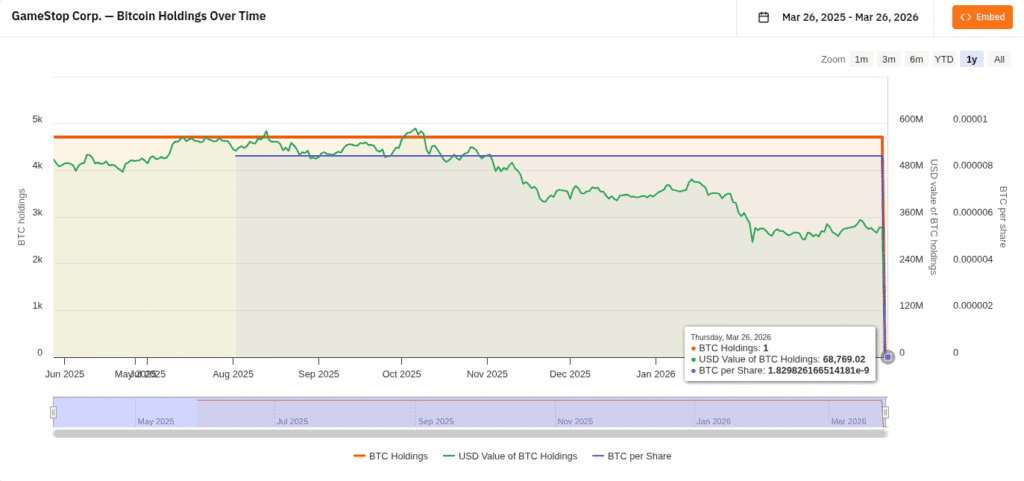
Source: Bitcoin Treasuries
Institutional adoption of Bitcoin continues to expand
While GameStop develops this short-term performance tactic with its Bitcoin treasury, the overall landscape of corporate adoption continues on its own course.
In contrast to this active management through derivatives, other corporations maintain a vision focused on long-term value preservation. In fact, while GameStop's strategy is developing, two other companies, Bitplanet and DV8 Public Company Limited, recently announced their formal plans to own 10.000 BTC eachThe objective of these entities is to consolidate a long-term reserve strategy, without liens or counterparty commitments, prioritizing direct ownership over the generation of immediate income.
Strategy also reactivated its $42.000 billion strategic acquisition program to buy Bitcoin through instruments such as STRC.
These moves reaffirm the growing interest of corporations in having direct exposure to the most significant asset in the crypto ecosystem, even if their motives and objectives differ. Furthermore, these divergent corporate decisions are occurring amidst a cryptocurrency market experiencing a tense calm, characterized by volatility stemming from the current geopolitical conflicts between the United States and Iran and global macroeconomic pressures.
Create your Bitcoin reserve on Bit2Me: click here