
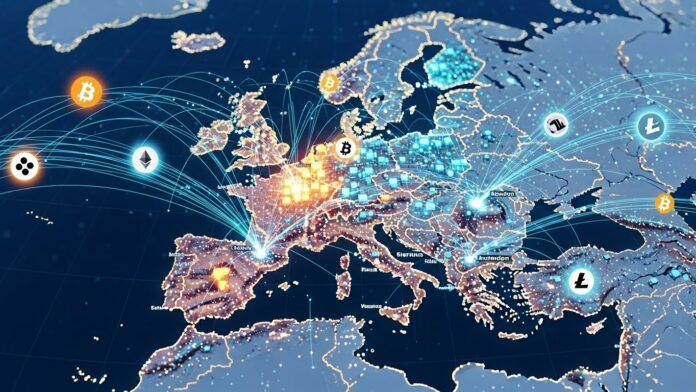
Europe has established itself as a key market in the crypto ecosystem, overcoming economic challenges and reaching a record high in transaction volume, according to the Chainalysis Report.
For years, the global narrative surrounding cryptocurrencies focused on the frenetic pace of adoption in Asia or the power of institutional volume in the United States. However, this year tells a different story. Between July 2023 and June 2025, Europe not only weathered economic turmoil but also staged a recovery that analysts are already calling historic.
Europe has proven to be much more than a mere participant in the digital ecosystem; it has become its anchor of stability. According to data revealed in the "Cryptocurrency Geographic Report 2025" According to Chainalysis, the region experienced a distinctive and revealing growth pattern.
After experiencing a significant decline in activity in mid-to-late 2024, the European crypto market did not stagnate. On the contrary, it staged a vigorous rebound, culminating in a peak transaction volume of $234.000 billion in the first half of the year.
Chainalysis experts highlighted in their analysis that this performance underscores a new reality: Europe has positioned itself as a mature market, defined by an unusually strong institutional presence and retail adoption that penetrates deeply into the economies of its various member states.
Create your Bit2Me account and trade crypto.Europe 2025: The new geography of crypto power
Leadership in the European crypto market has undergone a significant shift this year. Russia has become the largest recipient of investment, reaching $376.300 billion in the first half of the year, far surpassing the UK, which recorded $273.200 billion during the same period. Meanwhile, countries like Germany, Ukraine, and France are rapidly approaching these figures, demonstrating a more diverse and balanced expansion in the region.
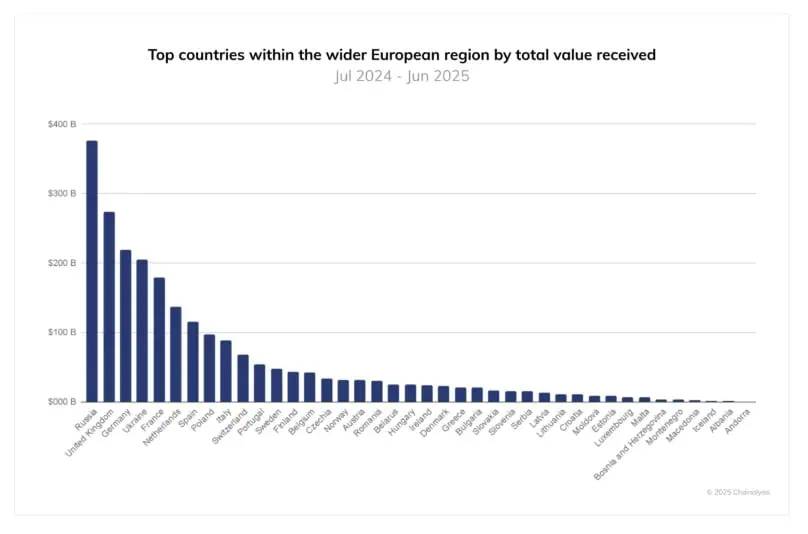
According to the firm's analysts, this evolution It reveals that mid-sized markets are gaining ground and approaching the scale of traditional powerhouses, thus strengthening a solid adoption network that drives a sustained growth cycle for the crypto ecosystem.
The positive correlation between market size and growth rates contradicts the notion that large markets tend to stagnate. Germany, with 54% growth, and Ukraine and Poland, with over 50%, demonstrate that expansion continues even in established ecosystems. Experts attribute this dynamism to a network effect: as liquidity and institutional participation increase, the market becomes more attractive, incentivizing new entrants and further solidifying its position.
Create your account and participate in the crypto expansionThe real impact of MiCA and the rise of the digital Euro
One of the determining factors for European maturity this year was the regulatory transition. After approximately ten months of implementation of the MiCA (Markets in Crypto-Assets) regulationEurope went from having a fragmented approach focused only on money laundering to operating under the world's first unified crypto framework.
While implementation has not been straightforward—with many jurisdictions operating in transition periods until 2026—the effect on institutional trust has been undeniable. The firm stated in its report that traditional financial institutions, previously hesitant, began actively exploring the sector, offering custody and trading services. From large banks to payment providers, regulatory clarity acted as the necessary catalyst for the entry of "smart money."
This new regulatory environment caused a seismic shift in the stablecoin market. By restricting service providers (CASPs) from using compliant coins, the market underwent a massive recalibration. A prime example of this impact was the exclusion of USDT from regulated channels, which opened the door for more compliant alternatives to gain prominence.
Furthermore, one of the most notable cases during this process was the extraordinary growth of EURC, the euro stablecoin issued by Circle. Between July 2024 and June 2025, its total market capitalization increased by an impressive 2.727%. Although it started from much lower levels, its growth far surpassed the 86% increase experienced by USDC, the leading dollar stablecoin, during the same period. Experts believe that the consolidation of euro stablecoins opens a new chapter for the integration of digital payments in the region.
Enter Bit2Me and trade stablecoins in eurosRussia versus the UK's growth in cryptocurrencies
Although the UK is no longer the leader it once was against Russia, its crypto market remains strong and growing, showing a 32% increase in the last year. Within this landscape, activity in Bitcoin and Ethereum has slowed, while altcoins and stablecoins are gaining more traction. This shift reflects a trend among retail users, who are increasingly preferring decentralized exchanges (DEXs) over centralized exchanges, a trend that has been accelerating since 2023.
In the institutional environment, the United Kingdom maintains an important role. High-volume transactions continue to concentrate on centralized platforms, and government efforts such as the Digital Wholesale Financial Markets Strategy seek to consolidate the country as a hub for the clearing and settlement of digital assets, an important step for its global positioning.
On the other hand, Russia is emerging as the most dynamic market in the region, registering an impressive volume of $379.300 billion. This growth is driven by a robust 86% increase in high-value institutional transfers and the rapid development of the DeFi sector. Activity on decentralized platforms increased eightfold at the beginning of 2025 and has since stabilized at a level three times higher than in 2023.
According to Chainalysis, a key factor in this boom was the introduction of the ruble stablecoin, A7A5, which facilitated international payments and strengthened the integration of cryptocurrencies into the country's financial services, positioning Russia as a central player in the evolution of the crypto ecosystem.
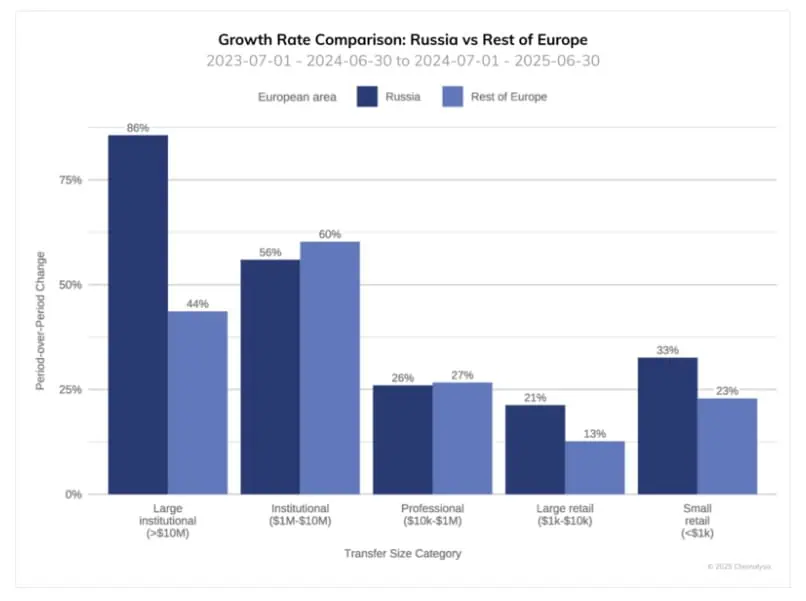
Europe on the global cryptocurrency map
The European landscape in 2025 reflects an ecosystem undergoing strategic transformation. The combination of harmonized regulation, institutional adoption, and the expansion of DeFi has created a more robust and attractive environment for investors and users. Market diversification, the rise of euro-denominated stablecoins, and Russia's consolidation as a regional leader demonstrate that Europe not only maintains its relevance but is also moving toward a central role in shaping the future of crypto.
The implications of all this are clear: it positions the region as a laboratory for regulatory and financial integration, capable of attracting institutional capital and fostering innovation in digital assets. At the same time, although Europe still faces challenges, it has ultimately demonstrated that maturity and resilience depend not only on scale, but also on the ability to coordinate regulation, innovation, and the active participation of all stakeholders in the ecosystem.
 Certificate
Main Cryptocurrencies Course
Basic levelBit2Me Academy brings you a new course in which you will learn everything you need about the most important cryptocurrencies that exist today.