
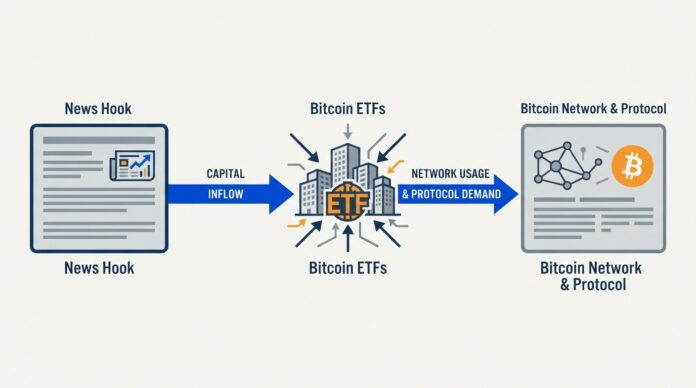
Bitcoin spot exchange-traded funds (ETFs) in the United States have registered net inflows of $1.920 billion during the last week. This movement represents the largest volume of capital raised by these financial instruments since October 2025, coinciding with a strong surge in the price of BTC.
The resurgence of flows into Bitcoin and the crypto market
Over the past week, the financial market has witnessed a notable shift in the trend of products linked to digital assets. Financial instruments linked to Bitcoin (BTC) in the US market attracted approximately $1.900 billion. According to recorded data, the exact figure is $1.920 billion, marking the strongest seven-day period for these products since October 2025.
This volume of capital coincides with a significant upward movement in the price of the main cryptocurrency. After starting the week trading near $63.000, Bitcoin experienced a surge of over 20%, surpassing the $78.000 mark and approaching $79.000 on Friday. If you are evaluating buy BitcoinIt is essential to understand how these massive institutional flows impact overall liquidity and market price formation.
The impact of Ethereum and institutional diversification
Institutional appetite hasn't been limited to Bitcoin alone. Ether (ETH)-based spot exchange-traded funds have also seen a significant surge in adoption. During the same period, these products attracted approximately $700 million in new capital inflows.
This simultaneous movement indicates that traditional market participants are looking to diversify their exposure within the crypto ecosystem. Similar to Bitcoin, Ether funds recorded their best week of inflows since October 2025, solidifying a recovery trend in interest in larger-cap crypto assets.
BlackRock's prominent role in raising capital
Analyzing the distribution of these flows, much of this weekly momentum is attributed to the iShares Bitcoin Trust (IBIT) managed by BlackRock. This fund, in particular, was responsible for attracting approximately $1.330 billion in net inflows over five consecutive trading days, demonstrating its dominant position in the US market.
IBIT's daily figures showed a very marked upward trend. Inflows rose from $160,2 million on Monday to a peak of $503 million on Thursday, before moderating to $239,3 million on Friday. The performance of institutional funds is often an indicator of medium-term confidence, although it should always be analyzed within a strategy with known and managed risk. You can learn more about how these instruments work through the educational resources of [website/resource name]. Bit2Me Academy.
Annual outlook: a 2026 of contrasts and volatility
Despite the recent surge in capital inflows, the year-to-date performance of US spot Bitcoin ETFs paints a complex picture. So far in 2026, these funds have experienced net outflows of $2.910 billion. The preceding months reflected marked institutional caution, with outflows peaking in June at $4.510 billion, following $2.430 billion withdrawn in May.
However, August marked a clear turning point. To date, it has accumulated $2.380 billion in net inflows, making it the strongest month of the year in terms of acquisitions. This contrast underscores the inherent volatility of the markets and the importance of maintaining a long-term perspective when building your crypto portfolio.
The precedent of October 2025 and risk management
To put the magnitude of these movements into context, it's necessary to look at the last major inflow cycle that occurred in October 2025. At that time, funds attracted $3.420 billion. However, those inflows were followed by a severe market correction on October 10, which triggered the largest liquidation event in the industry's history, wiping out approximately $19.000 billion in leveraged positions in just 24 hours.
Since October 6, 2025, when Bitcoin reached a price of nearly $124.700, the price has fallen by approximately 38%. This historical data serves as a reminder that large inflows of capital do not eliminate market fluctuations, reinforcing the need for prudent trading and avoiding excessive leverage.
Transparency and the MiCA regulatory framework in Europe
While the US market is experiencing these movements through ETFs, in Europe the focus is on legal certainty and user protection. The implementation of the MiCA Regulation provides an audited and transparent environment for those wishing to participate in the digital economy. Trading through authorized and registered platforms, such as Bit2Me, a leader in Spain, ensures that you interact with the crypto ecosystem under the highest standards of regulatory compliance.
Unlike unregulated markets, the European framework requires strict safeguards for asset custody and transaction transparency. Staying informed about global trends and local regulatory frameworks is essential for all users. To closely monitor these developments, you can consult regularly. news.bit2me.com.
FAQ
What does it mean for an ETF to register net inflows?
Net inflows indicate that more capital is flowing into the fund to acquire the underlying asset (in this case, Bitcoin or Ether) than is leaving through sales or redemptions. This typically reflects increased institutional interest and can bring greater liquidity and depth to the cryptocurrency market.
Why is the current situation being compared to October 2025?
October 2025 was the last period in which institutional inflows of this magnitude were recorded, reaching $3.420 billion. Analyzing these historical cycles helps users better understand capital behavior patterns and manage risk effectively in highly volatile environments.
The recent record influx into Bitcoin and Ether ETFs demonstrates the growing institutional presence in digital asset markets. However, understanding the historical context and operating in regulated and transparent environments remains essential for proper risk management.
Investing in cryptoassets is not fully regulated, may not be suitable for retail investors due to high volatility and there is a risk of losing all invested amounts.
Generative artificial intelligence tools were used to create this article.