
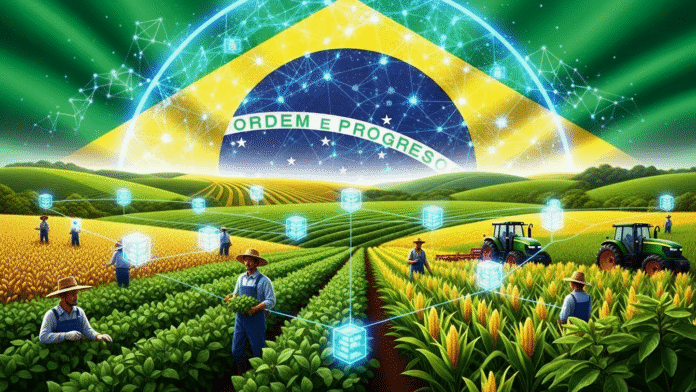
The government of São Paulo is promoting a pilot program for blockchain-backed microloans for rural farmers, with a mobile app that facilitates financial inclusion and transparency.
Brazil is taking concrete steps to help small rural producers access financing through a pilot project that combines microloans with blockchain technology. This effort, developed in collaboration with a local fintech company, arises in response to the difficulties these farmers face in obtaining loans from traditional banks.
Thanks to a mobile app, farmers across the country can apply for loans of up to 15.000 Brazilian reais, equivalent to about US$2.800, and receive them quickly and securely. The key lies in the digital technology behind the system, specifically blockchain, which offers transparent loan management and ensures that the funds are used appropriately. Furthermore, the app is designed to be user-friendly, even for those without technological experience, thus facilitating financial inclusion in rural areas.
Buy crypto on Bit2Me and access securelyBlockchain: the key to maintaining trust and control in agricultural credit management
The new pilot program in São Paulo takes as a reference point previous municipal initiatives, such as that of the municipality of Santo Antônio da Alegria, where it was used a token-based system for distributing social aidIn that experience, beneficiaries could access restricted funds through an app or physical terminals, with the goal of ensuring that the money was used solely to cover basic needs. In São Paulo, this idea is adapted so that the loans provided support the farmerswho can use them in authorized stores, acquiring agricultural supplies and services.
Luis Dal Porto, commercial director of Tanssi, the fintech company responsible for this technology, confirmed in a interview CoinDesk reported that the service launch is planned for next month and that the mobile app is already available for rural users.
To maintain solid financial stability and ensure fixed project costs, the decision was made to use a private network, as this option allows loans to have a fixed interest rate of 5%, avoiding the volatility that could arise from changes in transaction fees. According to the report, this strategy aims to guarantee the continuity of the model, regardless of market fluctuations or trends in operating costs.
On the other hand, the platform is known to have been designed with simplicity and accessibility for farmers in mind. The mobile application and physical payment devices allow for intuitive use, making it easy for users to manage their loans without complications. Furthermore, the system operates in a closed environment that gives the authorities complete control over resource management, helping to prevent misuse or misappropriation.
In short, the selected technology not only protects financial stability but also avoids congestion and variable fees, fostering confidence among all stakeholders. This approach aims to optimize the management of public funds, ensuring efficient and transparent operations.
Trade cryptocurrencies on Bit2Me: join todayA driver of financial inclusion in rural farming communities
The project in question is presented as an opportunity to promote financial inclusion in rural Brazilian communities. In the country, many small producers face barriers to accessing traditional credit, whether due to a lack of banking history or the informal nature of their economic activities. Therefore, this proposal is developed as a digital system that combines rapid disbursement of funds with control mechanisms to guarantee their productive use.
The mobile application developed by Tanssi acts as a bridge between technology and farmers, eliminating the need for users to master complex aspects of blockchain, allowing them to focus on their daily work while managing resources easily.
As mentioned, previous experiences, such as the one implemented in Santo Antônio da Alegría, have demonstrated that these digital systems can ensure that public resources are used appropriately and efficiently. In São Paulo, the goal is for these loans to boost both agricultural productivity and the formalization of small producers, fostering a more integrated and sustainable development of the rural sector.
 Certificate
Blockchain Course
Basic levelTake this course where we explain blockchain in a clear, simple and concise way so that you have a very clear idea of what this new technology consists of.
The digital transformation that empowers small farmers
Blockchain technology is emerging as a crucial tool to transform access to resources and liquidity in rural communities, especially among small farmers who traditionally face difficulties in obtaining financing and formal financial services.
By offering decentralized, transparent and secure systemsBlockchain enables the creation of platforms where farmers can access microloans, agricultural insurance, and efficient payment methods without costly intermediaries or bureaucratic barriers.
A prime example is the project "AgroChain" In Latin America, it has implemented smart contracts to facilitate direct loans to small producers, reducing time and costs, and allowing more farmers to access capital to invest in their crops or infrastructure.
This innovation not only boosts agricultural productivity, but it also generates greater economic autonomypromoting their financial inclusion and resilience to crises. Digitalization using blockchain offers transaction traceability and legal certainty, key elements for attracting investors and supporting sustainable development in rural areas.
Thus, the underlying technology of cryptocurrencies is opening a new horizon where innovation becomes a bridge to overcome financial exclusion, promoting a more equitable agriculture with better access to resources which directly impact the quality of life of small farmers. This technological shift is a fundamental step toward closing the financial and social gap that has thus far limited the potential of these communities.
Visit Bit2Me: buy and manage crypto