
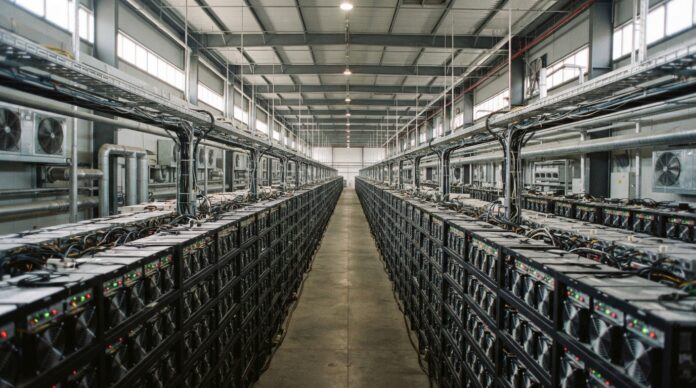
Bitdeer closed the second quarter of the year with a remarkable figure in its operations: the mining of 2.694 BTC, representing almost a fivefold increase compared to the same period last year. This growth reflects a significant expansion in its technical and operational capacity within the crypto ecosystem.
Despite this remarkable increase in production, the company has maintained a strict liquidity strategy, closing the quarter with only 150 BTC on its corporate balance sheet following strategic sales made earlier in the year to fund its diversification.
The leap in Bitcoin mining production
Bitcoin network processing capacity remains a key indicator of the sector's health and competitiveness. In this context, Bitdeer has reported the extraction of 2.694 BTC during the second quarter of the year. This figure represents an almost fivefold increase compared to the 565 BTC that the company managed to mine in the same period of the previous year.
This exponential growth is not a matter of chance, but rather the result of an aggressive expansion of its infrastructure. The company's average self-mining hashrate experienced a 389% jump, reaching 69,5 exahashes per second (EH/s). To understand the magnitude of this figure, it's important to remember that the hashrate measures the total computing power used to process transactions and secure the network. An increase of this magnitude demonstrates a strong commitment to consolidating its position in the industry, optimizing its equipment, and maximizing the energy efficiency of its facilities.
If you're interested in learning more about how the underlying technology and validation processes work, you can explore the educational resources at Bit2Me Academy, where the technical concepts of mining and the proof-of-work (PoW) consensus are broken down.
Corporate treasury and balance sheet strategy
Despite a significant increase in block production, the company's financial strategy has shifted towards immediate liquidity. Bitdeer ended the quarter holding only 150 BTC in its corporate balance sheet. This represents a 90% decrease compared to the 1.502 BTC it held in reserve twelve months prior.
This drastic reduction is primarily due to the liquidation of its 943 BTC treasury last February. Company management justified this move as a decision strictly tied to operational liquidity needs, ruling out any abandonment of its core mining business. In the crypto ecosystem, it is common for large mining corporations to adjust their reserves to cover high operating costs, such as electricity and hardware maintenance, especially during periods of infrastructure expansion.
For users who decide buy Bitcoin And to build their portfolio for the long term, the treasury management of large mining companies is a fundamental piece of information, since their institutional sales can influence the liquidity and circulating supply of the market.
Financial results and market response
In terms of revenue, the second quarter was positive for the company's gross income. Bitdeer reported total revenue of approximately €208 million ($228,8 million), representing a 47% increase compared to the €141 million ($155,6 million) recorded in the same quarter of the previous year.
Of this total, self-mining was the main driver, contributing approximately €153 million ($168,4 million). These results slightly exceeded the consensus estimates of Wall Street analysts, who projected revenues of around €204 million.
However, the aggressive expansion and associated costs have also taken their toll on the net income statement. The company's net loss widened to €84 million ($92,3 million), compared to €57 million ($62,9 million) the previous year. Despite these accounting losses, the company's shares showed a slight recovery of 1,5% in pre-market trading, after having fallen 15% over the past month.
Diversification towards Artificial Intelligence and high-performance computing
One of Bitdeer's most strategic moves in recent months has been its foray into the artificial intelligence (AI) and high-performance computing (HPC) sector. Bitcoin mining companies have a unique competitive advantage: they possess access to enormous amounts of energy and operate large-scale data centers.
Leveraging this infrastructure, the company signed a 16-year lease in Norway in August, valued at over €4.200 billion ($4.700 billion). This agreement will provide it with 121 megawatts of dedicated computing capacity exclusively for AI. As part of the European Economic Area, Norway offers a stable legal and regulatory environment that aligns with the transparency standards promoted by regulations such as the MiCA Regulation in the European Union.
This convergence between crypto mining and artificial intelligence is a growing trend in the sector. By diversifying their revenue streams, companies seek to mitigate the volatility inherent in mining and secure more stable cash flows through the rental of computing power for training AI models. You can closely follow how these technological partnerships evolve through news.bit2me.com.
FAQ
How much Bitcoin did Bitdeer mine in the second quarter?
The company mined a total of 2.694 BTC during the second quarter of the year. This figure represents an almost fivefold increase compared to the 565 BTC it produced in the same period of the previous year, driven by a significant 389% improvement in its processing capacity (hashrate).
Why has the company reduced its Bitcoin reserves?
Bitdeer ended the quarter with only 150 BTC on its balance sheet, a 90% year-over-year drop. This reduction is due to strategic operational liquidity decisions, having liquidated a large portion of its cash reserves earlier in the year to fund its daily operations and ambitious infrastructure expansion.
What is the relationship between crypto mining and artificial intelligence?
Mining companies own large data centers and have access to massive amounts of energy. Bitdeer is leveraging this infrastructure to diversify its business into high-performance computing, notably with a recent multi-million dollar deal in Norway to dedicate 121 megawatts exclusively to artificial intelligence operations.
Bitdeer's performance during this second quarter reflects the complex reality of the large-scale mining sector. On the one hand, technical capacity and block production continue to break records thanks to investment in more efficient hardware and increased hashrate. On the other hand, the need to maintain operational liquidity forces these corporations to make pragmatic decisions regarding their cash flow, prioritizing structural growth over simply accumulating assets.
Furthermore, the clear trend toward diversification in areas such as artificial intelligence demonstrates the immense cross-cutting value of the infrastructure built for the crypto ecosystem. As technology advances and European regulatory frameworks, such as MiCA, bring greater clarity and security to the market, we are likely to continue seeing major companies in the sector adapt their business models to maximize efficiency and ensure long-term sustainability.
Investing in cryptoassets is not fully regulated, may not be suitable for retail investors due to high volatility and there is a risk of losing all invested amounts.
Generative artificial intelligence tools were used to create this article.