
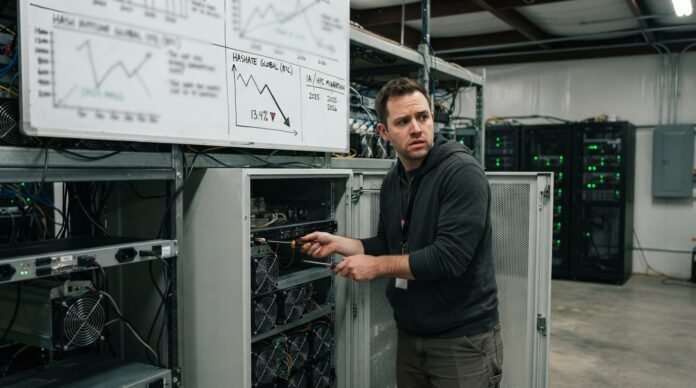
Publicly held Bitcoin mining companies have reduced their operating capacity, registering a 13,4% drop in their hashrate between the end of 2025 and mid-2026. This decline reflects a strategic shift in the sector, where operators are redirecting their energy and infrastructure towards artificial intelligence (AI).
The convergence between blockchain technology and high-performance computing is redefining the business model of large data centers globally, marking a new stage for the crypto industry.
The decline of hashrate in the public sector
Over the past few months, the processing capacity of major companies in the sector has contracted significantly. Data shows that The hashrate of a group of public miners fell from 368,3 exahashes per second (EH/s) to 319 EH/s, which represents a decrease of 13,4% in just six months.
This reduction contrasts with the overall performance of the Bitcoin (BTC) network, whose average hashrate decreased by 10,6% during the same period. Excluding a few companies that continued to expand their operations, the decline of the main group reaches a remarkable 21,2%, demonstrating a clear trend toward resource diversification.
Artificial intelligence as a new priority
The main reason behind this shutdown of mining equipment is the growing demand for infrastructure for artificial intelligence and high-performance computing (HPC). Facilities that were previously dedicated exclusively to securing the crypto network are now being adapted to host AI servers, a sector that requires massive amounts of energy and advanced cooling systems.
To better understand how the network works, block validation, and energy consumption, you can explore the educational resources of Bit2Me Academy, where the technical evolution of this ecosystem and its impact on global technology are detailed.
Radical change in the revenue model
The transition to AI is already clearly reflected in operators' financial statements. Some of the largest infrastructures in North America are currently generating most of their revenue through activities unrelated to cryptocurrency mining.
For example, during the second quarter, some companies reported revenues of $136,7 million from AI colocation services, compared to only $27,5 million from Bitcoin mining. Another notable example shows revenue of $31,9 million from HPC leasing, far exceeding the $12,8 million earned from BTC mining. If you're thinking about buy Bitcoin To build your portfolio, it is essential to understand how these corporate moves affect the underlying network infrastructure in the long term.
The end of the post-China expansion cycle
This pullback marks the end of the massive expansion cycle that began in 2021, following mining restrictions in Asia. At that time, North American companies raised capital and acquired new power plants to dominate the market. However, one halving cycle later, the sector's economics have changed dramatically.
The lower direct reward from mining, combined with the unstoppable rise of AI since 2022, has made resource reallocation the most logical option to maximize the efficiency of data centers and maintain competitiveness in the technology market.
FAQ
What is the Bitcoin hashrate?
Hashrate is a measure of the total computing power used to process transactions and mine new blocks on the Bitcoin network. A high hashrate indicates a more robust network, while fluctuations reflect changes in the active participation of miners.
Why are miners switching to artificial intelligence?
Mining data centers boast large-scale electrical and cooling infrastructures, ideal for artificial intelligence servers. By leasing this space for high-performance computing (HPC), companies gain more stable and predictable revenue streams.
Does this affect the security of the Bitcoin network?
Although the hashrate of some public companies has decreased, the Bitcoin network is designed to automatically adjust its difficulty. This ensures that block validation and protocol security remain stable, regardless of variations in overall computing power.
The evolution of Bitcoin mining demonstrates the technology industry's ability to adapt to new market paradigms. The convergence of crypto infrastructure and artificial intelligence not only optimizes energy use globally but also opens new avenues for the development of high-capacity data centers.
As the ecosystem matures under clear regulatory frameworks such as the MiCA Regulation in Europe, the diversification of operators underlines a transition towards more complex and resilient business models, consolidating the fundamental role of these facilities in the digital future.
Investing in cryptoassets is not fully regulated, may not be suitable for retail investors due to high volatility and there is a risk of losing all invested amounts.
Generative artificial intelligence tools were used to create this article.