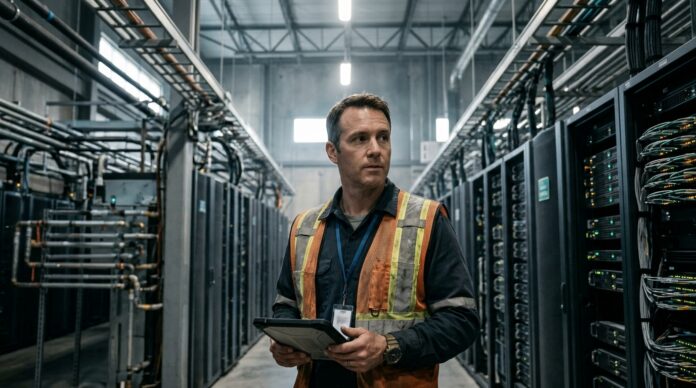
The convergence of Bitcoin mining and artificial intelligence is accelerating the creation of financial instruments for trading computing power. Following a strategic funding round, companies in the sector are adapting their hashprice derivatives models to target the high-performance data center market.
The mining ecosystem of Bitcoin It experiences a relevant structural evolution. Luxor Technology has raised $16 million in a funding round led by CMT Digital, with participation from hardware manufacturers such as Canaan and MicroBT, to expand its artificial intelligence hardware brokerage and computing power trading platform.
The conversion of mining infrastructure towards AI
Over the past few quarters, companies specializing in block validation on Proof-of-Work networks have begun diversifying their operating model toward high-performance computing (HPC). The search for stable revenue streams and the growing demand for processing power for deep learning models have transformed mining energy infrastructure into a coveted asset for the technology industry.
Industry data shows that publicly traded Bitcoin miners signed over $70.000 billion in contracts related to artificial intelligence and intensive computing by the end of March. This trend confirms that operators with large-scale power supply contracts and access to established substations have an immediate competitive advantage over other infrastructure developers facing prolonged grid outages.
To learn more about the technical principles behind the validation network and hardware, you can consult the training resources available at Bit2Me Academy, where the evolution of computing power within digital assets is analyzed.
The challenge of technical conditioning and data centers
Despite the availability of power, the transition is not simply a matter of replacing ASICs with graphics processing units (GPUs). Luxor's technical assessments of approximately one gigawatt of power capacity operated by miners revealed that, while most sites have sufficient power supply and adequate fiber optic networks, the physical facilities require extensive upgrades.
A data center designed for traditional Bitcoin mining tolerates more flexible thermal variations and redundancy levels than the critical demands of artificial intelligence environments. Complex workloads require high-precision liquid cooling systems, uninterrupted power redundancy, and extremely low latency. For this reason, many existing data centers must be almost completely rebuilt to meet the industrial reliability requirements demanded by enterprise HPC clients.
New financial instruments: derivatives for computing power
The core of this transformation lies in the creation of financial tools that provide certainty to buyers and sellers of computing power. Luxor seeks to replicate the success of its Bitcoin hashprice derivatives, applying similar models to fix future prices for the rental and consumption of power in data centers.
Until now, the provisioning of artificial intelligence capacity has relied on opaque bilateral agreements and long-term, fixed-term contracts. With the introduction of standardized contracts and price indices, infrastructure providers can hedge against the risk of technical obsolescence or devaluation of their processors. Meanwhile, companies developing algorithmic models gain budget predictability by securing computing capacity in advance without being exposed to unforeseen price spikes in the spot market.
The European regulatory framework and energy efficiency
Within the European Union, the development of data processing infrastructures and decentralized technologies operates under strict governance and sustainability requirements. Regulations such as the MiCA Regulation establish clear guidelines on transparency, while energy efficiency directives require rigorous audits of electricity consumption in high-capacity data centers operating within the EU.
Operators seeking to expand their activities in Europe must comply with transparent technical audits and ensure that the integration of combined mining and artificial intelligence workloads is carried out under audited operating standards and in accordance with EU regulations. For further regulatory analysis and industry trends, you can follow updates at news.bit2me.com.
FAQ
Why are Bitcoin miners diversifying their facilities towards AI?
The mining infrastructure has access to pre-contracted megawatts of power and fiber optic connections. By offering computing services for artificial intelligence, miners reduce their exclusive dependence on fluctuations in Bitcoin network block rewards and diversify their operating revenue streams.
Is it possible to use the same mining equipment to train artificial intelligence?
No, the ASICs used in Bitcoin are processors designed exclusively to solve the SHA-256 algorithm. Computing for artificial intelligence requires dedicated GPU processors or accelerators. However, electrical substations, transformers, and mining farm sites can be repurposed to build new, compatible data centers.
What function do futures contracts on computing power serve?
These instruments allow for pre-agreing the price of computing resources. They help hardware operators protect themselves against the depreciation of their computing components and allow development companies to fix the energy and processing costs of their technology projects in advance.
The professionalization of the computing power market is redefining the traditional boundaries between decentralized asset mining and the broader technology industry. As pricing indices and hedging mechanisms become more refined, access to energy-efficient and massive processing power is solidifying computing as a global strategic category subject to best practices in governance and technical transparency.
Investing in cryptoassets is not fully regulated, may not be suitable for retail investors due to high volatility and there is a risk of losing all invested amounts.
Generative artificial intelligence tools were used to create this article.