Despite global volatility, Bitcoin ETF investors are showing historic resilience, as crypto consolidates its position as the highest-performing macro safe haven in times of crisis.
The narrative of Bitcoin as a volatile and speculative asset is being rewritten by blockchain data and Wall Street behavior. In a context marked by geopolitical uncertainty and fluctuations in traditional markets, institutional investors are not only maintaining their positions, but also They are taking advantage of every correction to accumulate.
According to the latest data from Arkham Intelligence, the buying activity of major asset management funds suggests that institutional capital is strategically using the weakness of Bitcoin prices to strengthen its portfolios, ignoring short-term market noise.
During the last week, firms of the stature of BlackRock y Fidelity They have demonstrated a strong commitment to the leading cryptocurrency. According to Arkham reports, these entities acquired approximately $400 million worth of Bitcoin, compared to sales of $250 million. According to analysts, this movement resulted in net institutional buying pressure, confirming that the largest players in the market are seeing Bitcoin's intrinsic value above and beyond daily fluctuations.
Bitcoin withstands volatility: Buy BTC hereInvestor maturity: the change that came with spot ETFs
The arrival of Bitcoin spot ETFs has profoundly changed the profile of the average investor in the crypto sector. It's no longer just about retail investors seeking quick profits, but also about wealth managers who understand the long-term investment thesis.
James SeyffartBloomberg's ETF analyst, has noted that these investors are "surprisingly resilient".
Unlike previous cycles, where price drops triggered mass panics, current ETF holders seem to have a firm grasp of the nature of the leading cryptocurrency. Seyffart recently noted that many investors are strategically allocating single-digit percentages to their portfolios.
According to the expert, this controlled diversification allows them to remain calm during downturns and even buy more, following a methodology of average cost (DCA) which strengthens the market base. data SosoValue's data supports this thesis, showing positive, albeit modest, inflows even on days of high volatility, indicating a steady trickle of capital that is not deterred by the macroeconomic outlook.
Bitcoin as a safe-haven asset: Outperforming in times of conflict
Over the past few weeks, Bitcoin has returned to the center of the global financial conversation. Despite the correction it has experienced since its all-time highs in October, its role as “digital gold” It once again took center stage amid the tense climate dominating the Middle East. While traditional assets showed signs of weakness, the cryptocurrency surprised everyone with a strong and sustained recovery.
Since the recent conflicts in the region began in late February, market behavior has painted a clear picture. The S&P 500 retreated, gold and silver struggled between selling and stagnation, but Bitcoin took a different direction. In just one month, its price rose by nearly 10%.
At the beginning of this new conflict, the price of BTC was around $64.000, while to date it remains trading around $70.700.
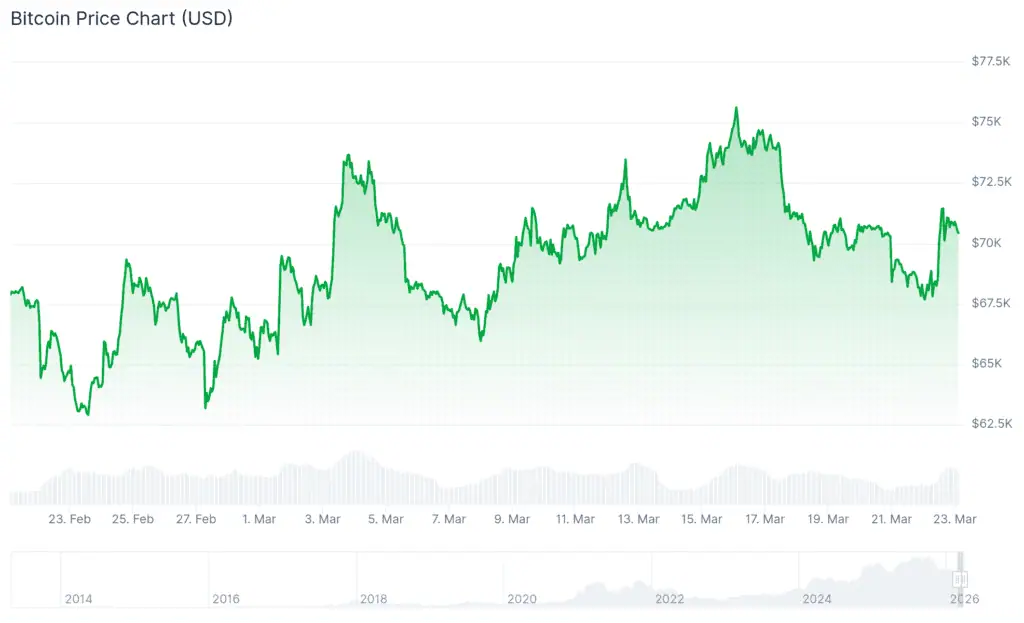
Source: CoinGecko
A recent report from CoinShares, titled Bitcoin's Iran Test: Safe Haven or Coincidence?It highlights that the conflict between the United States and Israel against Iran altered the global perception of risk. It explains that, although the economic scenario does not offer an ideal context, the increased geopolitical tension seems to have reinforced Bitcoin's usefulness as a safe-haven asset.
The study indicates that factors such as more balanced leverage, moderate movements in large portfolios, and the arrival of $1.500 billion in flows into Bitcoin ETFs at the beginning of the month strengthened that position, just as uncertainty reached its peak.
According to the firm's analysts, Bitcoin showed a reaction in March that reinforces its maturity as a financial asset in times of global volatility, attracting the attention of those seeking stability amid geopolitical noise.