
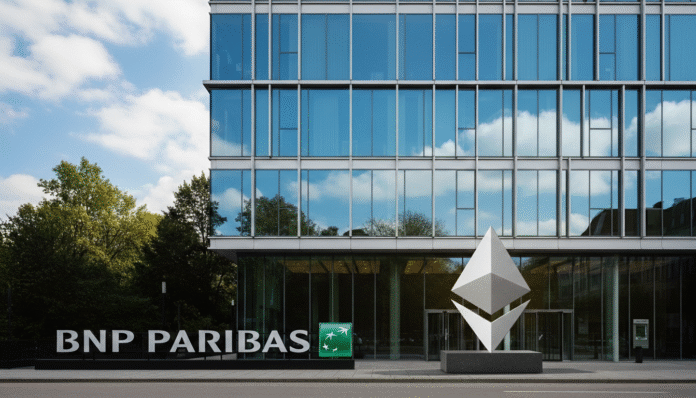
BNP Paribas is driving tokenization on Ethereum through a money market fund pilot in France, marking a key step forward in the institutional adoption of blockchain.
European banks are accelerating the migration of financial assets to the Ethereum network. In this context of constant innovation, the move by one of Europe's leading banks stands out. BNP Paribas, which has decided to formally adopt the blockchain technology originally developed by Vitalik Buterin for the management of high-relevance financial assets.
This French-based banking entity has launched a cutting-edge pilot project specifically focused on a class of tokenized shares belonging to a money market fund domiciled in France.
According to market experts, the initiative not only represents a technical experiment, but also validates the capacity of public networks to host regulated financial instruments under strict compliance standards and legal security.
Trade Ethereum on Bit2MeBNP Paribas' leap into public blockchain
BNP Paribas strengthens its digital strategy with a new issuance of fund shares on the Ethereum mainnetThe transaction, led by its asset management division, marks a significant step toward integrating the traditional financial model with open blockchain infrastructure. To execute this process, the entity used AssetFoundry, an internal platform designed to create and manage digital assets within a controlled and secure environment.
The project relies on an authorized access model that operates on the public blockchainallowing only verified participants to hold and transfer assets. This combination of transparency and regulated control gives the initiative special value within the context of institutional tokenization, where trust and traceability are key factors.
During the operational test, different units of the bank collaborated in a coordinated manner to cover the complete lifecycle of the financial product. This was reported in a releaseThe asset management division acted as the issuer, while the securities services area assumed custody and administration of the private keys necessary to interact with the network. Edouard Legrand, the asset manager's digital and data director, said that this second issuance of tokenized funds aims to demonstrate how public blockchain infrastructure can optimize operational efficiency and strengthen security in settlement processes.
BNP Paribas had already experimented with tokenization in private settings, but the decision to now operate on the Ethereum network reveals a shift in approach. The bank is not only exploring the technology but also reaping the benefits of a more interoperable and liquid ecosystem, aligning itself with the global trend driving the convergence of traditional finance and digital assets.
Create your account and buy ETH todayFinancial tokenization: the new infrastructure of global value
Tokenization has gone from being an experimental idea in the crypto industry to becoming a key tool in the digital transformation of the financial system. This blockchain-based digitization process allows ownership rights over real or financial assets to be converted into digital records within a network, facilitating their management, exchange, and traceability with a level of accuracy and security that traditional systems have yet to achieve.
The rise of asset tokenization is a response to the technological maturity of the crypto ecosystem and greater confidence from regulators and institutional capital, who have begun to see blockchain infrastructure as more than just a speculative bet.
In practice, banks and funds are exploring how tokenization can optimize market efficiency, especially in liquidity management. Money market funds are emerging as the perfect environment for these tests, as their dynamics of frequent trading and low risk allow for evaluating the technology's performance under real-world conditions. Recent experiments, such as the one conducted by BNP Paribas, demonstrate a substantial improvement in settlement times and a significant reduction in manual processes.
Similarly, platforms like AssetFoundry highlight that integrating financial records within blockchain architectures brings transparency and facilitates regulatory compliance by incorporating rules and controls directly into the asset code. This advancement marks a turning point: blockchain is consolidating itself as an infrastructure capable of supporting the global flow of value, redefining how assets are created, transferred, and monitored in contemporary markets.
Access Ethereum seamlesslyBanking and Ethereum: the new bridge to global tokenization
The success of pilot programs driven by French banks confirms that integration between traditional finance and public networks like Ethereum can be achieved without compromising security or regulatory compliance.
According to the bank, these tests demonstrate that financial institutions can operate on decentralized infrastructures while maintaining the identity verification and regulatory controls required by the banking system. By restricting participation to verified counterparties, banks reduce the operational risk typical of open environments and, at the same time, gain access to a global network that operates seamlessly.
Overall, this interaction between the banking system and blockchain technology accelerates the tokenization of real-world assets and marks a turning point in how capital is mobilized, managing value with greater efficiency, transparency, and international reach.
 Certificate
Blockchain Course
Basic levelTake this course where we explain blockchain in a clear, simple and concise way so that you have a very clear idea of what this new technology consists of.