

Spot ETFs have become a key gateway for institutional investment in Bitcoin, the largest cryptocurrency on the market.
Since their launch in the US market earlier this year, Bitcoin spot exchange-traded funds (ETFs) have proven to be a significant catalyst for the adoption of the world’s most prominent cryptocurrency.
To date, more than 1.000 institutional investors collectively own Bitcoin through these regulated financial instruments, demonstrating how in just a few months, spot ETFs have become a key element that is redefining the way institutions interact with Bitcoin and the crypto ecosystem.
According to recent data revealed in 13F filings sent to the Securities and Exchange Commission (SEC), the BlackRock's iShares Bitcoin Trust (IBIT), the largest Bitcoin exchange-traded fund to date, has attracted the attention of 661 institutional investors, reflecting the growing and sustained interest in this cryptocurrency as an investment asset.
Eric Balchunas, an ETF analyst at Bloomberg, has highlighted the phenomenon of Bitcoin-based exchange-traded funds, noting that their success stands in stark contrast to the experience of other financial instruments, which often face challenges in attracting institutional capital in their early stages. According to Balchunas, the undisputed success of these spot ETFs not only reflects a significant increase in confidence towards Bitcoin, but also a change in the perception of cryptocurrencies within the traditional financial market.
Spot ETFs are a gateway to Bitcoin
Bitcoin spot exchange-traded funds offer institutional investors a more accessible and secure way to participate in the cryptocurrency market. Through these funds, institutions can include Bitcoin in their portfolios without the need to directly purchase and manage this digital asset. Previously, Balchunas has highlighted that spot ETFs have removed many of the barriers that had historically limited institutional participation in the Bitcoin market, improving accessibility to the crypto space.
On the other hand, since its launch in January, the adoption of these financial instruments has been more than remarkable. As Balchunas highlighted on social media, in the last two 13F filing periods, institutional investors have expressed great interest in Bitcoin.
Spot ETFs have seen a significant increase in institutional participation in these two regulatory filing periods, with a 60% of major hedge funds in the US reveal they own Bitcoin via spot ETFsAccording to the expert, this interest translates into a change in the investment strategy of many institutions, which are beginning to see Bitcoin not only as a speculative asset, but as a legitimate and safe investment asset class.
In addition, Balchunas has pointed out that, despite the recent capital outflows experienced by some spot ETFs, the majority of investors have maintained their positionsHe stressed that during the second quarter, no hedge funds sold their holdings in Bitcoin ETFs, a fact that reflects solid confidence in the long-term potential of these crypto investment products.
More than 900.000 bitcoins are held in spot ETFs
Despite uncertainty in the broader financial market, these investment funds have attracted a significant amount of capital since their launch, and interest from institutional and corporate investors continues to increase.
According to the data consulted on the Bitcoin Treasuries platform, to date, the 12 Bitcoin spot ETFs listed on US stock exchanges hold a total of 901.527 BTC, which are valued at about $51.200 million at the time of writing.
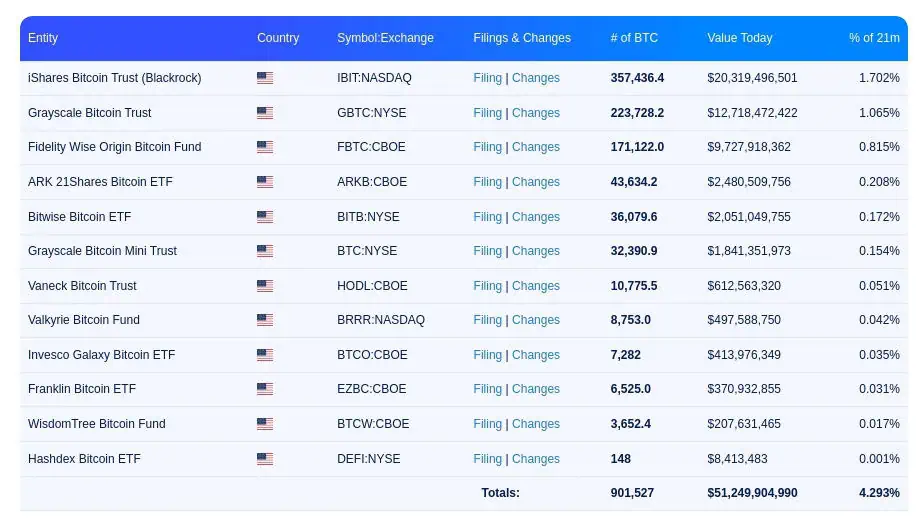
Source: Bitcoin Treasuries
While this market has not been without its challenges, facing its longest streak of daily net outflows since its launch, analysts like Balchunas maintain an optimistic outlook, indicating that the outflows represent only a small fraction of the total capital invested in these instruments. On social media, Balchunas commented that "nearly 99% of investors have resisted", stating that despite the difficulties, confidence in Bitcoin ETFs remains robust.
In summary, Balchunas stressed that spot ETFs are facilitating the entry of institutional capital into the cryptocurrency market and helping Bitcoin establish itself as a legitimate asset in the financial world, acting as a bridge to greater legitimacy and adoption of Bitcoin and cryptocurrencies.