
XRP remains near its current all-time high as the U.S. closes out Crypto Week with key legislation that is redefining the future of digital assets.
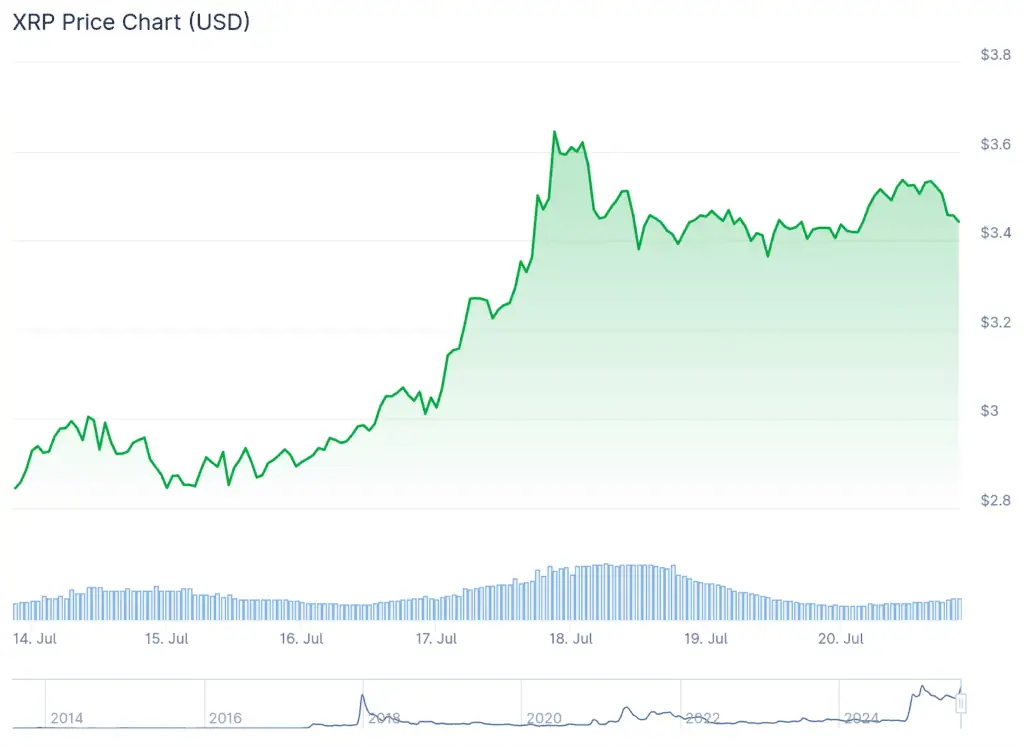
Ripple's native cryptocurrency, XRP, once again captured the attention of the crypto ecosystem this July by recording a new all-time high of $3,65 on the 17th. Although its price has fluctuated slightly since then, it remains near that level, with a current price of around $3,44 and $3,50, according to data from CoinGecko.
Industry analysts project that XRP's next target could be $4, driven by renewed institutional interest and a favorable regulatory environment in the United States.
This cryptocurrency's bullish rally, reaching a new all-time high, coincided with the celebration of "Crypto Week" in the US, a legislative event that marked a turning point for the sector. Over five days, from July 14 to 18, the House of Representatives debated and passed three key pieces of legislation seeking to establish a clear regulatory framework for cryptocurrencies, stablecoins, and digital assets.
A new record for XRP after seven years of waiting
On July 17, XRP surpassed its previous high from January 2018 and reached $3,65, consolidating a rise of over 70% over the past 30 days. This advance occurred amid a significant increase in trading volume, which surpassed $12.000 billion per day, more than double the recent average.
At the time of writing, XRP is priced at around $3,44, trading just 5% off its current ATH.
Source: CoiGecko
Ripple CEO Brad Garlinghouse called July 17 “historic for the crypto industry,” referring to both XRP’s new record and the passage of the GENIUS Act, which regulates stablecoins in the U.S. Garlinghouse celebrated the moment on social media, highlighting Ripple’s role in transforming the digital financial system.
Market enthusiasm was also reflected in open interest in XRP derivatives, which surpassed $11.000 billion, a record high suggesting strong participation from institutional investors.
BUY XRP ON BIT2METhe 'Crypto Week' that transformed regulation in the United States
During the so-called "Crypto Week," the United States Congress marked a historic milestone in the regulation of digital assets. In a joint effort and amid intense debate, legislators passed three fundamental laws that mark a turning point for the country's crypto ecosystem.
The GENIUS Act was passed on July 17 as a groundbreaking regulation for stablecoins, cryptocurrencies pegged to the value of traditional currencies like the dollar. This law requires issuers to hold 1:1 cash reserves and undergo regular audits to ensure transparency and trust, a move long awaited by the industry and previously approved by the Senate. The House of Representatives ratified the law during this crucial week, and President Donald Trump signed it a day later, hailing it as the greatest revolution in financial technology since the birth of the internet. The industry, including companies like Ripple, celebrated this measure as a decisive step toward the institutionalization of cryptocurrencies.
In parallel, the CLARITY Act was also passed, seeking to clarify the regulatory powers between two major agencies: the Securities and Exchange Commission (SEC) and the Commodity Futures Trading Commission (CFTC). The law aims to avoid conflicts and eliminate the uncertainty that has plagued several projects for years, including landmark cases such as Ripple vs. the SEC. This aims to create a more defined, efficient, and fair framework for overseeing digital assets.
Finally, the so-called Anti-CBDC Act was passed, which put a stop to the potential issuance of a digital currency by the Federal Reserve, defending financial privacy and rejecting the surveillance that could result from a state-run digital currency. This aspect is considered essential to protecting two of the most valued characteristics of the crypto world: decentralization and anonymity.
For all this, 'Crypto Week' represents a decisive moment for the United States to consolidate itself as a global leader in financial innovation, establishing clear and balanced regulations that strengthen confidence without stifling growth or innovation.

Ripple in the new US regulatory landscape
Ripple is experiencing an unprecedented moment. Regulatory changes in the United States have cleared up many of the concerns that had the sector on edge, and the company has taken advantage of this wave to transform its role in the digital financial industry.
Looking to the future, Ripple has taken significant steps to consolidate its own stablecoin, RLUSD, under much stricter regulatory oversight. Having a federal banking license not only supports confidence in RLUSD, but could also significantly increase demand for XRP as a liquidity asset in global transactions.
Institutional support doesn't end there. Ripple has partnered with financial giants like BNY Mellon, which already acts as custodian of its stablecoin reserves, a move that seeks to provide transparency and institutional solidity to its operations. RLUSD, regulated by the New York Department of Financial Services, is backed by real assets and designed to meet the most demanding requirements of large financial institutions.
Meanwhile, interest in XRP is also resurfacing in traditional financial markets. Recently, XRP-linked investment products, such as Futures ETFs Launched by ProShares, these new funds have gained visibility and legitimacy. These new funds allow investors to access XRP's performance through regulated markets, adding an extra layer of recognition to the cryptocurrency. Furthermore, expectations for the approval of an XRP spot ETF have been growing, with many experts placing it at around 95% before the end of the year, according to recent estimates from Bloomberg and specialized market analysts. This sign of confidence anticipates a strong inflow of institutional capital should approval materialize.
This entire scenario marks an important turning point in the history of XRP. Gone is the era dominated by uncertainty and legal battles with the SEC, which for years shaped the narrative surrounding the digital asset and Ripple as a company. Today, with a more stable regulatory framework and the support of key institutions, XRP is emerging as one of the most solid and promising bets within the crypto ecosystem.