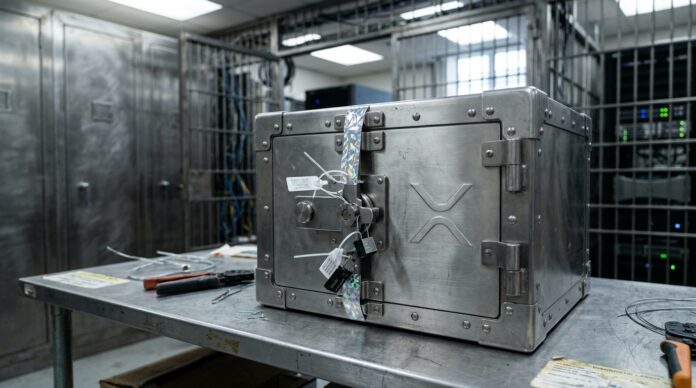
The developers of XRP Ledger have patched a critical vulnerability that had been present since 2015, which would have allowed attackers to generate and spend billions of XRP tokens without contributing the corresponding funds. The flaw compromised the network's strict issuance limit, but it was quickly neutralized without leaving any evidence of public exploitation.
The rapid technical intervention highlights the importance of regular audits and monitoring of layer one protocols, where the integrity of the monetary supply is essential to ensure the economic and operational stability of the ecosystem.
The XRP native token ecosystem has narrowly avoided a serious incident after a vulnerability was detected in the internal settlement logic of its decentralized network. The intervention was coordinated after it was confirmed that Researchers demonstrated how a payment could generate usable XRP without the issuer providing the funds. necessary to cover said transfer. The flaw, which had lain dormant for almost a decade in the ledger's codebase, directly threatened to violate the foundational fixed supply rule set at 100.000 billion units since the network's launch in 2012.
The origin of the failure in the internal exchange motor
The anomaly lay in the decentralized exchange mechanism embedded in the core of XRP Ledger, where participants place bids to exchange different assets. According to the security report submitted by researcher Cayden Liao and Veria AI on September 22, 2026, the vulnerability stemmed from an arithmetic computation error when processing massive volumes of transactions within a single atomic instruction.
In practical terms, a malicious actor could open hundreds of secondary accounts and place sell offers demanding disproportionately large amounts of XRP in exchange for minute fractions of another issued token. Subsequently, through a single orchestrated buy transaction, the system would attempt to execute all the offers simultaneously. When calculating the total amount owed, the software would experience a counting overflow, resulting in the buying account paying a negligible fraction of the total value.
As a direct result of this arithmetic discrepancy, the receiving accounts controlled by the attacker received the full XRP balance as if the transaction had been settled normally. To understand how these settlement and custody structures work within the digital asset sector, it is very helpful to consult specialized resources such as Bit2Me Academy, where the consensus architecture of the main distributed registries is analyzed.
Technical reproduction and absence of attacks on the main network
After receiving an internal alert on September 22, RippleX's engineering team replicated the exploit scenario in an isolated test environment. During technical checks, the specialists verified that the anomalously generated tokens could be transferred and subsequently spent in successive transactions, bypassing the network's post-transaction verification controls designed to ensure that the total token supply remains constant.
The system includes programmed safeguards to prevent new coins from appearing out of thin air after each validated block. However, this check relied on the total incorrectly computed during the initial processing, so the internal audit algorithm validated the transaction. Similarly, restrictions designed to limit the amount a single address could receive were circumvented, as the artificial monetary mass was distributed in a fragmented manner across hundreds of intermediary accounts.
Despite the extreme severity of the theoretical scenario, the engineering team confirmed that no records or evidence were found that the vulnerability had been exploited on public networks before it was patched. To carry out the attack vector in a real-world environment, the researchers only required a few hundred XRP to activate the necessary accounts, funds that were almost entirely recoverable after paying the relevant network fees.
Deployment of the xrpld 3.4.1 update
The technical solution materialized swiftly on September 25, 2026, with the release of version 3.4.1 of xrpld, the software that underpins the ecosystem's validator nodes. At the time of the patch release, the developers maintained discretion regarding the exact nature of the issue to allow network operators sufficient time to update their clients without compromising overall security.
Maintaining a rigorous updating discipline is critical in regulated and professional environments. Those who decide buy XRP Through platforms compliant with the European regulatory framework, they operate with infrastructures that constantly audit the status of the nodes to safeguard the custody of users' funds.
The discovery of this vulnerability coincides with a period of intensive technical review, during which advanced static analysis and machine learning tools are enabling the identification of long-standing vulnerabilities in various industry protocols. In the preceding months, several latent flaws in storage solutions and secondary payment layers also required direct intervention after being identified using similar automated methods.
The institutional impact and governance under MiCA
Maintaining a fixed monetary supply is one of the pillars underpinning institutional confidence in any digital asset. XRP bases its value proposition on an unchangeable cap of 100.000 billion units, a fundamental element for financial institutions integrating its technology into cross-border transfer corridors. Had a software vulnerability allowed for the dilution of this supply through covert issuance, the economic and reputational damage would have affected the entire ecosystem.
Within the European Union under the MiCA Regulation, issuers and cryptocurrency service platforms must guarantee high standards of operational resilience and technological risk management. Transparency in handling technical incidents and the speed of patch release are part of the EU guidelines aimed at protecting retail and institutional investors from critical code errors in shared ledgers. From informational spaces such as news.bit2me.com The evolution of these key updates for the digital financial sector is being closely monitored.
FAQ
Did the vulnerability affect users' actual balances?
No, the funds in users' wallets were never at direct risk nor were they stolen. The technical team thoroughly reviewed network logs and found no evidence that the method was used on the main network before the patch was applied.
Do token holders need to take any action?
XRP holders do not need to make any technical changes or move their funds from their usual wallets. The update only affected the xrpld software run by the network's nodes and validators, and this update has already been completed by the support infrastructure.
How does the patch prevent this scenario from happening again?
Version 3.4.1 of xrpld corrects the internal mathematical counting routine in bulk settlements of offers. This prevents multiple processing from distorting balances and ensures that no account receives assets that have not been previously backed and transferred by the issuer.
The coordinated resolution of this incident demonstrates the maturity achieved by the support and development teams in the preventive detection of complex threats in decentralized protocols.
Having responsible disclosure processes and an active technical community is essential to ensure the long-term stability of digital financial infrastructures in increasingly regulated and transparent environments.
Investing in cryptoassets is not fully regulated, may not be suitable for retail investors due to high volatility and there is a risk of losing all invested amounts.
Generative artificial intelligence tools were used to create this article.