
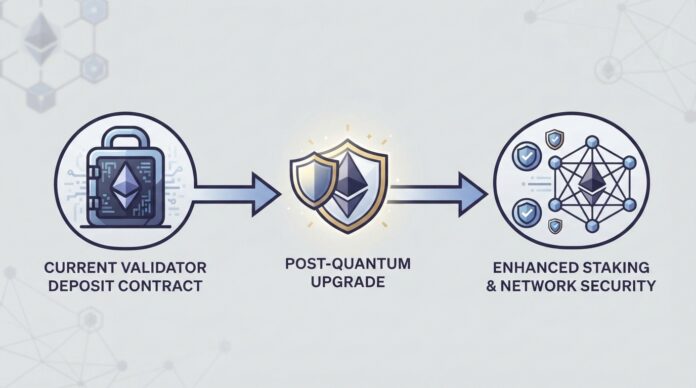
Ethereum researchers have submitted a proposal to redesign the validators' deposit contract. The main goal is to prepare the network to support new cryptographic systems and protect staking against potential threats from quantum computing in the future.
The quantum threat and the future of Ethereum
A group of researchers has proposed rebuilding Ethereum's deposit contract to protect the network against advances in quantum computing. This contract serves as the primary entry point through which users lock up their ETH to qualify as validators. These validators are responsible for verifying transactions, proposing new blocks, and maintaining the blockchain's decentralized operation.
Currently, tens of millions of ETH are staked within the network. This massive amount of assets underscores the critical importance of anticipating future vulnerabilities. Quantum computing poses a theoretical challenge to traditional cryptography, as advanced algorithms could potentially crack the private keys that protect these funds.
The role of BLS signatures in current validation
Today, network validators sign transactions using a cryptographic system known as BLS. The main advantage of this technology is that it allows hundreds of thousands of individual signatures to be compressed into a single signature. This aggregation keeps Ethereum's consensus mechanism efficient and scalable.
However, this system relies on elliptic curves. A sufficiently powerful quantum computer could solve these mathematical problems, allowing an attacker to forge signatures. Because the current contract strictly limits key sizes, a structural upgrade is required to support new formats.
Details of the proposal for the deposit contract
The proposal aims to add a flexible mechanism that supports different key sizes and signature formats using identifying tags. This will allow post-quantum cryptographic schemes to be incorporated in parallel with existing systems, enabling a smooth and secure long-term migration.
With these preventative initiatives, Ethereum seeks to consolidate its long-term security, ensuring that the validation ecosystem remains resilient to the technological evolution of quantum computing.
Investing in cryptoassets is not fully regulated, may not be suitable for retail investors due to high volatility and there is a risk of losing all invested amounts.
Generative artificial intelligence tools were used to create this article.