

Ethereum staking continues to grow exponentially with the influx of 1 million ETH in one week, further solidifying the security of the blockchain protocol.
During the last 7 days, the Ethereum staking contract saw an inflow of 1.000.000 ETH, a figure that reflects the commitment of cryptocurrency holders to the stability of the network.
According to records from the ValidatorQueue monitoring platform, this flow of assets raised the total deposited to 37.221.855 ETH, which is equivalent to 30,6% of the total supply in circulation.
This rapid growth, driven by the interest of large institutions, has caused severe congestion in the validator queue. The result is a waiting time that extends by almost two months before new nodes can begin operating. The trend reveals a sustained movement of capital that prioritizes obtaining consistent returns through transaction validation, relegating the idea of quickly selling digital assets to a secondary concern.
Stake ETH on Bit2Me EarnMore than three million ETH await activation on the network
According to the metrics analyzed in ValidatorQueueThe demand to participate in block validation on Ethereum exceeded the protocol's immediate absorption capacity.
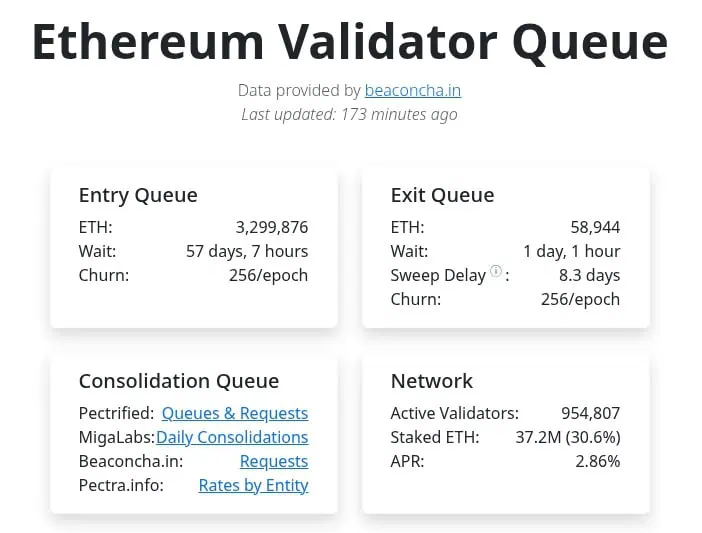
Currently, over 3,2 million ETH are waiting their turn to be activated in staking, creating a bottleneck that limits the entry of new validators. With the current system, only 256 can be added approximately every six minutes, a pace that dictates the internal growth of the network.
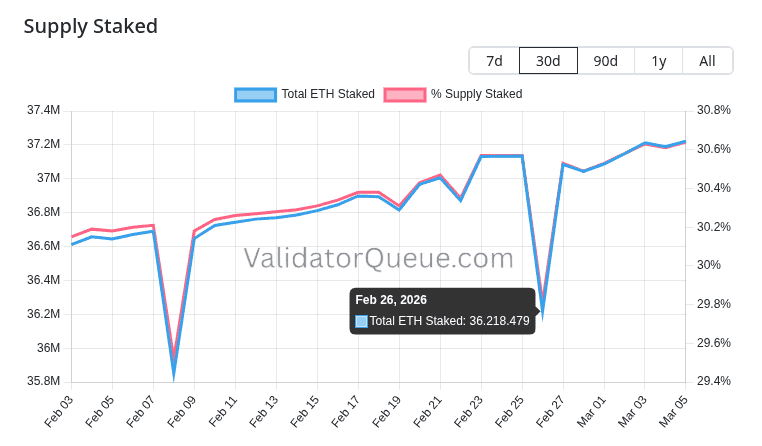
Market analysts emphasize that this massive increase in the waiting list is an indicator of technical confidence. According to specialists, investors are choosing to lock in their assets to obtain an annualized return, which, according to network data, stands at 2,86%.
To participate in staking, each node needs to deposit 32 ETH, a requirement that has fueled an unprecedented wave of deposits. The backlog is so large that, even if no more applicants were added, the system would take almost two months to activate everyone already on the waiting list.
These results are a clear demonstration of the growing interest in being part of the inner workings of Ethereum, a process that is progressing more slowly than many would like, but which confirms the level of commitment and expectation of its global community.
Log in now and put your ETH to workEthernet security is reinforced with over 950 active validators
Since Ethereum's transition to the Proof of Stake (PoS) consensus protocol, staking has become a key component of its ecosystem. It's not just a way to generate profits or returns, but a way to... a mechanism that supports the network and ensures its security.
When users deposit their coins into the corresponding contract, they assume the role of validators, an essential function that involves reviewing transactions and proposing new blocks. This commitment includes keeping a portion of their capital locked up, as the protocol rewards them with funds from new ether issuances and network transaction fees.
At the beginning of this month, the following were counted 954.807 active validators, a number that reflects the increasing degree of decentralization of the blockchain network.
Ethereum's transition to Proof-of-Stake (PoS) solidified a more efficient and sustainable way of operating the network, eliminating the need for expensive equipment and dedicated facilities like those used in digital mining. Instead, the protocol is sustained by direct financial support from the community, maintaining a balance between security, participation, and performance.
Buy, manage, and stake EthereumThe impact of the Pectra upgrade on ETH staking
The evolution of the Ethereum network has facilitated a more orderly inflow of this volume of capital into its ecosystem. Following the implementation of the Pectra updateImprovements were introduced that allow operators of large nodes to consolidate their assets more efficiently.
According to technical data from Beaconcha.in, this update gave institutions greater flexibility to manage thousands of ethers under a simplified infrastructure, reducing operational maintenance costs for those who secure the blockchain. This update increased the ETH staking limit, making it possible for validators to deposit from 32 to 2.048 ETH to facilitate the operation and minimize the technical complexity of the network.
Data from ValidatorQueue reveals that demand to join the staking system continues to grow steadily. Currently, the incoming queue exceeds three million ETH, while withdrawal requests barely reach 59.000 ETH. This significant difference confirms a clear trend: capital flows continue to favor remaining within the crypto ecosystem.
Create your account and buy ETH today