

Historically criticized for its inability to handle heavy loads, Solana showed significant improvements during the PENGU airdrop, although it did experience brief periods of inconsistency in block processing. Despite this, the network processed transactions at a healthy pace, demonstrating progress in its ability to handle high-demand events.
In its weekly research report on the cryptocurrency market, Galaxy Digital highlighted that the launch of the PENGU token on the Solana network has been a significant milestone that has enabled the blockchain platform demonstrate their resilience and ability to handle high workloads.
Solana has faced intense scrutiny due to its difficulty in handling massive loads on the network, resulting in frequent outages and performance issues. These flaws have led validators to restart the network several times in the past, raising concerns about its stability and reliability.
However, despite these challenges, the deployment of PENGU, the native token of the Ethereum-based Pudgy Penguins NFT collection, has served as a test case that has revealed significant improvements to Solana’s infrastructure.
Galaxy Digital highlights Solana's performance
Despite the slight instability that the network showed minutes after the PENGU deployment, Galaxy Digital has highlighted that Solana added blocks without significant interruption and processed blocks at a standard skip rate.
According to the firm, about an hour after the token airdrop went live, the Solana network suffered from about ten minutes of inconsistent block processing, with the skip rate jumping to around 20%. However, this skip rate was temporary and did not affect the overall operation of the network. For reference, the skip rate per epoch typically fluctuates between 2% and 5%, Indian the firm. After this period, transactions on the network continued at a healthy pace, despite the significant increase in load during the PENGU airdrop.
“Historically, Solana has come under scrutiny for not being able to handle an outsized load on the network and experiencing outages when under stress. However, through the PENGU airdrop, the chain added blocks without an outage and processed blocks at a standard skip rate.”, they said Galaxy Digital analysts.
Solana recorded a new record of daily transactions
The launch of PENGU on Solana was a resounding success in terms of performance and adoption.
According to data shared by Galaxy Digital, Around 1,1 million addresses claimed their allocation of PENGU tokens, with roughly 900.000 of them claiming the airdrop in the first 24 hours of launch on December 17. This rush to claim the airdrop caused Solana’s transaction count to skyrocket, with true transactions per second (TPS) exceeding 1.500 TPS.
In addition, data Data from cryptocurrency and blockchain analytics platform Artemis Analytics show that on that day, Solana's daily transactions reached a total of 66,9, setting a new historical record.
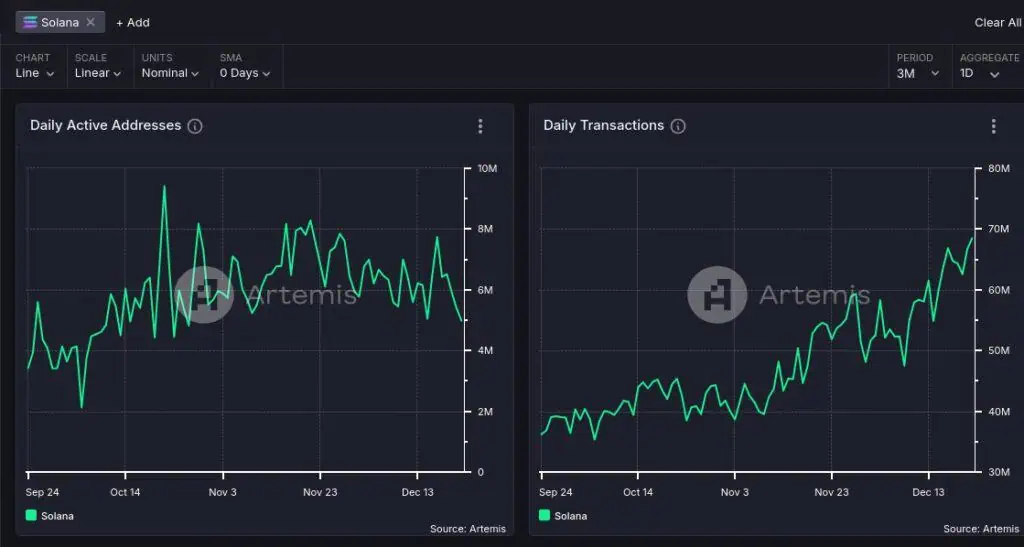
Source: Artemis Analytics
However, this achievement was surpassed a few days later, on December 22, when the network processed 68,5 million daily transactionsThis new daily record also underscores Solana’s ability to handle high workloads efficiently and without significant disruptions.
PENGU confirms the improvement of Solana's ecosystem
The launch of PENGU is just one of many signs that the Solana ecosystem has improved and grown in recent times. The blockchain platform has implemented significant technical and operational advances, like Firedancer, which allow it to handle higher loads and reduce interruptions, which were becoming increasingly frequent.
Furthermore, Solana adoption by projects and developers has increased, leading to a steady growth in the number of applications and users. This boom is a sign of confidence in Solana’s technology and its development team.
In conclusion, the deployment of the PENGU token has shown that Solana is overcoming its past challenges and looking to consolidate its position as one of the most resilient and efficient blockchains in the crypto ecosystem. Solana is currently the sixth most capitalized blockchain in the market, with a total value of $91.500 billion.