

The final ruling in the Ripple vs. SEC case will push XRP past its all-time high and transform the cryptocurrency market, experts say.
The legal case between Ripple Labs and the U.S. Securities and Exchange Commission (SEC) captured the attention of the crypto world, generating uncertainty among investors and the blockchain industry. This dispute, which centered on allegations of selling unregistered securities through the XRP token, marked the course of a key asset within the crypto ecosystem.
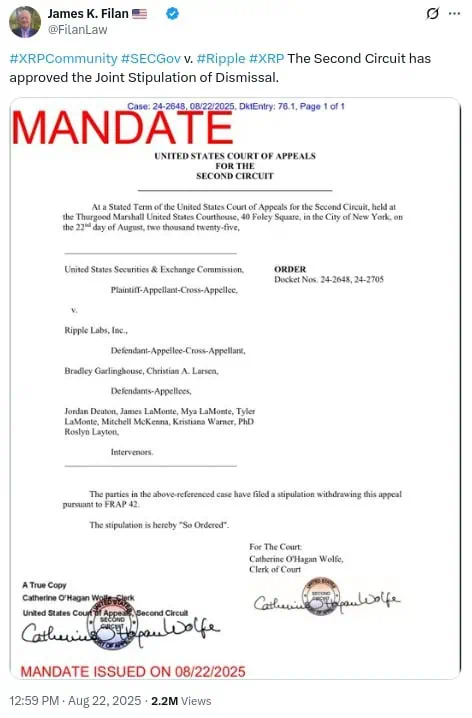
However, certainty about XRP's future began to emerge as it became known that both parties had agreed to withdraw their respective appeals. This outcome brought with it transformative potential that could propel XRP past its previous highs, consolidate its institutional adoption, and establish clear regulatory precedents for cryptocurrencies.
The legal battle that redefined the rules in the crypto market
The SEC's December 2020 lawsuit sought to argue that Ripple had conducted an illegal securities offering through the sale of XRP, a transaction valued at over $1.300 billion. A key point of contention was Ripple's categorization of XRP as a financial security, which could pose significant regulatory obligations and limitations on its use and trading. For years, this labeling raised significant market concerns about the token's future, affecting its liquidity, acceptance on asset exchanges, and its appeal to institutional investors.
Despite the complexity of the case, in 2023 the court set a relevant precedent by declaring that Public sales of XRP did not qualify as securitiesThis partial ruling was a clear signal that Ripple was not fully within the traditional framework of securities regulation. At the same time, the ruling established that some direct sales to institutions violated certain regulations, leading to sanctions and legal clarifications. This judicial balance gave way to a new stage in the dispute, in which the main expectation shifted to the final ruling before the Court of Appeals. issued at the end of August.
ETF approval drives new era of XRP
In recent months, following the case's closure, XRP has demonstrated remarkable resilience and growth, adjusting to market fluctuations and the regulatory environment. By 2025, XRP reached a new all-time high above $3,65, surpassing a record that had remained unbroken for seven years. This rally was accompanied by news that strengthened investor confidence, including the launch of the first XRP exchange-traded fund (ETF), the REX-Osprey XRP ETF (XRPR).
La authorization This ETF under Law 40 represents a key tool for attracting institutional capital, since it offers a regulated and accessible vehicle for investing in XRP without the need to directly acquire the token, although it is not a 100% spot product.
The impact of this approval extends beyond a simple price increase. It opens the door to broader and more structured adoption of XRP within the financial ecosystem. ETFs act as catalysts for the accumulation of tokens by large investors, which in turn can promote market stability and liquidity. Therefore, experts anticipate that, with the positive resolution of the case between Ripple and the SEC, the approval of more XRP-linked financial products will be facilitated, consolidating its position in both the retail and institutional markets.
Regulatory clarity is another key aspect of this new phase. Dialogue between authorities and crypto companies like Ripple will help define clear rules for digital assets, a permanent necessity for the sustainable development of cryptocurrencies.
Towards a future of institutional expansion and adoption
The outlook for XRP is promising, with a scenario in which a favorable conclusion to the litigation represents a turning point for its listing and its role in the global financial market. The combination of a court ruling that clears up doubts, the arrival of regulated financial products, and the growing interest of institutional investors provides a solid foundation for sustained growth.
Beyond mere speculation, XRP's evolution reflects broader trends in the crypto sector, where integration with traditional financial systems and regulatory clarity are becoming determining factors. The mainstreaming of products like the XRP ETF demonstrates the maturity of cryptocurrencies, which are increasingly viewed as legitimate assets with potential for expansion.
Ultimately, the final ruling in the dispute between Ripple and the SEC not only resolves a dispute of significant legal and economic impact. It could also become a historic opportunity for XRP, boosting its adoption, driving its price to new levels, and consolidating its presence among both individual users and major market players.
For observers in the financial and technology industries, this chapter marks the beginning of a new era, where the definition of clear rules will allow cryptocurrencies to advance toward a future with greater opportunities and a more robust and transparent market.