
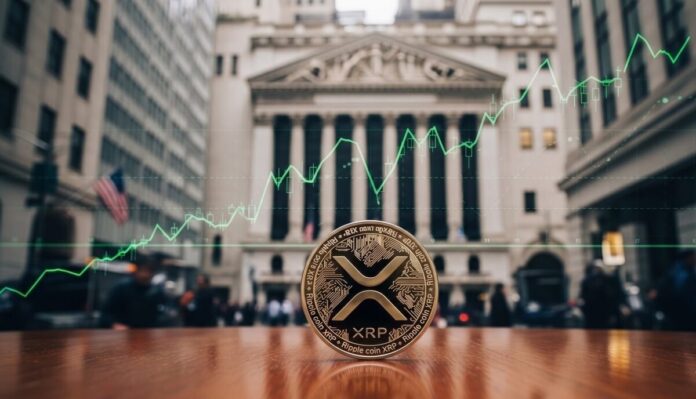
Ripple declares the start of the "institutional era" for XRP after record inflows into its ETFs and validation from giants like Goldman Sachs and Citadel. We analyze the figures and the technical shift that positions the digital asset as a pillar of the new financial infrastructure.
The narrative surrounding XRP as an asset under regulatory siege has been buried under a mountain of smart capital. Ripple, the company that issues this cryptocurrency, has confirmed that the transition to the institutional era is not a future projection, but a consolidated operational reality in the first quarter of 2026.
After years of legal battles that kept professional capital on the periphery, the arrival of regulatory clarity and the structure of Exchange-Traded Funds (ETFs) have transformed the perception of XRP, shifting it from being an object of litigation to a centerpiece in Wall Street portfolios.
Ripple supports this paradigm shift with a resilience metric that is uncommon in the traditional market: US spot XRP ETFs did not register a single day of net outflows during their first month of trading.
By December 2025, the cumulative flow in these investment funds already exceeded 1.000 millionThis marks a significant milestone in the speed of XRP adoption. The persistence of these inflows, even during periods of price volatility, suggests that fund managers are not speculating on short-term momentum, but rather executing long-term strategic allocations.
The institutional shift that redefined Ripple's ecosystem
Ripple explained that its current recognition and strategic importance stemmed not only from legal grounds, but also from building a financial infrastructure capable of meeting the risk requirements of large institutions. Beyond the dispute it waged against the Securities and Exchange Commission (SEC)The company's focus was on developing a robust ecosystem that would offer confidence to the most sophisticated trading desks.
In a recent blog postThe company broke down this process, emphasizing that it progressed in an orderly manner. First, the consolidation of regulated futures marketsWith the launch of Bitnomial in March 2025, followed by the introduction of CME contracts in May of the same year, the latter surprised everyone by reaching $1.000 billion in open interest in a very short time, highlighting a pent-up demand for XRP that far exceeded estimates from the retail segment.
But the turning point came with the update of quotation standards Driven by the SEC in 2025, the reduction of review times from 240 to 75 days facilitated a much more dynamic environment for new cryptocurrency-based financial products. From then on, several prominent firms launched almost simultaneously to offer their clients regulated access to XRP. Among them were: Canary Capital, Bitwise, Grayscale y franklin templetonwhose listed products began to appear consistently on Bloomberg terminals.
Diversifying issuers in this market not only provided liquidity, but also eliminated single counterparty risk, allowing firms like Goldman Sachs to begin building large positions with greater security and predictability.
Goldman Sachs' validation of XRP
In March 2026, a regulatory submission 13F This further confirmed the dominant presence of institutional capital in the XRP ecosystem. Goldman Sachs reported an exposure of $153,8 million in the cryptocurrency, strategically distributed among funds such as Grayscale's GXRP and Franklin Templeton's XRPZ.
The most striking aspect of this data is that Goldman Sachs alone holds 73% of the institutional capital identified in these financial instruments. This decision reflects a deep technical understanding of the asset's functional potential. Ripple emphasizes in its analysis that, Unlike other assets, fund managers interpret XRP as a practical utility tool, capable of settling transactions in seconds.
This validation is complemented by the Citadel entrancewhich has begun integrating XRP into its balance sheets for market-making operations, providing deep liquidity that reduces volatility and attracts lower-risk investors.

XRP gains ground with solid data and increased demand
Ripple's current optimism is also supported by network data that accompanies its financial success. While Bitcoin has established itself as a store of value comparable to gold and Ethereum functions as a global infrastructure for executing smart contracts, XRP has built a distinct proposition focused on serving as a international settlement layerfocused on speed and operational efficiency.
Its digital ecosystem has evolved with the incorporation of tools such as RLUSDRipple's stablecoin, developed to facilitate more secure and predictable international payments, allows financial institutions to improve their liquidity management by reducing the need to hold funds tied up in pre-funded accounts in different countries.
Furthermore, XRP's value within this system is based on its function as a bridge asset, capable of connecting different currencies and financial systems in real time. Its demand stems from both market interest and practical use in value transfer operations, where speed and cost make a tangible difference.
Ripple's horizon in 2026
Looking ahead to the rest of 2026, Ripple isn't stopping at ETFs. Its technical roadmap includes cutting-edge developments designed for central and commercial banks, addressing real-world problems in the financial sector.
For example, the confidential tokens They allow the handling of institutional guarantees without revealing sensitive information, thus protecting privacy in large-scale operations. formal verification systems They ensure that banks can seamlessly integrate XRP into their balance sheets while complying with Basel III requirements, perfectly aligning with global capital standards. Furthermore, the network is strengthened against the risks of... quantum computingpreparing the ground for lasting security.
In light of this development, Matt Hougan, CIO of Bitwise, emphasized that demand for XRP persists even in weak markets because professionals see it as a necessary diversification tool against the dominance of Bitcoin and Ethereum.
In summary, XRP is now positioned as an essential component of the global financial infrastructure.