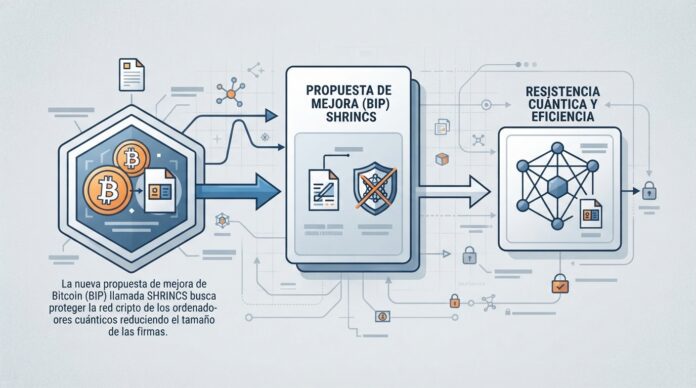
The crypto community is debating a new Business Improvement Proposal (BIP) called SHRINCS, designed to protect the network from the future threat of quantum computing. This signature scheme significantly reduces the amount of data required, seeking a technical balance between advanced security and operational efficiency.
The move towards a post-quantum crypto ecosystem
The crypto ecosystem is constantly preparing for the technological challenges of the future. Recently, the technical debate has gained new momentum with the publication of the Bitcoin Improvement Proposal (BIP) for SHRINCS. This document outlines a post-quantum signature scheme specifically designed to be integrated into the main network architecture.
Quantum computing poses a long-term theoretical challenge to current public-key cryptography. Advanced quantum computers could eventually deduce private keys from public keys. Therefore, proactive research is essential to maintaining Bitcoin's robustness.
The space problem in cryptographic signatures
One of the biggest obstacles in designing quantum-hardened solutions is data size. Current cryptographic signatures (such as ECDSA or Schnorr) are between 64 and 70 bytes. In contrast, standard post-quantum schemes supported by NIST are tens of times larger, which would drastically reduce network performance if adopted without optimization.
Shrincs technical specifications
SHRINCS achieves a reduction in the size of hash-based post-quantum signatures by approximately 13 times compared to NIST standards. With an optimized base size and the leveraging of structures like SegWit, this proposal minimizes the impact on block performance.
FAQ
What is a BIP in the crypto ecosystem?
A BIP (Bitcoin Improvement Proposal) is a formal document that presents new features, processes, or technical standards for the community to evaluate and discuss.
When will quantum computing become a real risk?
Although experts estimate that it will still be years or decades before we see quantum computers capable of breaking current cryptography, proactive development ensures a safe and orderly transition.
The SHRINCS proposal demonstrates the developers' continued commitment to Bitcoin's long-term security, paving the way for a robust architecture against future disruptive technologies.
Investing in cryptoassets is not fully regulated, may not be suitable for retail investors due to high volatility and there is a risk of losing all invested amounts.
Generative artificial intelligence tools were used to create this article.