

Polygon has introduced its autonomous private identity protocol for Web3, Polygon ID, to empower its users across networks.
Polygon developers have introduced a native identity protocol for blockchain that will align its users with the privacy spirit of Web3. The protocol, called Polygon ID, is based on zero-knowledge proofs (zk-SNARK), making it the first self-contained private identity protocol for Web3 of its kind.
In a publication Recently, developers indicate that the new identity protocol is designed to empower users by enabling the creation of trusted interactions with Web3 services and applications. This open source protocol is the latest major development within the Polygon ecosystem. Its official launch is scheduled for the third quarter of this year.
It may interest you: Polygon exceeds 2,4 million active unique addresses per month
Polygon ID aligns with Web3 principles
Polygon ID users will be able to use this identity protocol to access different Web3 applications privately and anonymously. Polygon ID helps meet the world's digital identity needs by verifying and authenticating users' information without risking their privacy, the developers said.
In this way, users will be able to complete KYC (Know Your Customer) and KYB (Know Your Business) records without the need to disclose or disclose confidential information to third parties.
Mihailo Bjelic, co-founder of Polygon, tweeted that this private identity protocol is a fundamental component in the vision that is building the network, which aspires to become the de facto platform for access and development of Web3.
Bjelic also assured that the new protocol will guarantee the privacy of users by default, as well as decentralization, leaving control over their personal data in the hands of the users themselves. “There is nothing in the digital identity space right now that meets all of these requirements”, he stressed.
Building with zk-SNARK, iden3 and Circom
In order to accredit and demonstrate users' access rights to applications and services and not their identity, Polygon ID implements zk-SNARKs and also takes advantage of the innovation of the Iden3 sovereign identity protocol and the circuit framework Circom 2.0 arithmetics, indicates the publication. The combination of all these will give rise to the new generation of applications and services based on blockchain and Web3.
On the other hand, being open source, Polygon ID will adjust to the development of the ecosystem, allowing existing and future protocols in the blockchain industry to adapt and develop it according to their own needs.
Polygon ID Use Cases
Of the many use cases that Polygon ID can have in the blockchain industry, developers highlighted building new forms of reputation through decentralized sybil or credit scoring; building new decision-making and governance models in DeFi, through voting power and experience-based reputation; creating player reputation profiles for blockchain and Web3 games; the development of social applications and private and censorship-resistant P2P communication and interaction systems, among others.
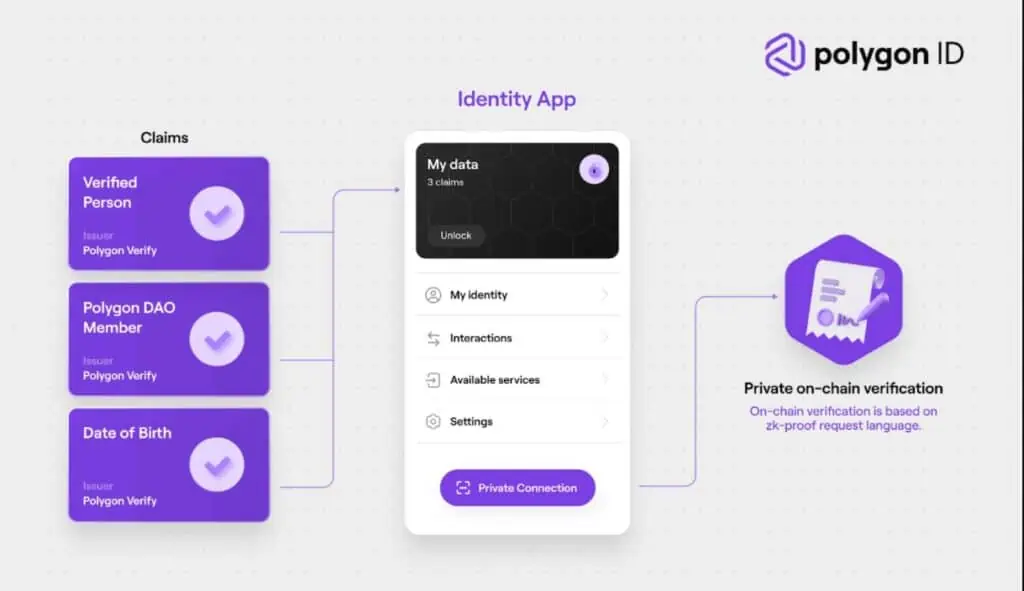
During the current development phase, the Polygon team will structure and implement the new identity protocol in its suite of applications, such as Wallet, Platform and Connect, so that developers using Polygon can test the protocol, to become familiar with how it works. and integrate it into your own applications.
Building Web3
In February, Polygon developers reported a capital round of 450 million dollars, participated by Sequoia Capital, SoftBank, Galaxy Digital, Tiger, Republic Capital and Kevin O'Leary, among others.
The funds are being invested in the creation of cutting-edge zero-knowledge (ZK) technologies, which are key to developing Web3 and incorporating the next 1.000 billion users into this innovation.
Since its founding in 2017, Polygon has been working on solutions and tools to increase the scalability of Ethereum to make Web3 a reality. To date, in addition to Wallet, Platform and Connect, the Polygon ecosystem has other solutions such as Polygon PoS, Edge and SDK. In August last year, the network merged with Hermez Network, based on zero-knowledge (ZK) proofs, to advance its decentralization strategy.
Continue reading: Polygon integrates Hermez Network in the first complete blockchain merger in history