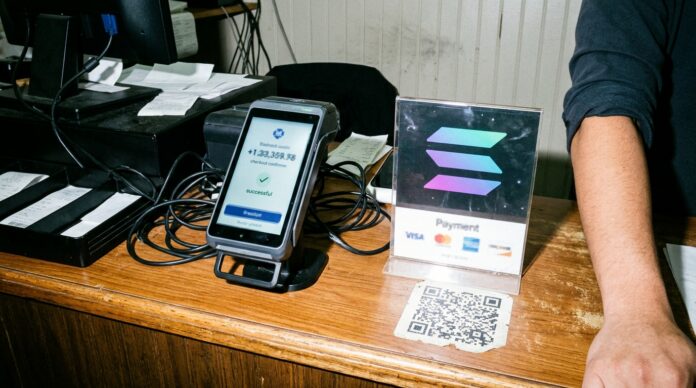
Polygon Labs has announced the expansion of its Open Money Stack suite to Solana, enabling businesses and developers to unify stablecoin services, bank connections, and cross-chain transfers into a single technical and commercial integration. This strategic move aims to address the fragmentation that has historically hindered commercial payments with digital assets.
With this move, two of the most dynamic ecosystems in the crypto sector are joining forces to accelerate business adoption through an architecture designed to simplify collections, global settlements, and conversion of traditional money across multiple chains, overcoming the barriers of technical incompatibility that limited the day-to-day operations of companies.
Unifying payments with stablecoins and bank ramps
Polygon Labs has decided to take a key step in its interoperability strategy by Extend your payments infrastructure with Open Money Stack stablecoins to SolanaUntil now, companies seeking to operate with digital payments had to independently integrate different payment gateways, custody providers, cross-chain transfer services, and bank clearing entities. This technical complexity generated enormous operational friction and increased maintenance and development costs.
Open Money Stack aims to eliminate this fragmented system by consolidating financing through bank accounts, cards, and fiat transfers into a single access point. Businesses operating on the Solana network can now integrate embedded wallets, issue direct international payments, and coordinate transactions without needing to sign individual contracts with multiple intermediaries in the traditional and digital financial sectors. Thanks to this modular approach, any business application can manage money flows without relying on custom development.
To better understand the evolution of multi-chain architectures, you can consult the latest Bit2Me News Regarding innovation in blockchain payments, the initiative reduces integration periods from weeks to just a few hours, allowing businesses of any size to incorporate stable digital assets with automated accounting reconciliation processes that comply with international regulatory frameworks.
Multi-network interoperability: Solana, Polygon, and Ethereum
Technical integration allows for the transparent channeling of funds not only between the banking system and Solana, but also across networks such as Ethereum, Tron, and Polygon's own ecosystem. This means that a trading platform can collect fiat or stablecoin funds on one network and settle near-instant payments to suppliers or users on a completely different one, without the end customer perceiving the complexity of cross-chain bridges or assuming unnecessary operational risks.
For projects that seek buy Solana By integrating liquidity in POL and ETH, this architecture eliminates the need to manage multiple application programming interfaces (APIs). For example, an international remittance provider can receive fiat currency from a sending user, issue USDC on Solana, and connect the final settlement to the recipient's local bank account in a matter of minutes, ensuring complete traceability of the money flow.
The system leverages cross-chain messaging protocols and account abstraction layers that hide complex private key management from end users. Thus, the sender only needs to authorize the transaction, while the underlying infrastructure handles token standard changes, validates signatures at the destination, and coordinates settlements with partner financial institutions.
Kira and the first institutional use cases
One of the first projects to adopt this integrated infrastructure has been Kira, a company specializing in cross-border payments and transfers. The firm uses Open Money Stack's capabilities to enable its clients to convert stablecoin remittances directly into dollars in their bank accounts, simplifying payments to suppliers and business partners abroad.
This functionality responds to a growing demand in international trade, where the speed and cost of traditional transfers remain a barrier for businesses. Sandeep Nailwal, co-founder of Polygon, highlighted that the biggest challenge facing fintech companies and banks that want to operate with blockchain technology lies in connecting these solutions to the payment infrastructures their users already routinely use.
Corporate cross-border transfers often experience delays of days due to correspondent banking networks and multiple intermediary fees. With implementations like Kira's on Open Money Stack, B2B settlements are processed in seconds, maintaining real-time visibility into the status of funds and drastically reducing administrative costs for SMEs and multinational corporations.
Solana's impetus and the consolidation of Polygon
Polygon's entry into Solana comes at a time of remarkable growth for the latter, which has processed over five trillion dollars in stablecoin transaction volume so far this year, according to data from the Solana Foundation. Furthermore, the network recently implemented its Alpenglow upgrade and strengthened institutional settlement standards with contributions from major international financial institutions.
For its part, Polygon continues to strengthen its role as a comprehensive payment solutions provider, following strategic moves such as the acquisition of the Coinme platform. The combination of Solana's transactional performance with Polygon's extensive network of institutional and Layer 2 partnerships creates a favorable environment for global payments. You can find more details about the development of these infrastructures in the analysis of cross-chain platforms. Bit2Me News.
Those who wish to learn more about how decentralized finance and settlement protocols work can get training at Bit2Me Academy, where the evolution of these systems and the impact of the MiCA Regulation on the European regulatory environment are analyzed, ensuring a safe and transparent adoption for companies and individual users.
FAQ
What is Polygon's Open Money Stack?
It is an infrastructure toolkit developed by Polygon Labs that brings together bank on- and off-ramps, integrated wallets, and stablecoin transfers between various blockchains into a single technical connection to facilitate corporate adoption of digital asset payments.
Why has Polygon decided to integrate with the Solana network?
The integration allows companies active in Solana to access bank funding channels and multi-network settlement without dealing with dispersed providers, taking advantage of the high transaction volume of stablecoins and the settlement speed offered by the Solana ecosystem.
How does the MiCA Regulation affect the use of stablecoins for businesses?
Within the European Union, the MiCA Regulation requires that stablecoins be backed by transparent reserves and issued by authorized entities. Interoperable payment platforms make it easier for merchants to meet these regulatory compliance and traceability requirements with operational guarantees.
The convergence between Polygon and Solana represents a significant step toward a more accessible and efficient global payments ecosystem for the enterprise environment. By overcoming technical compatibility barriers and simplifying fiat on-ramps, both networks demonstrate that interoperable collaboration is essential to driving the practical adoption of stablecoins in the digital commerce of the future.
Investing in cryptoassets is not fully regulated, may not be suitable for retail investors due to high volatility and there is a risk of losing all invested amounts.
Generative artificial intelligence tools were used to create this article.