

The activity generated by ordinals and the new Bitcoin token standard, BRC-20, congests the network and drives up commission rates.
More than 400.000 transactions were waiting to be confirmed on the Bitcoin network on Sunday, May 7, due to congestion generated by the growing demand for Ordinals NFTs and tokens based on the BRC-20 standard in Bitcoin, which are related to ordinals.
Similar to the Ethereum blockchain, Bitcoin now has a token standard that allows for the minting of new assets on the blockchain.
With demand for these assets, mostly memecoins, on the rise and their listing on major cryptocurrency exchanges and trading platforms in the industry, activity within the blockchain has skyrocketed along with commission rates on the network, which have also risen exponentially, reaching a nearly two-year high.
The data in the mempool show, at the time of this edition, a total of 402.295 BTC transactions pending, while commission rates average $8 per tx.
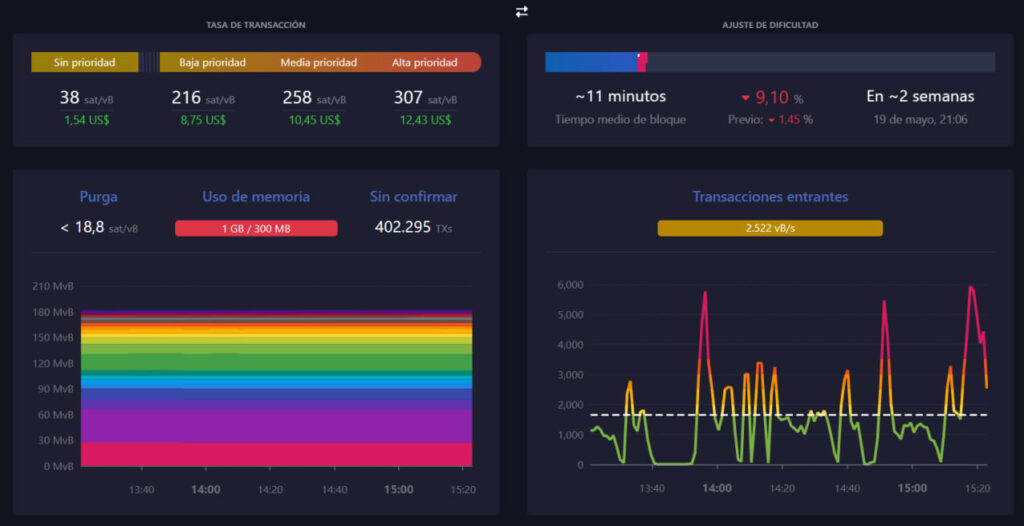
Source: Mempool.space
Transactions linked to Ordinals, a protocol that allows files to be recorded on the Bitcoin blockchain similar to NFT tokens, also continue to grow, contributing to the current congestion on the network.
According to Dune Analytics, There are 4.334.447 inscriptions of ordinals in BitcoinThis is 64% higher than the number of ordinal NFT listings on the blockchain last week.
The number of daily transactions in Bitcoin doubles
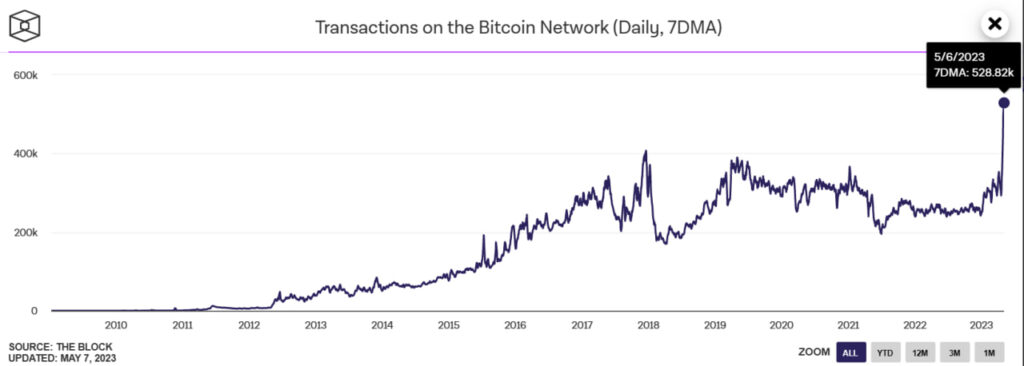
Over the past 30 days, the number of daily transactions on the Bitcoin network has nearly doubled, from 293.300 transactions per day in mid-April to 528.800 transactions per day, actually.
More than 3,24 million Bitcoin transactions have been made so far this month, according to data from The Block Research.
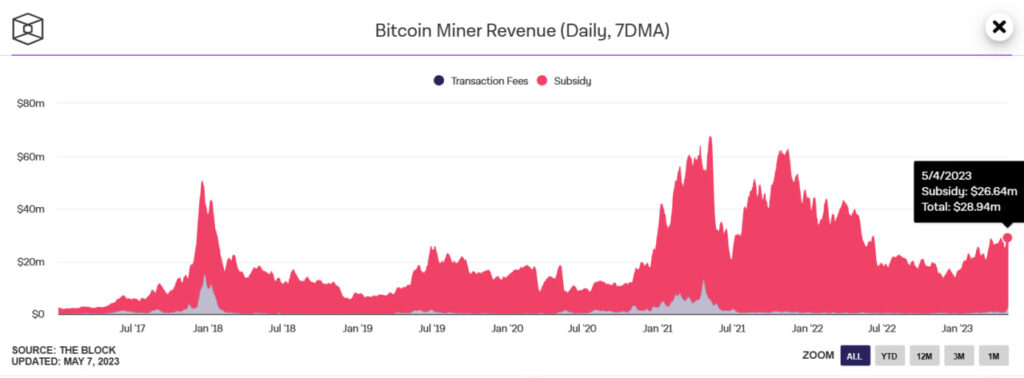
On the other hand, commission fees, which users pay to confirm their transactions, have reached two-year highs. Bitcoin miners are the main beneficiaries of these commission fees and, according to the same data platform, they are receiving close to $29 million a day in profits between block rewards and transaction confirmation revenue.
El 12,17 % of the revenue recorded by Bitcoin miners this May comes from commission fees paid on the network.
What congests the Bitcoin network?
Ordinal-related inscriptions in Bitcoin continue to grow at a rapid pace. Ordinals were launched this year thanks to the Segwit and Taproot upgrades and gave rise to BRC-20 tokens, which use ordinal inscriptions of JSON data.
Anonymous Bitcoin Core operator Cøbra shared with his followers on Twitter his theory that the increasing activity these protocols are generating within Bitcoin represents a denial of service attack, or DoS, on the network. Cøbra said that Bitcoiners and the crypto community need to coordinate to find a way to respond to the current attack.
“If fees increase, more exchanges will use network congestion as an excuse to prevent withdrawals,” manifested the anonymous trader in reference to actions taken by Binance.
The cryptocurrency company stopped BTC withdrawals on Sunday, pointing to network congestion and the large number of transactions that were awaiting confirmation. A few hours later, Binance resumed Bitcoin withdrawals on its platform.
An opportunity for Lightning Network
Anthony Pompliano, co-founder and partner at Morgan Creek Digital Assets, told Will Clemente, crypto analyst and co-founder of Reflexivity Research, that the recent congestion the Bitcoin network is currently witnessing may be a catalyst for Lightning Network adoption.
Meanwhile, Pierre Rochard, vice president of research at Riot Platforms, said that Binance's actions highlight the competitive advantage that companies that use the Lightning Network have to develop their applications and payment services with bitcoins.
The Lightning Network is a second-layer network designed to give users a fast and accessible way to make payments with Bitcoin. The Lightning Network's capacity has grown by 6% this year, reaching 5.580 BTC.
Continue reading: Grayscale: Ordinals can accelerate Bitcoin adoption