
Optimism developers have released the alpha version of a new fail-safe system that they hope will improve security and move towards full decentralization of the network.
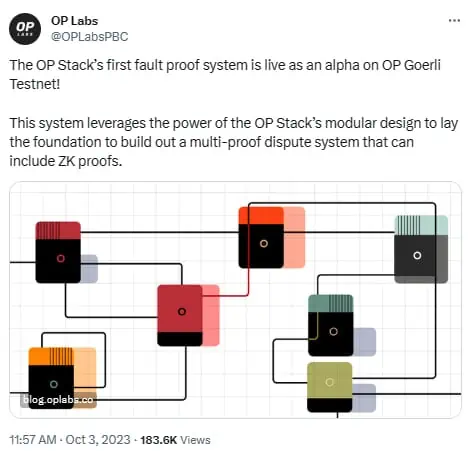
Earlier this month, Optimism released the alpha of its first fail-safe system on the Goerli testnet.
As explained by the developers, it is an innovative fail-safe system that leverages the power of the OP Stack open-source modular software stack, focused on the development of highly scalable and interoperable blockchains, to lay the foundation necessary to build a multi-proof fail-safe system that can Include zero-knowledge proofs or ZK.
Through X, the scalability network developers commented that the new fail-safe system integrates key components to secure the network, ensuring stability and reliability.
The objective of this new system is mitigate the risk of malicious activities on the network, preparing Optimism to become a Superchain and to offer users a completely decentralized environment.
Karl Floersch, CEO of OP Labs, the lab that develops the Optimism network, explained to Blockworks that fault testing is a important safety measure and are designed to set the stage for Optimism's second stage of decentralization.
In April 2022, the developers of Optimism announced the creation of their own governance token, called OP, in order to introduce democratic governance to the network. Later, in June of this year, they presented a framework for the maturity of rollups, incorporating new updates in different phases that will progressively improve the protocol.
Within this framework, Optimism developers designed 3 phases, called “Full Training Wheels”, “Limited Training Wheels” and “No Training Wheels”. As part of the second phase, the developers explained the need to implement a fully functional testing system, in order to ensure decentralization of fraud-proof presentation and provision of user exits without operator coordination. For the final phase, the fail-safe system will be managed entirely in a permissionless manner and users will have sufficient time to exit in case of unwanted updates, the developers explained.
“This is the final stage where the rollup is managed entirely through smart contracts.”
On the other hand, in the Immunefi vault system, Optimism keeps locked just over $2 million dollars, which are part of its bug bounty program to detect any existing failure or vulnerability in smart contracts Bedrock, the first version of the OP Stack codebase.
At press time, the OP token is trading down 3,8% in the last 24 hours. Its price, $ 1,2 dollars Currently, it has accompanied the slight correction that the crypto market in general has seen this Monday, of 1,8%.
Continue reading: Polygon Miden, a solution that emphasizes privacy and scalability for Web3