
Stacks, the Bitcoin smart contract solution, has confirmed that the window for activation of its next Nakamoto update will begin on August 28.
In a recent blog post, Mitchell Cuevas, Growth Lead at the Stacks Foundation, confirmed the imminent activation of Nakamoto later this month, an event that will not only mark a milestone in the evolution of Bitcoin's Layer2 network, but It also promises to transform the way users interact with the market-leading cryptocurrency.
Nakamoto will activate on August 28, developers confirm
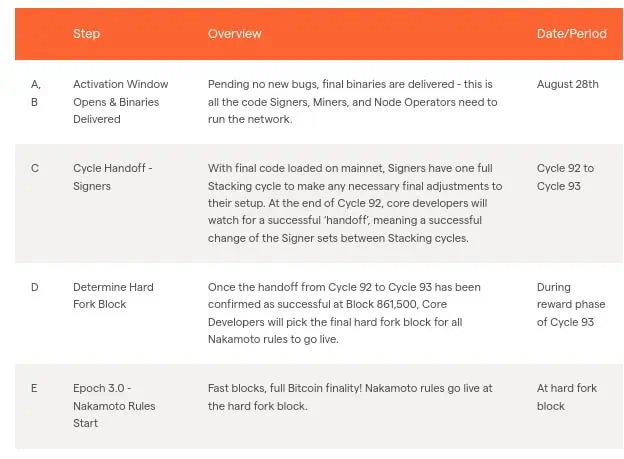
According to the publication shared by the Foundation, Nakamoto activation window will officially open on August 28. During this window, the final binaries will be delivered to network operators, who will have a full stacking cycle, cycle 92, to make any necessary adjustments to their configuration. The foundation explained that this process is crucial as it will ensure that the transition to the new Nakamoto rules goes smoothly.
On X, Stacks developers also provided details on the activation sequence of the new update, noting that it is designed in well-defined steps to ensure its successful activation. First, the activation window will open and the binaries will be delivered. Signers will then receive a full cycle to make adjustments before a successful “handover” is confirmed between stacking cycles. This handover is essential, as it will allow the core developers to choose the final hard fork block, a step that will activate the new Nakamoto rules, they explained.
It is important to note that the activation of Nakamoto is not just a technical change. The upgrade represents significant progress toward improving the efficiency and speed of the Stacks network.
Franklin Templeton, one of the issuers of Bitcoin exchange-traded funds in the United States, dedicated an investor note to Nakamoto in March, highlighting that the activation of this update will improve the Stacks network's capabilities to process blocks more quickly and achieve full Bitcoin finality. This means that the blockchain will be able to process transactions faster and more securely.
Nakamoto was initially scheduled to be implemented in April. However, the development team in charge requested more time for the deployment of this update due to the need to build an advanced signature recovery and resilience system. As reported This medium, Stacks developers stressed the importance of building this system before the launch of Nakamoto to ensure the security of deployment on the network.
What is the Nakamoto Stacks update?
The Nakamoto update is a set of improvements designed to optimize the operation of the Stacks network, which operates on the Bitcoin blockchain. At its core, Nakamoto seeks to implement a new set of rules that will allow developers and users to take full advantage of Bitcoin's capabilities and security, while maintaining the unique features of Stacks.
This update is designed to strengthen the Stacks network and improve its usefulness in the blockchain ecosystem.
One of the most notable features of the update is the introduction of “fast blocks”, which will improve the speed of transaction confirmation and improve finality, ensuring that transactions are irreversible once confirmed. This adds an additional level of security for cryptocurrency users.
Another important aspect of the update is the introduction of sBTC, a version of Bitcoin that will be integrated into the Stacks ecosystem. According to the developers, sBTC will be ready for launch on the mainnet approximately four weeks after the Nakamoto launch. This asset will allow users to enjoy all the benefits of Bitcoin while interacting with the protocols and decentralized applications (dApps) running on Stacks.
The activation of Nakamoto at the end of the month represents a watershed moment for the Stacks network and its community, as the update has the potential to transform the way users interact with the blockchain.