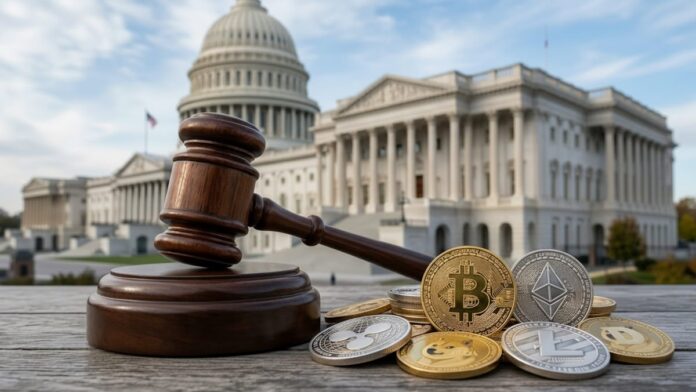
The capital of the United States is at a legislative boiling point.
As the calendar relentlessly marches toward the Easter recess, the halls of the Capitol resonate with a debate that could define the nation's technological and financial future for the next decade.
La CLARITY ActAn ambitious project designed to establish a definitive regulatory framework for digital assets has become the top priority for a group of lawmakers who fear that, without clear rules, American innovation will end up seeking refuge on foreign shores.
Senator Kevin Cramer, one of the most influential voices in this process, has intensified his media campaign to raise awareness among his colleagues about the urgency of the moment. In recent statements, Cramer warned that the current legal loophole is not just an administrative nuisance, but an existential risk to technological competitiveness U.S..
According to the legislator, the lack of a coherent legal framework defining the roles of banks and stock exchanges in relation to cryptocurrencies is sending a signal of uncertainty to the world. Therefore, the goal is to reach a consensus and hold a vote on the CLARITY Bill before lawmakers recess for the Easter holidays.
Tim Scott, chairman of the Senate Banking Committee, also awaits a final agreement Regarding the performance payout on stablecoins by the end of the week, as reported by journalist and presenter Crypto in AmericaEleanor Terrett, who has closely followed this regulatory development.
Trade regulated stablecoins on Bit2MeThe CLARITY Act, a legal framework to stem the brain drain of technological innovation
The essence of the CLARITY Act lies in its ability to transform an ecosystem that, until now, has operated in a legal "gray area".
Senator Cramer has been emphatic in pointing out that Congress must prioritize a structure that offers transparent and predictable guidelines for the digital marketplace. During a recent interview Speaking to Fox Business, he indicated that the committee should prioritize the bill before Easter. This regulatory proposal not only seeks to protect consumers but also to provide financial institutions with the necessary confidence to integrate blockchain technology into their daily operations.
However, the path to passing this regulatory bill has not been without its obstacles. Beyond the lack of consensus between the banking and cryptocurrency sectors, the Senate Banking Committee is also currently overwhelmed, grappling with a packed legislative agenda that includes major bills like the SAVE Act and debates on defense funding. This parliamentary congestion has raised concerns among proponents of the CLARITY Act, who fear that any delays beyond April will jeopardize its progress due to the increasing political pressures that typically dominate the second half of the legislative year.
Despite these challenges, optimism persists. Cramer, along with Senator Cynthia Lummis, maintains that it is still possible to make progress simultaneously on multiple fronts. Both legislators argue that the passage of this law would represent a historic milestone, ending years of regulatory uncertainty and allowing the United States to reclaim its position as the undisputed leader in the global digital economy.
Access stablecoins: trade USDC hereThe debate about stablecoins and competition with traditional banking
The CLARITY Act has faced its greatest resistance due to a lack of consensus on the convergence of two previously distinct financial worlds. Traditional banking institutions have expressed a structural concern: they fear that the regulation will allow technology companies to operate with functions similar to those of a bank, such as attracting deposits through stablecoins and offering returns, without being subject to the same regulatory and capital oversight burden. For banks, this is not just a matter of competition, but of systemic stability, arguing that a massive migration of liquidity into digital assets could deplete the capital of the conventional financial system.
However, the crypto community and blockchain technology advocates argue that fair regulation is not about applying old laws to modern technology, but about creating an equitable and proportionate framework that fosters innovation.
Primarily, the crypto community argues that the law should not penalize the efficiency of blockchain and that imposing excessively burdensome banking requirements on technology startups would act as a barrier to entry that stifles competition and forces developers to move their projects to jurisdictions with more dynamic frameworks.
This sticking point has slowed negotiations in the Senate Committee, as the parties seek common ground.
Manage stablecoins on Bit2Me: click hereThe United States seeks regulatory clarity
As Easter approaches, the U.S. Senate is working against the clock under pressure from various economic and institutional sectors. The CLARITY Act, a proposal seeking to establish clear rules for the use and legal treatment of digital assets, remains at the center of the debate. To date, the lack of uniform regulation within the sector has generated uncertainty among developers, banks, and technology companies operating with blockchain and cryptocurrencies in gray areas.
For this reason, Senator Kevin Cramer and other legislators argue that the bill's passage would bring greater legal certainty to the ecosystem, strengthening user and investor confidence and marking a decisive step toward the maturity of the digital market. They also emphasize that this measure could solidify the United States' leadership within the global blockchain industry.
Furthermore, in a year where the economy dominates the political agenda, the future of the CLARITY Act could become a decisive milestone for the development of the crypto sector in North America. Its outcome, experts point out, will not only impact technological innovation but also how the United States approaches digital competitiveness against the rest of the world.
Join Bit2Me and trade crypto securely