

81,41% of Helium governance has approved the protocol's migration to the scalability-focused Solana blockchain.
The Helium Foundation has announced that the Helium crypto community has overwhelmingly approved the HIP-70 network upgrade proposal, to migrate the Helium protocol from its native blockchain to the Solana blockchain. This migration process involves moving all of the protocol’s operations, including the HNT token, governance, and Helium mining rewards, to the new network, the developers explained in the proposal.
HIP-70 was introduced earlier this month and sparked a lot of controversy among Helium users, mainly due to the history of bugs and hacks that have occurred on the Solana blockchain in recent months.
However, according to the voting results, A total of 6.177 votes, representing 81,41% of the network governance, were in favor of migrating the protocol towards the new blockchain.
Helium developers behind HIP-70 argue that the blockchain change will significantly improve the protocol’s performance and efficiency, as well as HNT’s compatibility with other projects in the Solana ecosystem, among other things, further boosting its utility and creating new use cases for the token.
It may interest you: Helium developers propose migrating the protocol to Solana
What advantages does Solana offer for Helium development?
The Helium Improvement Proposal, HIP-70, notes that Solana has a massive developer ecosystem, highly scalable decentralized applications, and integration teams that will drive the growth and utility of Helium and its compatibility with other projects in the blockchain ecosystem.
The proposal also indicates that users and holders of HNT tokens will be able to enjoy better support for their hardware and software wallets on Solana and that they will be able to integrate into the DeFi protocols, NFT markets and Metaverses that are developed on this network. There was even talk about Saga, the Android mobile phone that will integrate the Solana blockchain and that could play an important role in the future of Helium.
Helium Foundation COO Scott Sigel also noted that on Solana, Helium will be able to fulfill its ambitious mission of deploying and managing large-scale wireless networks. Recall that Helium is a blockchain protocol designed as the world’s first decentralized wireless network for the Internet of Things (IoT).
However, despite the advantages listed by Helium developers and the decision made by the crypto community, many still express their dissatisfaction with the results of the vote.
On Twitter, the users They continue to comment that the Helium developers should have chosen a more stable blockchain, citing Avalanche, Cardano, Polygon Network or Cosmos as other options.
HNT price up 6%
At the time of writing, Helium’s native token, HNT, is up 6,08% over the past 24 hours, according to data from CoinMarketCap.
HNT is trading at $4,70 and has a market cap of $589,4 million, currently. Trading volume for this token has also grown by 102% this week, surpassing $39,9 million traded, at press time.
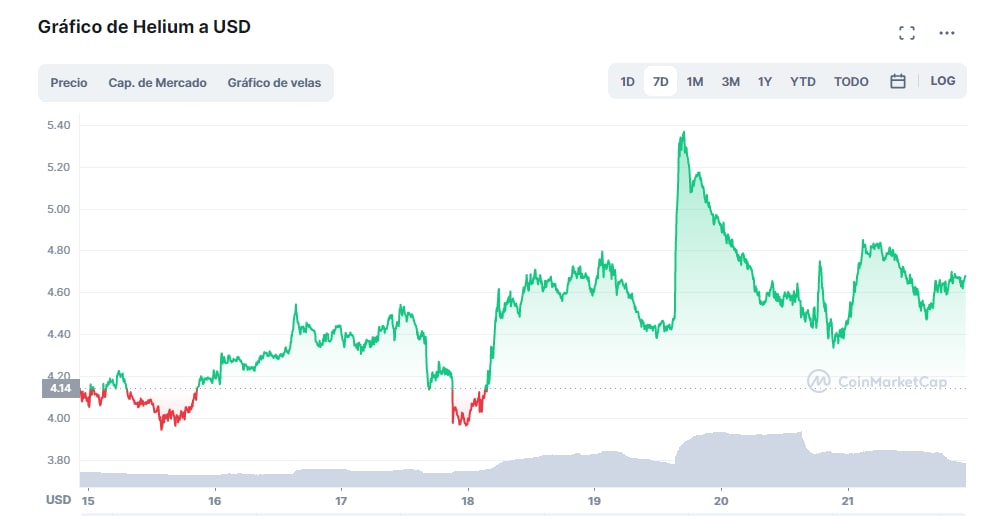
Source: CoinMarketCap
Despite criticism from the broader community, the price of HNT appears to be reacting positively to the news of the blockchain migration. Over the past week, the value of HNT has increased by approximately 14%.
Helium founder Amir Haleem said on his Twitter account that the development team had spent months considering different blockchains and sidechains and that Solana was by far their best choice.
Continue reading: Helium allows a hobby fisherman to track his crab pots