
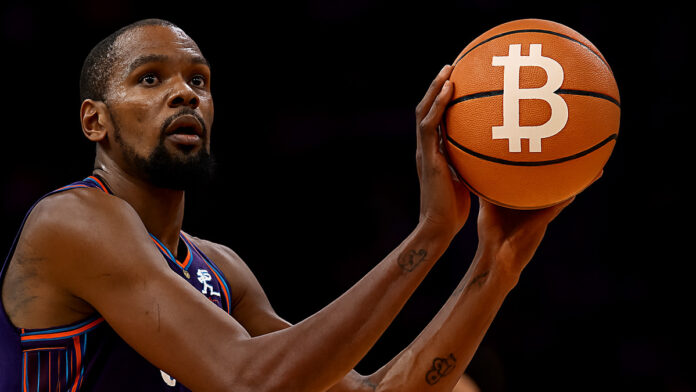
The case of Kevin Durant, who managed to recover more than 20 million in Bitcoin after years of not remembering his password, demonstrates the vital importance of proper private key management and secure cryptocurrency storage.
NBA forward Kevin Durant is back in the news, but this time not for a play on the court, but for an unexpected story: he managed to recover a Bitcoin investment valued at more than $20 million today.
For years, Durant had lost access to this large amount of cryptocurrency because I didn't remember the password from his account at Coinbase, a major platform for managing digital assets. The story of how he eventually managed to access these funds serves as a critical reminder of the importance of correct management of passwords and private keys In the crypto world, security is a decisive factor that can determine access to or the ultimate loss of large sums of money.
Buy and store your Bitcoin safely at Bit2MeAn early investment in Bitcoin turned into a fortune
In 2016, Kevin Durant and his business partner Rich Kleiman bet on Bitcoin at a time when its price was around $600 per unit. With a initial investment of approximately $100.000, they put their trust in an asset that was still considered very volatile and risky by the traditional market. However, thanks to the strong appreciation of Bitcoin, whose value reached an all-time high of $125.506 per coin on October 5th, that small investment turned into a multi-million dollar sum that currently exceeds $20 million.
But for Durant, this exponential growth was accompanied by an unexpected barrier: he forgot his Coinbase account password and, as a result, was unable to access his funds for years.
The outcome of this terrible episode for the NBA forward was ultimately successful thanks to recovery efforts that were detailed at the conference. Game plan CNBC's Rich Kleiman and confirmed by Brian Armstrong, CEO of the platform. Their situation reflects the complexity and technical risks to which cryptocurrency investors are exposed, especially when facing loss of access due to a lack of proper key management.
Don't be like Durant: Protect your BTC with Bit2MeLosing access: A story shared by hundreds in the crypto world
In the crypto world, Durant's story is just one more in a troubling series of problems. Losing a password, misplacing a private key, or disposing of the device that stores it can mean those digital assets are forever out of reach. There is no “password recovery” service. As with email, in blockchain, lost access is, in most cases, irreversible.
The figures circulating in the industry are revealing: between 20% and 30% of all existing bitcoins could be locked forever due to these human errors or oversights. That amounts to billions of dollars that, although they remain on the network, They cannot be moved or spent, remaining frozen in a digital limbo.
Emblematic examples of similar cases serve to illustrate this problem. Stefan Thomas, a German programmer, forgot the password needed to access 7.002 bitcoins which he received in 2011 as payment for an educational video about cryptocurrencies. Another notable case is that of James howells, a British miner who lost access to 7.500 bitcoins when accidentally discarding a hard drive which contained the private key for those coins.
Both cases demonstrate that a lack of caution can turn an opportunity for wealth into a bitter memory, making it clear that, in cryptocurrency, safeguarding the keys is just as important as acquiring them.
Hold BTC with total security on Bit2MeSecure key management: a challenge for today's investors
The crypto world operates under its own rules, very different from those of the traditional financial system. There are no banks or technical support available to reset passwords or restore access to a blocked account. It all depends on the user: who owns the private keys, owns the coinsThis autonomy, while one of the ecosystem's greatest virtues, also entails enormous responsibility.
Therefore, understanding how protecting those keys becomes essential. Security tools—such as hardware wallets, backups in secure locations, or complex passwords—are not optional tips, but true pillars for avoiding irreversible losses. In an environment where there are no "second attempts," digital education and discipline make the difference between preserving assets or losing them forever.
Meanwhile, Bitcoin continues to assert its position as an asset of growing value. Its adoption by institutions, governments, and investment funds reinforces its role as a digital reserve and, consequently, also raises the value of currencies that could otherwise be rendered inaccessible by simple human carelessness. This paradox—an increasingly valuable asset safeguarded by security that depends solely on the individual—underscores a central message: anyone investing in cryptocurrencies must understand that safety is not an option, but the first step towards maintaining the independence that this expanding financial ecosystem promises.
Buy Bitcoin and keep it safe at Bit2MeThe silent lesson of the Bitcoin world
In short, Kevin Durant's recovery of over $20 million in Bitcoin highlights one of the most significant challenges in the cryptocurrency world: the management and security of private keys and passwords.
Beyond the spectacular appeal of the multi-million-dollar profits Bitcoin can generate, history warns of the criticality of having reliable systems in place to ensure access to digital assets. Losses due to forgetfulness and cases of device deletion or damage have marked the experience of many investors, demonstrating that security is as important as the investment itself.
As Bitcoin and other cryptocurrencies continue to gain ground and value, the lesson from this event should be an impetus for all users adopt solid practices in the custody of their digital assets and prevent their fortunes from being trapped beyond their reach. In other words, for those who participate in this market, security isn't a luxury; it's the pillar that sustains their investment.
Protect your BTC investment with the security of Bit2Me