
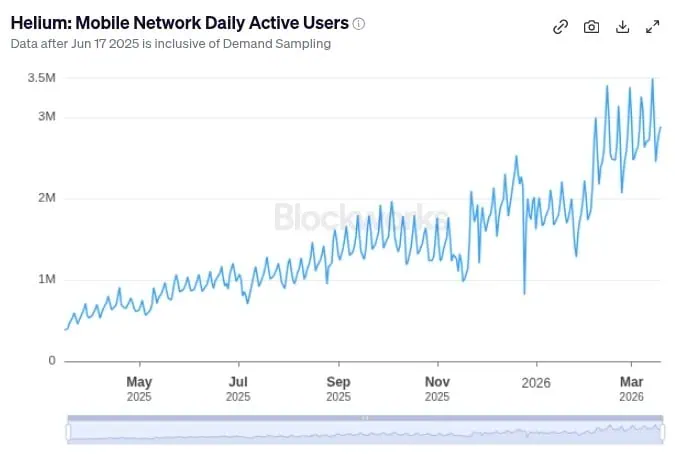
The Helium network is registering 3,5 million daily active users, redefining telecommunications in Solana.
The telecommunications sector is experiencing an unprecedented paradigm shift. Helium Mobile has achieved what many considered a theoretical experiment: consolidating a massive, decentralized, and highly efficient communications network.
By reaching the milestone of 3,5 million daily active users and an explosive 1800% growth in data traffic, the project not only marks a historic record (ATH), but also validates the viability of decentralized physical infrastructure networks (DePIN) as the future of global connectivity over the Solana network.
Join the DePIN revolution: buy HNTThe meteoric rise of a network built by the people
Helium Mobile has consolidated its position as a leader in the DePIN ecosystem by registering 3,5 million daily active usersThis figure is not just a number; it is an "All-Time High" (ATH) that symbolizes the maturity of a technology that has gone from being a niche promise to a tool for mass use.
What is truly surprising is the speed of this adoption. In just four months, the platform has managed to triple its user base, starting from one million users in November 2025. This parabolic growth indicates that Helium's value proposition—cheaper, more transparent and participatory connectivity— is resonating strongly in a market traditionally dominated by corporate giants.
Source: Blockworks
Unlike traditional mobile operators, which rely on a centralized and bureaucratic architecture, Helium has demonstrated that decentralization can scale more organically and rapidly. The ability to expand without requiring a single entity to manage each cell tower is what has allowed the project to become a viable alternative, challenging the status quo of global telecommunications.
Opera Helium on Bit2Me: access nowThe technical engine: Solana and the 1800% explosion in data traffic
One of the key pillars behind this success is the underlying infrastructure. Helium's strategic migration to the Solana network in 2023 was the necessary technical catalyst to support this volume of transactions. Solana, known for its high processing speed and extremely low transaction costs, has enabled seamless reward distribution and network management for millions of simultaneous participants.
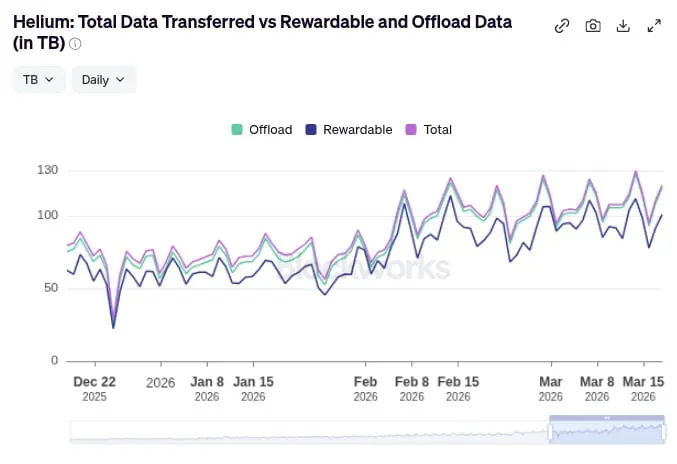
The technical data is compelling. According to reports from the firm Blockworks, the network currently manages a volume of information that reaches... 130 terabytes per dayIf we go back just one year, to March 6, 2025, the network was processing a mere 7 terabytes. This massive 1800% increase in data traffic In just twelve months, it is irrefutable proof that users not only register, but also consume the network intensively for their daily needs.
Source: Blockworks
This data flow not only originates from activity between home devices (hotspots), but is also integrated with data downloads from partner carriers. This hybridization demonstrates that Helium's technology is capable of absorbing real mobile traffic demand, becoming a complement—and in many cases, a replacement—for traditional networks.
The platform's data shows that the operational efficiency gained after the move to Solana has eliminated bottlenecks, allowing the network to grow at the pace of user demand.
Join Helium: Buy HNT on Bit2Me todayHelium: connectivity becomes community-based
The heart of Helium lies in the concept of "Decentralized Physical Infrastructure," or DePIN. In this model, network ownership is returned to the citizens. Through hotspots—low-power devices that broadcast a wireless signal—any individual can become a network node. By doing so, they not only provide coverage to their community but also receive rewards in digital assets for their contribution.
This social and economic impact has been felt particularly strongly in major European cities like Madrid and Barcelona. Previous reports have detailed cases of users generating up to €400 per month simply by keeping their equipment active in high-demand areas. This ability to monetize a basic service like connectivity transforms the passive consumer into an active manager of the infrastructure.
The ease of installation of these antennas and the low cost of data plans for those who connect to them have created a virtuous cycle of growth. The success of reaching 3,5 million daily internet users confirms that the world is ready for a new communications standard: one where control does not reside in a single central entity, but rather in a global network of independent contributors coordinated by blockchain code and transparency.
Helium reaches record high: buy the token on Bit2Me