
The Philippines' monetary authority, the country's central bank, has no plans to ban cryptocurrencies.
Felipe Medalla, an economist and current governor of the Bangko Sentral ng Pilipinas, the country's monetary authority, clarified that the Philippines has no plans to ban the use of cryptocurrencies and digital assets within its territory.
Medalla shared these statements during an interview with journalist Jenny Ortiz of Forkast's, in which she revealed her views on the crypto industry.
Among other things, although he has made it clear that he is not a fan of Bitcoin or cryptocurrencies, Medalla acknowledged that these digital assets can be very useful as an alternative to governments, especially in financially and economically restrictive economies.
It should be remembered that cryptocurrencies, Due to its open and decentralized nature, allow users to send and receive value without intermediaries and without censorship.
Medalla also spoke about the cryptocurrency market, indicating that due to its level of volatility it would be better to simply call them “cryptoassets.”
He also reminded investors that they should never invest more than they are willing to lose – a fundamental principle of investing, which is the golden rule within any market.
It may interest you: Andorra moves forward with its cryptocurrency law
The Philippines' view on cryptocurrencies
The governor of the Central Bank of the Philippines commented that cryptocurrency exchange platforms must be regulated and comply with current legislation on the prevention of money laundering and other financial crimes.
This is the country's "official" political viewpoint regarding crypto assets, he said.
“Our political view is that they should not be used to evade money laundering.”
According to Finder’s Cryptocurrency Adoption Rates report, Asian economies are leading the way in crypto adoption.
This report identified the Philippines as the country with the fifth largest cryptocurrency adoption rate globally28% of the Philippine population claims to be cryptocurrency users, with the most popular being Bitcoin, followed by Bitcoin Cash, Ripple, Litecoin and Ethereum.
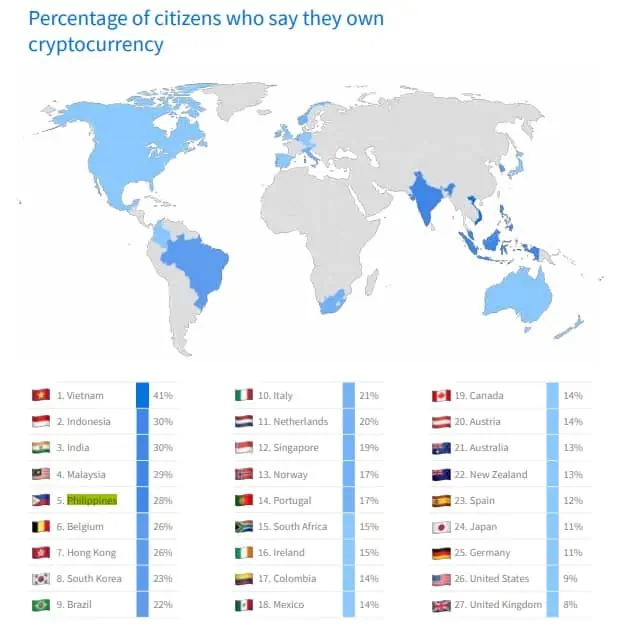
Source: Finder
Philippines is working on developing a CBDC
Regarding the development of a central bank digital currency (CBDC), Medalla commented that The bank has a preference for developing a wholesale digital currency, which is used by the country's banking and financial institutions to make interbank payments, settlements, among others, instead of a retail digital currency for citizens.
He also pointed out that The central entity will launch a CBDC pilot which will allow the country to explore the potential of new technologies to implement improvements in payments and optimize its current financial system.
Cryptocurrencies in Asia
Elsewhere in Asia, monetary authorities in Singapore and India have recently weighed in on cryptocurrencies.
Singapore's central bank has said it will strengthen its regulatory framework to mitigate the risks of cryptocurrencies being used for illicit activities.
Meanwhile, in India, the country's central bank declared in February of this year that its negative position towards cryptocurrencies had not changed. Although by that date, the Central Bank had lifted its ban on cryptocurrencies, it accompanied its declaration with an onerous tax plan to discourage the use of crypto assets in the country.
Continue reading: BCG predicts that cryptocurrencies will reach 1.000 billion users by 2030