

While Ethereum has reduced its energy consumption since the implementation of the Proof of Stake consensus protocol, the network now faces a new challenge: centralization.
Ethereum developers have introduced a new improvement proposal for the blockchain network, called EIP-7514 “Add Max Epoch Churn Limit”, this proposal seeks to slow down the maximum growth rate of ether staked in staking pools.
Ethereum researcher Luke Nolan explained that EIP-7514 allows for a reduction in the number of new validators that can join the network per epoch in order to significantly slow the growth of active validators.
Although this is a short-term solution, EIP-7514 will help Ethereum address the growing challenge of centralization.
Currently, Ethereum staking is dominated by over 30% of the Lido platform, which poses a risk to the network's principle of decentralization. As Nolan commented in his article“It does not bode well for a decentralized blockchain to have such a large concentration of validators under a single provider, as ideally, block production should occur in a decentralized manner.”
Lido is one of the most popular staking platforms in the crypto industry, primarily because it allows users to stake Ethereum without the cost of having to set aside 32 ETH (approximately $53.560) to operate their own validator within the network.
Stability, another concern generated by the growth of validator nodes
In addition to centralization, the growth of Ethereum validator size also poses a problem for the stability of this blockchain.
In the middle of this month, Galaxy Digital's vice president of research, Christine Kim, manifested that Ethereum was getting close to reaching an unsustainable number of active validators. This raises two main potential risks: first, an overload on the network that can lead to node errors and cause interruptions on the chain and, second, technical debt that could make it difficult to complete certain operations.
Kim commented that if the pool of Ethereum node validators continues to grow, nodes will be forced to use more sophisticated hardware to support higher bandwidth and internet speeds, which is “a centralizing force that would reduce the number of independent node operators over time.”
Also, during the experiments carried out on the Holesky test network, which was Relaunched last Thursday, September 28, Ethereum developers ran tests with 2,1 million active validators, which is almost 3 times the current number of active validators on the mainnet, encountering issues with finalization.
Ethereum Foundation development engineer Parithosh Jayanthi said that validators in Holesky's tests had too many validation duties, which led to not enough attestations or messages being propagated across the network. In contrast, tests conducted with a smaller number of validators, 1,4 million, were successful, the foundation engineer said.
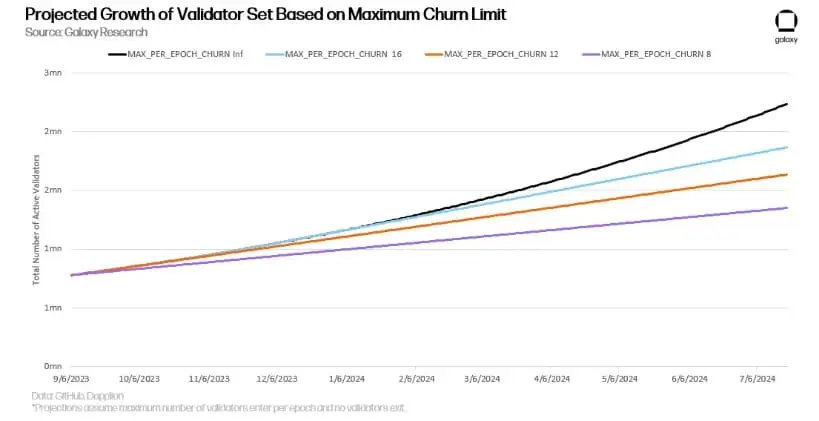
EIP-7514 emerged as a possible solution to the growth and centralization challenges facing the network due to the success of staking.
This improvement proposal seeks to set the maximum number of validator inputs and outputs per epoch to a certain number, in order to limit the growth size of the network's validator pool. Kim commented that this improvement proposal does not in itself address concerns related to the growth of the validator pool size, but it does provide a temporary solution to slow down or decelerate this growth while developers develop and evaluate more robust proposals for this.
EIP-7514 was introduced by Ethereum core developer Tim Beiko and pseudo-anonymous developer “Dapplion,” who is part of the Lodestar client team.
In addition to this proposal, the Ethereum development team is also evaluating other proposals that also seek to solve the challenge of Ethereum validator size growth, such as the one presented by researcher Mike Neuder, from the Ethereum Foundation, who points out that increasing the maximum effective balance of the validator, from 32 ETH to 2.048 ETH, could incentivize solo staking, moving ETH holders away from centralized service providers.
Like the EIP presented by Beiko and Dapplion, Neuder's proposal is also a short-term and temporary solution to the problem outlined in this article.
Continue reading: Asia is increasingly participating in the development of Ethereum, noted Vitalik Buterin