

Ethereum 2.0 has accumulated almost 6 million ETH tokens, valued at more than $12.000 billion; a bet by investors that exceeded the initial expectations of developers.
In just 7 months, the network of staking de Ethereum 2.0 has accumulated more than $12.280 billion in value, coming from the nearly 6 million tokens that network investors have deposited so far.
At the time of this edition, the network has accumulated a total of 5.969.512 ETH y 181.209 validatorsIt is worth remembering that to become a validator within the Ethereum 2.0 network you need to make a deposit of at least 32 ETH, about $65.500 according to the current value of the cryptocurrency, which is $2.047 per unit.
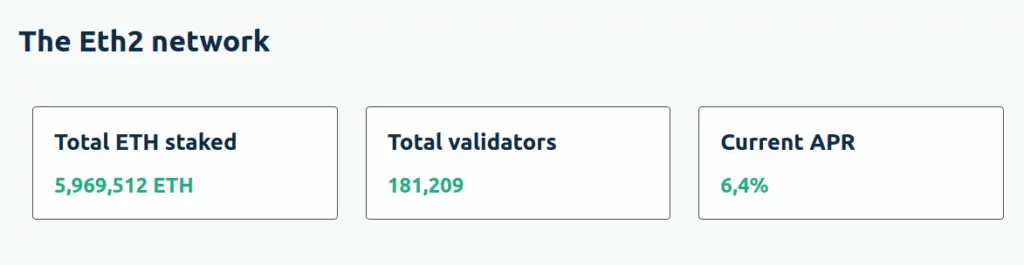
Source: Ethereum Launchpad
Ethereum 2.0, the new network that Ethereum developers are building Ethereum To address scalability issues and gas costs, it has attracted the attention of thousands of investors around the world, who continue to deposit value, as if it were a common savings account.
The first phase of the network, called Beacon Chain, was successfully launched in December last year, taking the first step towards the rebirth of Ethereum as a blockchain much more powerful, scalable and energy efficient.
It may interest you: It's official! Ethereum 2.0 began with the generation of the Genesis block on the Beacon Chain
Ethereum, a victim of its own success
Ethereum 2.0 is one of the most anticipated updates by the Ethereum crypto community and the industry in general, as it will help the blockchain overcome several of the fundamental problems it faces today, many of which arose as a result of its successful trajectory.
The current demand for Ethereum, which has become the leading network par excellence for building and running decentralized applications (Dapps) and smart contracts (smart contracts), and which is also positioned as the second cryptocurrency The largest cryptocurrency in the industry by market capitalization, has struggled with scalability and performance, which in turn has raised transaction costs to levels that were previously unimaginable.
Ethereum's scaling and gas issues have unintentionally helped other projects position themselves as better, more viable options for users, especially investors with small wallets who simply can't afford the high fees the network demands to confirm transactions. To address these issues and remain an industry leader, developers have been working on building Ethereum 2.0, an upgrade based on the Ethereum consensus protocol. Proof of Stake which allows the blockchain to be made faster and more efficient.
Proof of Stake eliminates the need for miners and replaces them with validators, who instead of solving complex mathematical problems to produce and confirm a block, use their cryptocurrency, as deposits and collateral for their work, to validate transactions and claim the rewards of each of the blocks generated on the network.
11 times more validators than expected
For the first phase of Ethereum 2.0 to go live, the developers explained that there needed to be a minimum of 16.384 validators on the network. The current number of active validators on Ethereum 2.0 is 11 times higher than the initial number stated by the developers.
Likewise, the amount of ether cryptocurrencies staked on the network is much higher than the amount initially needed. staking This is the process by which validators deposit value within PoS-based blockchain networks. This technique allows validators to lock their cryptocurrencies to ensure the security and protection of the network while earning interest on their deposits. Therefore, this mechanism is often similar to the way traditional savings accounts work; although, of course, with better benefits and qualities.
Although Ethereum 2.0 began with the activation of the Beacon Chain, the network is still far from complete. Ethereum 2.0 is being built in 3 phases; Phase 1 and Phase 2 are expected to be active perhaps in 2022 or much later. The developers have faced several issues that have delayed their work.
Continue reading: Ethereum 2.0 Improvement Plans Boost Network Adoption