
Recently, Bitcoin mining difficulty hit a new all-time high as top miners on the blockchain network navigate the challenges and opportunities of the crypto market.
The volatility of the cryptocurrency market has raised concerns among Bitcoin miners, especially about the profitability of their operations. However, despite the current context, Bitcoin mining difficulty, which determines how difficult it will be to extract the next block on the network, registered a new all-time high, driven by the hash rate or computational power of the blockchain.
Despite volatility and bearish sentiment among cryptocurrency investors, Bitcoin miners are rolling out new operational capacity, upgrading their mining equipment and expanding their operations, as is the case with CleanSpark, which has taken a bold step by acquiring seven mining facilities in the state of Tennessee (United States), for an investment of $27,5 million.
According to experts, this highlights the resilience of Bitcoin miners, particularly in the United States, in the face of the challenges of the crypto market.
Bitcoin network difficulty hits new all-time high
Bitcoin mining difficulty, which adjusts roughly every two weeks, has hit a new record, marking a significant increase in the level of competition among miners on the blockchain network.
According to data from Coinwarz, the difficulty of Bitcoin mining increased to 92,67 trillion (T), marking an increase of 3,6% compared to the last increase.
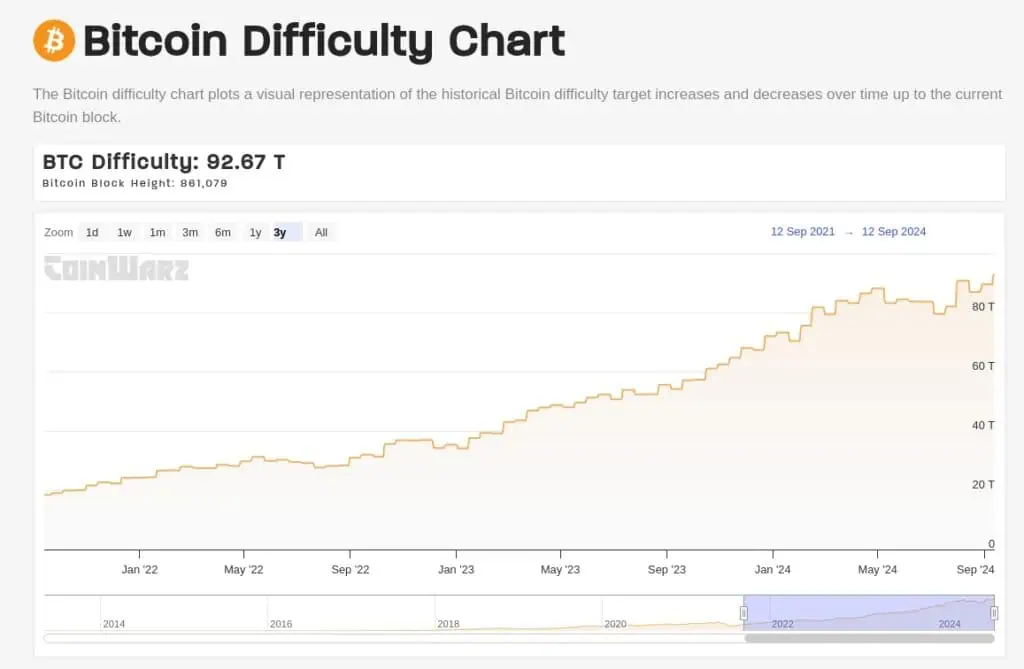
Source: Coinwarz
This adjustment in Bitcoin mining difficulty, which is based on the amount of computing power used to process transactions on the network, has reached levels not seen before. An increase in this measure means that more computing power is required to solve the mathematical problems needed to validate transactions and, therefore, to mine new blocks in Bitcoin.
On the other hand, the recent all-time high in the Bitcoin network's mining difficulty reflects the sustained growth of its hash rate, which has been driven by the incorporation of new technologies and more efficient mining equipment. However, despite the importance of this milestone, the increase in mining difficulty also brings with it challenges for many miners on the network, who must invest in more powerful and expensive hardware to remain competitive in this sector. As the pressure on profit margins intensifies, miners are forced to optimize their operations and look for more profitable and economical sources of energy.
Miners' income has been declining since April
Despite the increase in mining difficulty, miners' revenue has seen a noticeable drop since April. This decrease is due to several factors, including the arrival of the fourth halving and, with it, the reduction in the reward per block mined on the blockchain network.
But in addition to the halving, the price of Bitcoin has shown considerable volatility, which has directly impacted miners' income.
With the price fluctuating between $44.000 and $73.000 so far this year, miners' profit margins have come under pressure, and many have had to re-evaluate their operating strategies. In fact, the combination of increased mining difficulty and lower revenue has led some miners to shut down their operations or seek more profitable alternatives.
CleanSpark to open new facilities in the United States
Amidst these challenges, CleanSpark has decided to expand its mining operations in the United States by acquiring seven facilities in Knoxville, Tennessee. This move, which represents an investment of $27,5 million, is a testament to CleanSpark’s confidence in the future of Bitcoin mining in the country.
The company has been looking for ways to increase its production capacity and improve its operational efficiency, and its recent acquisition is a significant step in that direction.
La CleanSpark Expansion in Tennessee will provide the cryptocurrency mining company with an additional 5 exahashes per second (EH/s) of hash power on the Bitcoin network. CleanSpark plans to install state-of-the-art S21 Pro miners, to reach its goal of operating 37 EH/s of Bitcoin power before the end of this year.
This expansion also reflects a shift in the dynamics of Bitcoin mining in the United States. As more companies look to establish themselves in the country, competition is intensifying, but so are opportunities for those who can adapt to changing market conditions. CleanSpark has stood out for its focus on sustainability and the use of renewable energy, allowing it to reduce costs and improve its profitability in the sector.