

Cryptocurrency and DeFi activity in Europe has made the continent the largest cryptocurrency economy, blockchain analytics firm Chainalysis reported.
In his most recent reportChainalysis detailed that Europe has become the largest cryptocurrency economy worldwide, thanks to the volume of activity recorded within the ecosystem of decentralized finance (DeFi)According to the report, Central Europe, Northern Europe and Western Europe (CNWE) has the largest cryptocurrency economy in the world, receiving over $1 trillion in crypto-asset transactions over the past year. This figure represents 25% of the global cryptocurrency activity recorded during this period.
Since July 2020, the growth in cryptocurrency activity recorded in Europe has been quite significant. Last year, this region had ranked second. Chainalysis attributed the decline in cryptocurrency activity in East Asia to the huge interest and growth of the industry in Europe.
It may interest you: Cryptocurrencies, the driving force of emerging economies in Latin America and the world
DeFi and institutional investors
Although retail and professional activity in cryptocurrencies in Europe has remained stable compared to last year's figures, the factors responsible for positioning Europe as the main economy in the crypto industry are the large cryptocurrency transactions and a high trading volume within the DeFi ecosystems.
Chainalysis details that the transaction volume recorded in the CNWE region grew significantly in practically all cryptocurrencies and all types of services with these digital assets and, especially, in DeFi protocols.
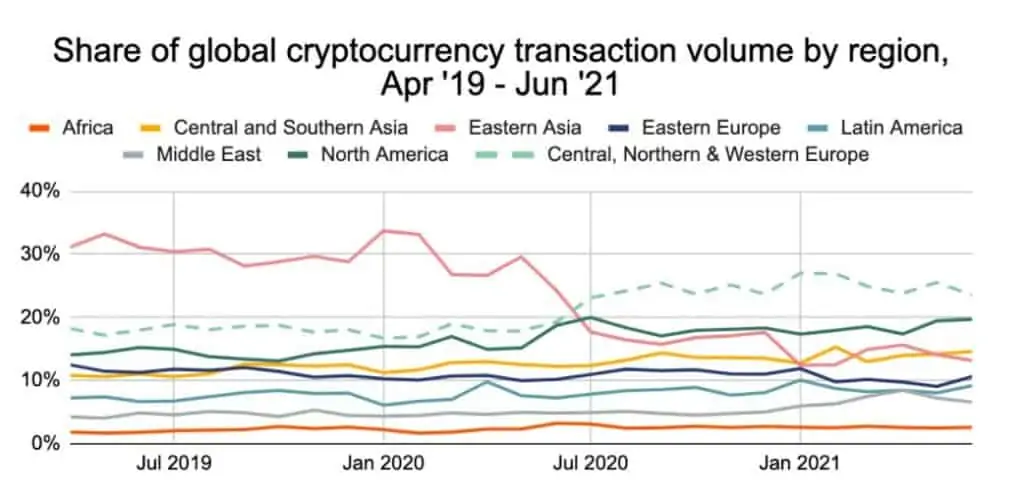
Source: Chainalysis
The intelligence firm blockchain He highlighted that Europe has become the world’s leading cryptocurrency trading partner, with the region sending and receiving at least ¼ of all value received by other regions in the cryptocurrency industry. Chainalysis data shows that Europe hosts a large volume of institutional transactions, with amounts exceeding $10 million per transaction.
Since last year, the total volume of institutional cryptocurrency transactions in Europe has grown by more than 3.000%. By July 2020, this volume reached $1.400 billion, while by June this year it had already exceeded $46.300 billion in the region.
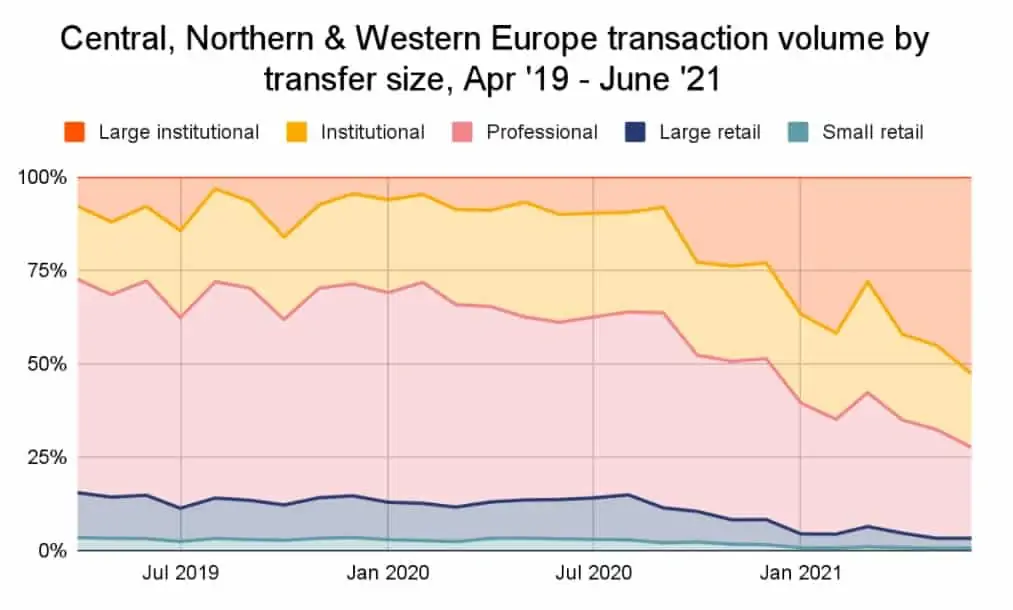
Source: Chainalysis
DeFi
The total volume of institutional cryptocurrency transactions for June this year, accounting for more than half of all recorded crypto asset activity in Europe, went to decentralized finance platforms, Chainalysis said.
The blockchain intelligence firm highlights that much of this transaction volume occurred within the Ethereum blockchain. In fact, the data from The Block Research show that activity within this blockchain for June of this year was 1.000% higher than that recorded in July 2020. Much of Europe's DeFi transactions are occurring through the decentralized exchange (DEX) Uniswap.
United Kingdom
Another interesting fact in the Chainalysis report is that the United Kingdom is the nation with the highest volume of cryptocurrencies received in DeFi protocols, with 49% of the total transactions with crypto assets in the region this year. According to the figures, the United Kingdom has operated 170.000 billion dollars in DeFi. Other countries with a significant volume within the decentralized financial ecosystem are France, Germany, the Netherlands and Switzerland, which lead the first 5 places in this ranking.
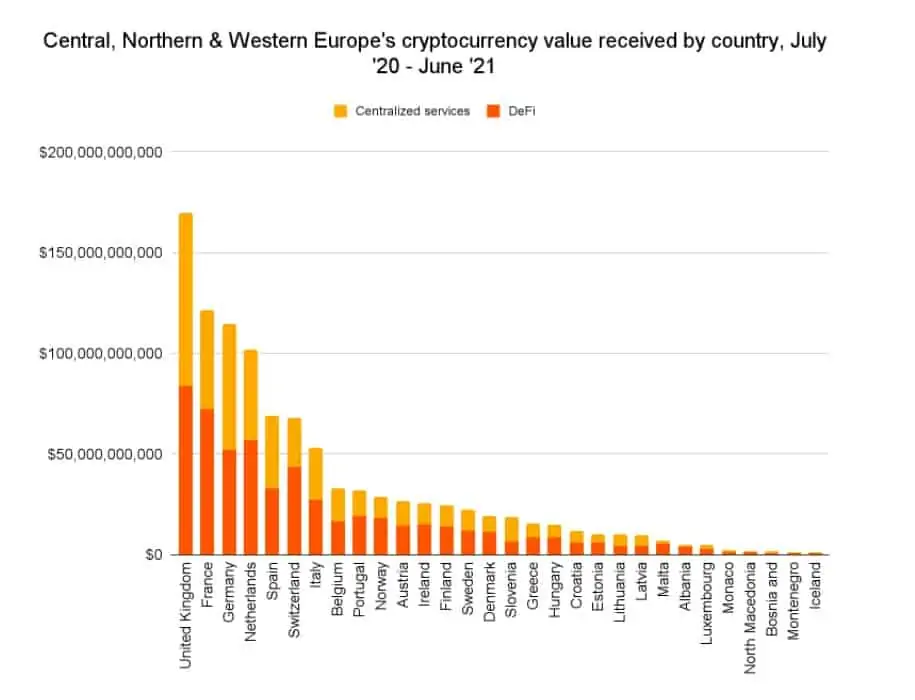
Source: Chainalysis
The chart above shows that cryptocurrency trading activity on centralized exchanges and in DeFi is almost uniform across all European countries except Albania, where DeFi trading accounts for a small percentage of its total volume.
Finally, the firm concludes that ETH and wETH are the most used cryptocurrencies in European countries, followed by Bitcoin, the market-leading cryptocurrency and some altcoins y stablecoins.
Continue reading: Bitcoin and cryptocurrencies are now legal for payments and remittances in Cuba