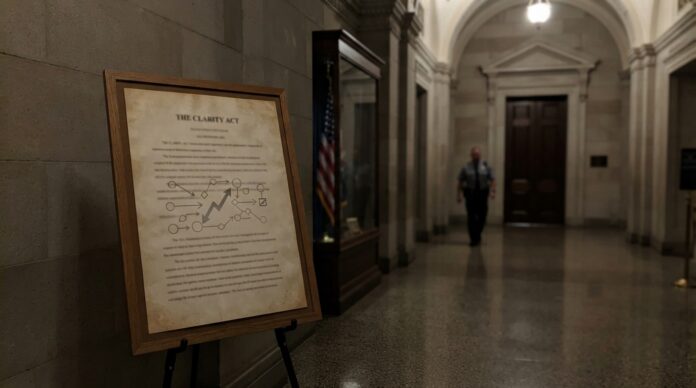
Donald Trump urged the US Congress to pass a balanced version of the Clarity Act during a recent summit on digital asset policy at the White House. The main objective is to establish a clear regulatory framework that allows various platforms to operate under regulatory oversight.
The push for the Clarity Act in the White House
During a high-level meeting focused on the future of digital assets, the US administration He urged Congress to pass a fair version of the Clarity ActThis legislative proposal seeks to resolve one of the biggest challenges of the crypto ecosystem in North America: the lack of clear boundaries between the jurisdictions of the various regulatory agencies.
The debate over whether certain crypto assets should be treated as securities or commodities has been a source of friction for years. The passage of regulations of this magnitude would provide the necessary framework for developers and companies to operate with known and managed risk, avoiding the coercive actions that have characterized recent US policy.
The Hyperliquid case and regulatory adaptation
One of the highlights of the meeting was the explicit mention of emerging platforms. It was noted that regulators are actively working to integrate Hyperliquid into a US legal framework that complies with all current regulations. This move is significant, as it demonstrates a willingness to adapt laws to new technological realities rather than prohibit them.
Hyperliquid, a well-known technology in the decentralized finance (DeFi) community, represents the kind of innovation the United States doesn't want to lose to other jurisdictions. By creating a regulatory environment, it facilitates transparent interaction between users and these protocols. To stay up-to-date on how these protocols are evolving, you can check regularly. our news portal.
The size of the market: 45 million in the spotlight
Political decisions are not made in a vacuum. During discussions on the adoption and economic impact of these measures, a revealing figure was brought to the table: the existence of a base of 45 million (45M) participants and units of value that require protection and clarity. This number underscores the urgency of establishing guidelines that do not stifle technological innovation.
When a market reaches 45 million (45M) adoption rates, regulatory inaction ceases to be a viable option. Policymakers understand that providing an audited environment is fundamental to maintaining the country's global competitiveness and ensuring that Web3 development takes place under appropriate security standards.
The regulatory contrast: United States versus Europe
While the United States debates the details of the Clarity Act, the situation in Europe is very different thanks to the MiCA Regulation. This regulatory framework has already established clear rules for the issuance and provision of crypto-asset services, making the European Union a global leader in regulation.
Operating under the MiCA umbrella means that platforms must comply with strict transparency and audit requirements. If you want to learn more about how this regulation protects European users and shapes the future of the industry, you can explore the educational resources available at Bit2Me Academy.
The future of institutional adoption
The potential passage of the Clarity Act would open the door to greater institutional participation in the US market. Large corporations and asset management funds require legal certainty before building their digital asset portfolios at scale. By clearly defining the rules, friction is reduced and a more mature ecosystem is fostered.
These types of regulatory moves often have a domino effect. If the world's leading economy manages to establish a fair and balanced framework, other nations still in gray areas are likely to accelerate their own legislative processes, benefiting the crypto industry as a whole.
FAQ
What is the Clarity Act?
It is a proposed law in the United States designed to provide a clear regulatory framework for crypto assets. Its main objective is to define the responsibilities of different government agencies and establish transparent rules for companies in the sector.
Why was Hyperliquid mentioned at the White House?
It was cited as an example of the technology platforms that US regulators are trying to integrate under a compliant legal framework. This demonstrates the government's interest in regulating, rather than restricting, decentralized financial innovations.
What is the difference with the regulation in Europe?
Europe already has the MiCA Regulation, a comprehensive legal framework that regulates cryptocurrency markets in a unified manner across all member states. This provides an audited and transparent environment, ahead of the debates currently taking place in the United States.
The evolution of public policies surrounding crypto assets reflects the maturity of an industry that has moved from a niche market to a global financial pillar. The pursuit of consensus in the White House and the push for regulations like the Clarity Act are fundamental steps toward the normalization of the sector.
As legal frameworks are defined and adapted to new technological realities, the global ecosystem is strengthened. Regulatory clarity not only protects participants but also lays the foundation for the next wave of innovation in the digital asset sector.
Investing in cryptoassets is not fully regulated, may not be suitable for retail investors due to high volatility and there is a risk of losing all invested amounts.
Generative artificial intelligence tools were used to create this article.