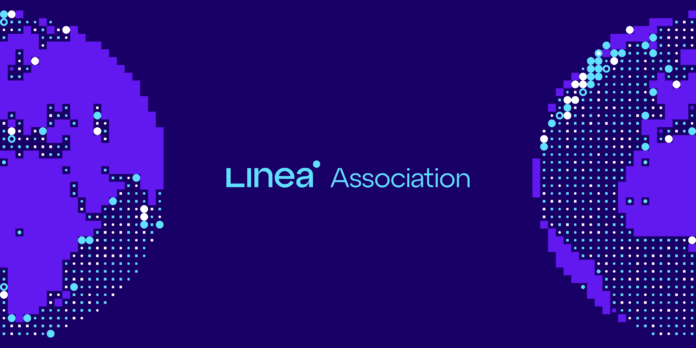
ConsenSys, the prominent blockchain software company, advances towards the decentralization of its Layer 2 technology with the introduction of the Linea Association.
The Linea Association is a non-profit organization based in Switzerland that will oversee the development and governance of Linea, a Layer 2 rollup of the Ethereum Virtual Machine (zkEVM) based on zero-knowledge (ZK) proofs. The association's core goals are to support Linea technology, foster its market, and advance the roadmap towards full decentralization.
Furthermore, The association is expected to play a crucial role in the governance of the network, community-led with the Introduction of a new governance token scheduled to be launched in Q2025 XNUMX.
Decentralization is seen as core to Linea’s vision, with the goal of it being openly owned and governed by all, aligning with Ethereum’s principles as a public good.
Linea takes a new approach to decentralization
The Linea Association was presented recently with the aim of fostering a decentralized environment where developers can build decentralized applications (dApps) efficiently and securely.
ConsenSys, known for its commitment to the development of blockchain technologies, has taken the initiative to create this organization to ensure that Linea evolves under principles of decentralized governance, a topic that has become crucial in discussions about the future of blockchain networks.
Development of our own token
One of the most notable plans of the Linea Association is the development of a token called LINEA, which is expected to be available by 2025. This token will not only serve as a means of exchange within the ecosystem, but will also support a treasury aimed at promoting the growth and development of open source software. With this, the network will not only secure financial resources for its development, but will also foster an active community committed to technological advancement.
The LINEA token will be crucial for the governance of the Linea network, allowing holdings to participate in decision-making and the evolution of the network.
The distribution of the LINEA token will be done through token generation events (TGE), ensuring that contributors to the ecosystem receive a fair share of the token. This approach will promote decentralization and ensure that the Linea network becomes increasingly sustainable and resilient.
Decentralization in blockchain and Web3
Decentralization is a fundamental principle in the blockchain and Web3 ecosystem, as it seeks to eliminate intermediaries and empower usersIn this context, ConsenSys has emphasized the need to prioritize and ensure decentralization to prevent a few from controlling access to and use of emerging technologies.
The creation of the Linea Association is a step towards this goal, as it promotes a structure where decisions are made collectively by participants rather than by a centralized entity.
The importance of the decentralized approach in blockchain and Web3 lies in several factors such as security, which is reinforced by distributing information across multiple nodes, making cyber attacks difficult and reducing the possibility of manipulation.
Another factor to consider is transparency, since all transactions are recorded in the blockchain as a public ledger that can be verified by any user.
Furthermore, decentralization fosters financial inclusion by allowing individuals from anywhere in the world with internet access to participate in the digital economy without the need for intermediaries. These factors contribute to the creation of a more democratic digital environment, where blockchain technology can be a driver of equity and economic innovation.
What is Linea and what is its relevance in Ethereum?
Linea is a Layer 2 solution based on technology zk-rollups, designed to improve scalability and efficiency on the Ethereum network. Linea provides an efficient solution to scalability and transaction cost challenges.
The implementation of zk-Rollups is a major step towards reducing Ethereum fees, allowing for cheaper and more accessible transactions for a larger number of users.
Furthermore, The scalability offered by Linea is crucial for the development of more sophisticated decentralized applications (dApps), which can operate without the restrictions of the Ethereum mainnet. This not only improves the end-user experience, but also promotes innovation and diversification of services on the blockchain.
A flexible solution to customize and optimize dApps
On the other hand, Linea’s flexibility with its modular design is essential, as it allows developers to customize and optimize their dApps to meet specific needs, contributing to a more robust and adaptable ecosystem.
In short, Linea has become a key component for the continued growth and evolution of Ethereum, thanks to its ease of processing transactions off the main chain, allowing for significantly reduced gas fees and improved response times. These features are of utmost importance for the smooth operation of dApps, thus facilitating a more conducive environment for these applications to flourish.