
Although the CLARITY Act is still under debate, its mere introduction is causing the Ethereum network to undergo a transformation in 2026. While the price remains range-bound, transaction volume is reaching all-time highs, driven by this law and the resurgence of the DeFi ecosystem.
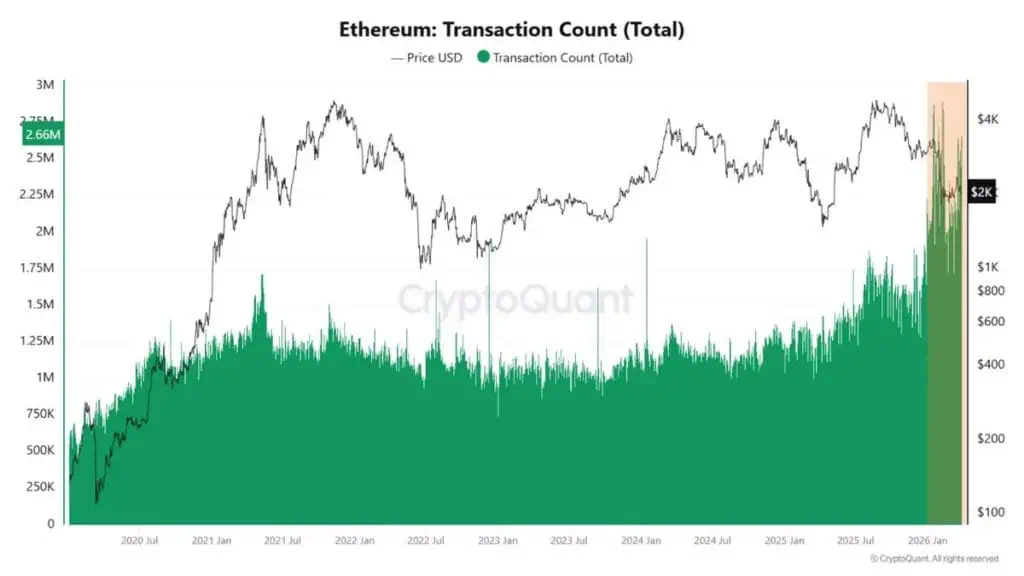
According to the latest data from CryptoQuant analysts, the Ethereum network is showing signs of a structural shift. Unlike previous cycles, where ETH price action typically preceded utility, current data reveals a paradox: the cryptocurrency's price remains consolidated within a sideways range, while network activity—measured by the "Ethereum: Transaction Count (Total)"—has climbed sharply to 2,66 million daily transactions.
Analysts suggest that the current traction of blockchain is not due to short-term speculative euphoria, but to real and sustained use of its infrastructure. Therefore, we are facing a scenario where on-chain activity is dictating the pace of growth, establishing the foundations for a long-term structural upward trend.
Trade Ethereum (ETH) on Bit2MeThe use of smart contracts outperforms market speculation
According to analysts, the main driver behind the surge in transaction counts in the Ethereum ecosystem is the renewed vigor of the Decentralized Finance (DeFi) sector. After a period of uncertainty between 2024 and 2025, marked by capital outflows and diminishing returns, liquidity is returning to decentralized protocols based on the Ethereum network with a more robust composition. Analysts note that this flow is not merely transitory; it represents a reintegration of capital into fundamental services.
Data such as the provision of stablecoin-based liquidity, decentralized lending markets, and volume on decentralized exchanges (DEXs) are shown as pillars of this growth.
The platform's report suggests that Ethereum network usage has shifted toward executing smart contracts that facilitate trading and asset management, demonstrating that users are interacting with this infrastructure as a global financial settlement layer. In short, this increase in the protocol's actual usage is validating the resilience of blockchain technology, allowing it to operate independently of market fluctuations.
Source: cryptoquant
The CLARITY Act: A safe harbor for DeFi innovation on Ethereum
One of the most decisive catalysts for structural change in the use of the Ethereum ecosystem is the new legal landscape being built in the United States. The CLARITY Act has emerged not only as a set of rules, but as a first serious framework for to integrate DeFi into the global financial system.
Historically, one of the biggest obstacles to innovation in Ethereum was the risk of legal liability for developers. The uncertainty surrounding whether simply writing and publishing open-source code could turn a programmer into a regulated financial institution had a chilling effect on the industry.
However, the current draft of the CLARITY Act—still under debate—introduces a fundamental concept for the ecosystem, according to CryptoQuant analysts: the safe harbor or safe harbour for non-custodial developers.
This legal text clarifies that publishing code is not equivalent to operating a financial entity, which is leading the market to shift from the premise that "building is risky" to that of "building within a defined framework." According to analysts, this legal distinction has become a inflection point which is allowing developers to focus on the scalability and efficiency of smart contracts, reducing systemic risk and fostering a more robust and professional development ecosystem.
Visit Bit2Me: buy ETH todayFrom price speculation to structural network demand
CryptoQuant's analysis also highlights a historical divergence in Ethereum's behavior. In the past, rising prices were the incentive that drew users to the network. Now, in 2026, the dynamic has reversed: on-chain activity is what's sustaining the value and generating real demand for block space.
Thus, although the price of Ethereum remains within a range, trading between $1.900 and $2.100 in the last month, the growth in transactions indicates a steady uptake of the network's services.
Analysts also said that technical challenges and debates about the scope of Know Your Customer (KYC) regulations and restrictions on stablecoin yields persist, but that the global debate on crypto regulation has undeniably evolved. The current discussion is no longer about whether the technology should be allowed or banned, but rather how it should be effectively integrated.
In summary, the data indicate that this regulatory clarity is releasing institutional capital flows that were previously held back due to legal risk, and that the Ethereum network is in a phase of sustainable growth, where blockchain infrastructure aligns with real economic utility, marking the beginning of a new era for programmable finance.
Create your account and access Ethereum