Natural disasters caused economic losses of $220.000 billion worldwide last year, of which traditional insurance only covered $107.000 billion, leaving a significant gap in financial protection for families, businesses, and public administrations.
To address this structural deficit, the tokenization of specialized financial instruments is emerging as a technical alternative for channeling capital toward extreme risk hedging through distributed ledgers. This technological approach aims to facilitate liquidity and make subscription models more flexible in areas severely vulnerable to climate-related emergencies.
The global insurance gap and the pressure of disasters
The gap between total economic losses caused by extreme weather events and the sums paid out by the traditional insurance sector continues to widen year after year. The record of $220.000 billion in global damages compared to the $107.000 billion covered by conventional policies demonstrates that more than half of the economic impact falls directly on affected communities and state coffers.
This divergence takes on particularly critical dimensions in vulnerable geographic regions such as Asia-Pacific. According to technical estimates from the Organisation for Economic Co-operation and Development (OECD), 91% of losses caused by catastrophes in 2023 lacked insurance coverage in this region. The lack of reliable claims records and the complexity of modeling unprecedented events mean that conventional insurers struggle to adequately price risks such as typhoons, massive floods, or earthquakes.
The catastrophe bond market and its technical operation
Faced with the capacity limitations of direct insurance, the catastrophe bond sector or cat bonds It has experienced remarkable activity. These assets transfer the financial risk of specific extreme events from insurers or government entities directly to the capital markets. Those who participate in these instruments assume the possibility of losing their principal in the event of a predetermined loss, in exchange for receiving periodic coupons as compensation for the risk assumed.
The global market reached $65.600 billion in outstanding bonds last June. Furthermore, new issuances totaled $11.300 billion during the second quarter, marking the highest quarterly volume ever recorded, according to Artemis reports. Despite these figures, the standard operating structure keeps the market almost exclusively reserved for specialized funds and institutional investors, typically with minimum investment amounts of $250.000.
In traditional schemes, issuing these instruments requires the creation of a special purpose vehicle (SPV), independent actuarial audits, fiduciary custodians, and a cross-border legal infrastructure that increases structuring operating costs by 2% to 3% of the total issued. This limits their technical viability for smaller regional portfolios.
Blockchain-based issuances for hard-to-insure risks
Faced with these barriers, the international firm Harneys and the platform dropRWA have planned an initiative to structure and issue tokenized catastrophe bonds with legal ownership registered directly on the blockchain in early 2027 from Bermuda. The purpose is to create fractional equity units that facilitate the entry of new capital vehicles into specific risk portfolios through a transparent infrastructure.
Henry Tucker, head of Harneys in Bermuda, emphasized that tokenization is not about transforming disaster insurance into a speculative instrument or a financial casino, but rather about committing real capital to clearly defined technical contingencies. The decentralized infrastructure allows a technical underwriter to isolate a severe risk, such as typhoons in Southeast Asia, and establish a capital vehicle that can be audited in real time. This evolution coincides with the consolidation of the tokenized real-world assets (RWA), which represent tangible economic rights over immutable records.
By splitting these securities into smart contracts, medium-sized or niche institutional portfolios can provide liquidity from considerably smaller tickets, avoiding the bureaucratic rigidity of centralized clearing houses and reducing settlement times after the event.
Parametric automation and decentralized climate oracles
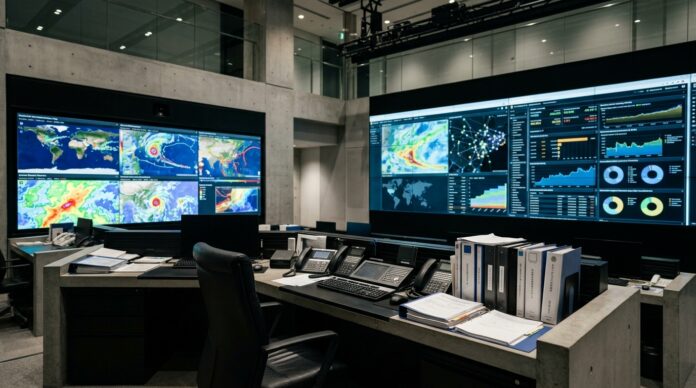
One of the distinguishing features of catastrophe bonds based on distributed ledger technology is the integration of parametric coverage through smart contracts. In conventional insurance, settling a claim requires an on-site expert assessment that can take weeks or months. In contrast, parametric structures rely on objective physical parameters: the sustained wind speed of a hurricane, the magnitude of an earthquake on the Richter scale, or the millimeters of accumulated rainfall in a given geographic area.
To connect this data from the physical world with the blockchain's internal logic, decentralized oracle networks like Chainlink are used. These data infrastructures collect certified information from government weather agencies, seismological stations, and Earth observation satellites. When an oracle verifies, by consensus, that the critical parameter has been exceeded, the smart contract automatically executes the transfer of the escrowed capital to the secured entity, without the need for intermediary administrative procedures.
This immediacy in disbursement is fundamental for public administrations and civil aid entities, since the availability of funds in the first hours after a disaster significantly reduces the secondary socio-economic impact in the affected areas.
Institutional integration and governance frameworks
The use of insurance-linked catastrophe bonds already has significant institutional precedents in the global financial system. For example, in May, the World Bank coordinated a $200 million hurricane hedge to protect Jamaica's public finances. The arrival of blockchain technology aims to optimize the administrative efficiency and secondary liquidity of these types of sovereign and multilateral issuances.
Within the European regulatory framework, developments related to tokenized financial instruments and smart contracts are analyzed through the lens of the MiCA Regulation and the guidelines for DLT-based market infrastructures. Vehicles representing negotiable securities or risk transfer instruments must guarantee due diligence, technical segregation of assets in custody, and transparency of execution conditions, avoiding the opacity that traditionally increases the cost of cross-border reinsurance agreements. decentralized financial markets.
The combination of a strict regulatory framework with auditable chain governance allows issuances to maintain compliance equivalent to that of traditional capital markets, mitigating operational risks and providing legal certainty to all parties involved.
FAQ
What is a tokenized catastrophe bond?
It is a debt instrument structured on a blockchain that transfers the financial risk of a specific natural disaster to the capital markets. If the defined catastrophe occurs under the established parameters, the funds held in custody are released to cover the issuer's losses; otherwise, participants receive their capital back along with the agreed-upon compensation.
How do smart contracts determine when a claim is paid?
This is achieved by using decentralized oracles that transmit official readings from meteorological or seismological agencies. If the verified objective data exceeds the threshold set in the smart contract (for example, a certain hurricane category), settlement is executed automatically.
Why does tokenization help close the disaster coverage gap?
It reduces the high administrative and structuring costs typical of traditional intermediation, allowing bonds to be split and creating hedging vehicles for local risks that were previously not viable for multinational insurers.
Does blockchain technology eliminate the regulatory requirements for these bonds?
No. Tokenized bond issuances must comply with the securities and insurance laws of the relevant jurisdictions, ensuring the legal validity of the contract and the proper identification of participants in accordance with current regulations.
The incorporation of reinsurance instruments into the blockchain infrastructure reflects the progressive maturity of real-world assets, guiding decentralized technology towards tangible solutions for the global economy.
As the insurance gap puts pressure on governments and communities in the face of climate change, tokenized capital models offer a technical, transparent, and programmable way to mobilize resources towards risks that the traditional financial system cannot fully cover.
Investing in cryptoassets is not fully regulated, may not be suitable for retail investors due to high volatility and there is a risk of losing all invested amounts.
Generative artificial intelligence tools were used to create this article.