

BitMine is injecting $259 million into staking, intensifying network congestion with a 22-day wait for new validators.
BitMine Immersion Technologies has moved beyond being a mere spectator with large ETH reserves to become one of the most influential players in Ethereum network security. The company, which holds the largest institutional ETH reserves of this cryptocurrency with over 4 million ETH, has aggressively accelerated its asset management strategy at the start of 2026.
Far from keeping its capital static, BitMine is mobilizing hundreds of millions of dollars' worth of ETH toward staking—locking funds to validate transactions on the blockchain—a maneuver intended to generate passive returns, but which, due to its scale, is causing immediate technical side effects. The company is exacerbating an unprecedented bottleneck in the entry of new validators to the blockchain network.
Join Bit2Me and stake your ETHThe bottleneck in the Ethereum network
BitMine made a large-scale move last Sunday to deposit 82.560 ETH to stakingA sum close to $259 million, according to current market prices. The data comes from on-chain analytics firm Arkham. show The transaction was executed using the BatchDeposit contract, a tool designed to process multiple inputs simultaneously. However, the system is already operating at its maximum capacity, reflecting the intense level of activity on the Ethereum network.
This capital injection brings BitMine's total active staked assets to 544.064 ETH—approximately $1.620 billion. However, the Ethereum network has a security limit that regulates how many new validators can join per epoch to prevent consensus instability.
BitMine's aggressive entry has exceeded this limit, boosting the "entry queue" to over 1,32 million ETHIn practical terms, this means that any entity, including BitMine itself, wishing to activate new validator nodes today, must face a Estimated waiting time of 22 days before your funds start generating the annual return of 2,8%.
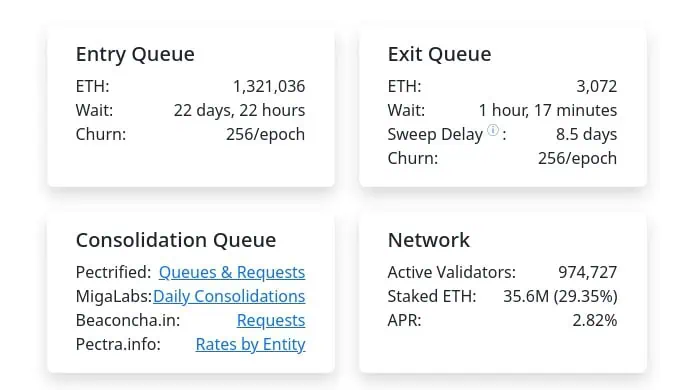
Source: validatorqueue, according to data provided by beaconchain
Since December 26, the company has been offering staking services with an initial transfer of $219 million. But the company's vision goes beyond relying on third parties; BitMine plans to launch its own staking platform in the first quarter of this year. MAVAN (Made-in-America Validator Network), its own internal validation infrastructure.
Following successful pilot tests with institutional providers to ensure the integrity of the funds, the firm seeks to vertically integrate the process, reducing operating costs and maximizing the net return on its gigantic reserves.
Access ETH staking with Bit2Me EarnOver 35 million ethers in staking
Currently, over 35,5 million ethers—29% of the total existing supply—are locked in staking contracts. This percentage represents a significant reduction in the liquid supply available on exchanges for immediate trading.
Market analysts, such as Abdul Rehman, have pointed out the disparity between the saturated inbound queue and the minimal outbound queue, with only 3.072 ETH requesting withdrawalThis is a fundamentally bullish indicator. Historically, when the demand to lock up ETH drastically exceeds the intention to sell or withdraw, the asset's price tends to react positively to the supply shock.
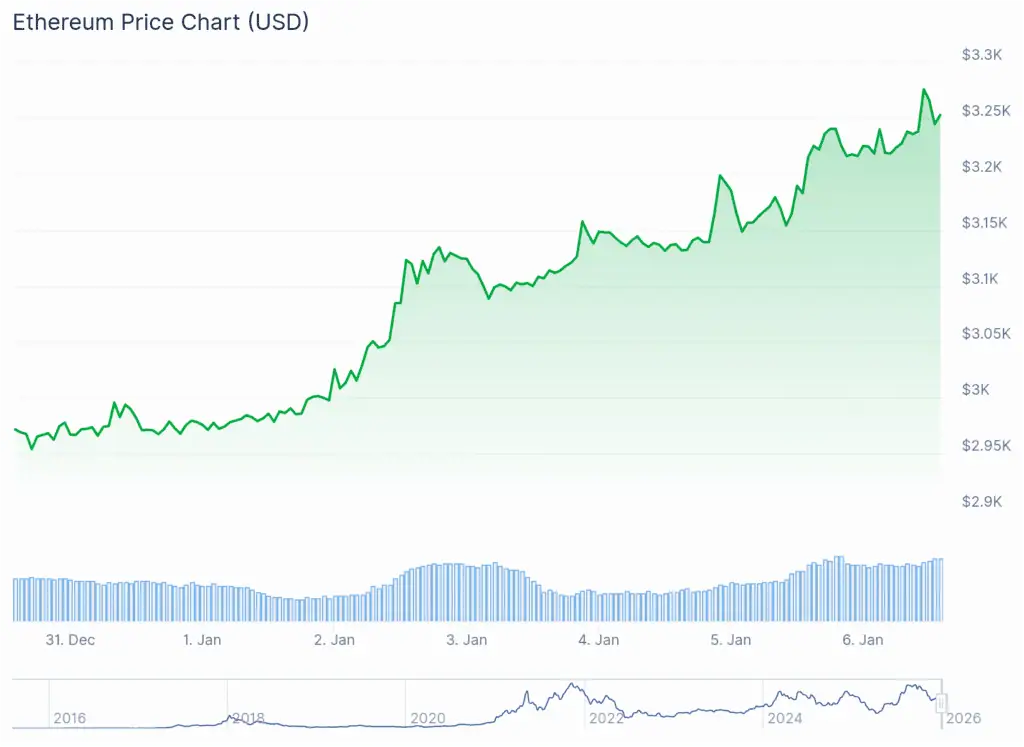
Source: CoinGecko
In this optimistic climate, BitMine's management is preparing for financial scenarios that, while hypothetical, require corporate restructuring. Tom Lee, the company's president, has informed shareholders of the need to approve an increase in the number of authorized shares to $50 billion. This request is based on internal models that explore a future where Bitcoin could reach $1 million and, based on correlation and utility, Ethereum could trade at around $250.000 per unit.
Although these figures seem very distant at present, Lee's logic is pragmatic: if the value of the 4 million ETH in treasury skyrockets, BitMine's share price would rise to levels unaffordable for the average retail investor. Therefore, authorizing new shares would allow the company to execute Splits or stock splits, keeping the stock liquid and accessible on the stock market, ensuring that the company's legal structure does not become an obstacle during a potential bull market supercycle.
Create your account and trade Ethereum todayInstitutional capital is betting on Ethereum for the long term
The current dynamics of the Ethereum market reveal a maturation in the behavior of large capital. Unlike previous cycles marked by short-term speculation, the saturation of the validator queue demonstrates a commitment to long-term holding.
Institutions like BitMine are not only buying the asset, but are also willing to wait weeks in a technical queue and lock up their capital indefinitely for moderate returns, prioritizing accumulation over immediate liquidity. With over a million ethers waiting to be added and a network infrastructure slowly adjusting to this massive demand, the message from smart money is clear: confidence in Ethereum's security and economic future is, at this moment, absolute.