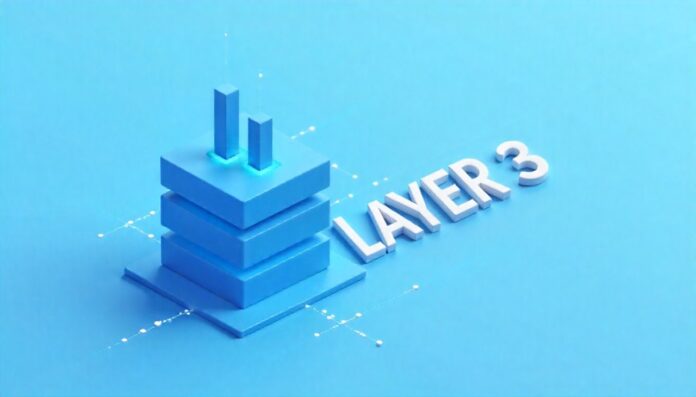
Layer 3 blockchain networks are redefining usability and privacy in Web 3. Learn how they work and what role they play in the evolution of decentralization.
Blockchain technology has evolved dramatically since its inception, and now Layer 3 networks are revolutionizing the landscape. These new layers build on the solid foundations of Layer 1 and Layer 2 networks, but offer something much more specialized and valuable: functionality focused on specific sectors such as gaming, social media, and finance, without sacrificing system security or stability.
Layer 3 offers an environment tailored to the specific needs of each application, allowing them to operate more efficiently and with a better user experience. Thus, decentralization becomes not only more robust but also more practical and accessible in everyday life, opening the door to a future where blockchain technology is naturally integrated into multiple areas.
Trade crypto with Bit2Me, securely and frictionlesslyLayer 3: Blockchain technology within everyone's reach
Layer 3 networks represent a significant advancement in the evolution of blockchain technology, focusing on offering a more accessible experience tailored to user needs. Unlike previous layers, which focused on technical aspects and increasing network capacity, this one new layer It is designed for specific applications that require speed, advanced functionality, and flexibility, such as video games, social networks, or innovative financial services.
One of the main strengths of Layer 3 is its ability to simplify interaction with the blockchain, making it easier for users without deep technical knowledge to take advantage of its benefits naturally and without complications.
Several innovative projects are demonstrating how this new technological layer is revolutionizing the way decentralized applications are managed. Orbs Network, XAI Games, zkLogin, DEGEN Chain, Dojo and Lens Protocol are some key examples that demonstrate this evolution.
zkLogin, for example, offers the ease of logging in using traditional accounts like Google or Apple, but without sacrificing security, achieving a much more comfortable experience for the user. Meanwhile, XAI Games processes thousands of internal microtransactions within its game without overloading the main network, resulting in much smoother and more enjoyable gameplay.
Lens Protocol stands out as a social platform built on blockchain, designed to give users true control over their content and digital identity. That is, unlike conventional social networks, Lens allows creators and users directly own and monetize their profiles, posts, and followers, creating a fairer and more decentralized environment.
A more private and accessible blockchain
Additionally, Layer 3 incorporates technologies that strengthen privacy, protecting sensitive user information without making it public. This opens up new possibilities in fields such as healthcare, digital identity, and secure communication, where data protection is essential.
By incorporating these innovations, Layer 3 not only expands the ways blockchain can be applied, but also makes it more practical and reliable for both everyday use and specialized applications. In essence, this layer elevates blockchain to a new level of speed, functionality, and security, bringing it tangibly closer to people's everyday lives.
This combination of increased privacy, efficiency, and accessibility is driving mass adoption of the technology, facilitating the development of decentralized solutions that previously seemed distant or overly complex. Thus, Layer 3 not only transforms blockchain into a more powerful tool, but also into an accessible resource for innovation in various key sectors.
Bit2Me connects you to blockchain. Explore crypto here.Layer 1 and Layer 2: the foundations on which it is built
To understand the role that Layer 3 networks play, it is important to first recognize the structure on which they are based. At the base we find Layer XNUMX networks. Layer 1, which are the main blockchains such as Bitcoin, Ethereum, Solana, Avalanche and Cardano, among others. These networks are responsible for managing transactions, ensuring consensus, and maintaining system security. Their role is fundamental to preserving the decentralization and integrity of the entire network.
On this basis, scalability solutions emerge, known as Layer 2, which are designed to improve efficiency in transaction processing. Technologies such as Lightning Network y Stacks for Bitcoin, or Arbitum y Optimism For Ethereum, they work by optimizing the use of the underlying infrastructure through innovative methods, in order to make operations faster and cheaper. These layers work in conjunction with Layer 1, complementing them rather than replacing them, and contribute to improving the user and developer experience.
In this context, Layer 3 networks complement architecture with a focus on customization and specific purpose. While previous layers focus on infrastructure, performance, and scalability, Layer 3 is dedicated to creating environments tailored to different needs, facilitating the development of more sophisticated and specialized applications. This clear modularity allows each level to fulfill a specific function, ensuring that security and efficiency remain intact.
Thus, these layers together form a tiered structure that drives constant progress in the evolution of Web3, enabling broader, more functional adoption that adapts to diverse scenarios. The interaction between these levels opens up a promising path for development and innovation within the blockchain ecosystem.
 Certificate
Blockchain Course
Basic levelTake this course where we explain blockchain in a clear, simple and concise way so that you have a very clear idea of what this new technology consists of.
The future of Layer 3: towards a more intuitive and modular Web3
The evolution toward Layer 3 networks represents a turning point in blockchain development. As the infrastructure consolidates and scalability improves, the focus shifts toward user experience and specialization. Layer 3 networks allow for the construction of functional, intuitive, secure applications tailored to real-world contexts, and this transition is key to transforming Web 3 from a technical space into an everyday tool.
Experts point out that the future of L3s lies in modularity. Instead of building monolithic solutions, developers can assemble specific components for each need, achieving greater flexibility in both design and governance. Furthermore, interoperability across layers and networks opens the door to more collaborative and dynamic ecosystems.
With the increasing adoption of this architecture, we will see a diversification of L3 platforms focused on different sectors. From decentralized social networks to blockchain-based healthcare systems, the possibilities are vast. The important thing is that these solutions seek to complement the previous layers, creating a richer and more functional structure.
In essence, the development of Layer 3 marks a crucial point of evolution, connecting blockchain technology with real user needs and offering a much more intuitive and accessible experience, laying the groundwork for a future where decentralization is tangible and much more practical.
With Bit2Me, you can trade crypto fluently. Get access today.