

The state of Massachusetts is moving forward with a bill to create a strategic Bitcoin reserve, joining the long list of US states that could change the financial landscape of the United States and the future of cryptocurrencies.
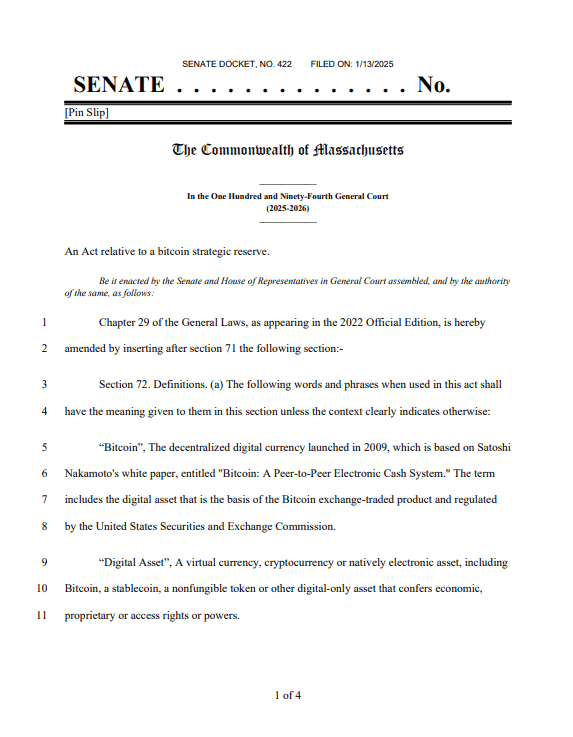
The state of Massachusetts has introduced a bill seeking to establish a Bitcoin strategic reserve. This initiative, led by Republican Senator Peter Durant, marks a significant milestone in the state’s financial history and positions it as the first “deep blue state” to seriously consider including Bitcoin in its state reserves.
With an investment limit of up to $900 million under the bill, Massachusetts joins a growing list of US states that are exploring the possibility of integrating Bitcoin into their financial strategies.
The Massachusetts Bitcoin Strategic Reserve Proposal
The bill, called SD 422, proposes the creation of a separate fund known as the “Commonwealth Strategic Bitcoin Reserve.” This fund would be administered by the Commonwealth Treasurer and would allow for investment in Bitcoin and other digital assets using unspent, unencumbered or unencumbered funds.
The legislation states that the amount invested in BTC cannot exceed 10% of the total deposited in the Commonwealth Stabilization Fund, which currently stands at $9.000 billion. This means that, in theory, Massachusetts could allocate up to $900 million to the purchase of Bitcoin, based on the current fund.
A historic turn in the state's financial policy
Massachusetts, known for being a traditional bastion of the Democratic Party, has surprised many with this proposal, which aligns with the most ambitious goals of the national administration, now led by Donald Trump of the Republican Party.
Although some Democratic lawmakers have shown skepticism towards cryptocurrencies, the Republican victory in the last presidential election has spurred a new wave of progressive policies regarding digital assets. Senator Durant, one of the main drivers of this initiative, has argued that the widespread adoption of Bitcoin and its growing institutional acceptance make it a viable option for the crypto market. The ideal time for Massachusetts to diversify its financial reserves.
Durant, like other US lawmakers, believes that Bitcoin is not just a digital currency, but a financial tool that can offer stability and additional returns in an increasingly digitalized world. “Massachusetts has the opportunity to lead this transformation and ensure a more robust financial future for its citizens,” he said.
A movement that spreads across the United States
With the introduction of this bill, Massachusetts is joining the race towards Bitcoin adoption. To date, several states, including Florida, Texas, Pennsylvania and Alabama, have already begun exploring the possibility of establishing strategic Bitcoin reserves. In Texas, for example, a bill was introduced in December 2024 to create a similar reserve, arguing that such a measure could help stabilize the state economy and combat inflation.
Florida, meanwhile, has been one of the most proactive states in adopting cryptocurrencies. Governor Ron DeSantis has repeatedly expressed his support for Bitcoin, even proposing that the state accept tax payments in cryptocurrencies. In Pennsylvania and Alabama, lawmakers are also considering proposals to integrate Bitcoin into their state reserves, following the lead of other states that see cryptocurrencies as an opportunity to diversify their assets, protect themselves against the volatility of traditional markets, and move toward innovation.
Bitcoin's role in the global economy
At the federal level, the United States is also considering the creation of a Bitcoin strategic reserve. During his presidential campaign, Donald Trump expressed his support for cryptocurrencies and promised more progressive policies for the development of this industry.
With his return to the White House, Trump and his administration are now working on various proposals that seek to make the nation a global leader in cryptoassets and emerging technologies. Among these proposals, the inclusion of digital assets such as Bitcoin in the Federal Reserve reserves, alongside gold and traditional currencies, is being discussed.
Other countries, such as Brazil, Russia, and Poland, are also considering integrating Bitcoin into their reserves, so it is likely that as we move forward this year we will see an increase in institutional adoption and increased regulation of the crypto sector. Furthermore, if the United States approves the creation of this store of value, it could boost the stability and widespread acceptance of Bitcoin and cryptocurrencies.