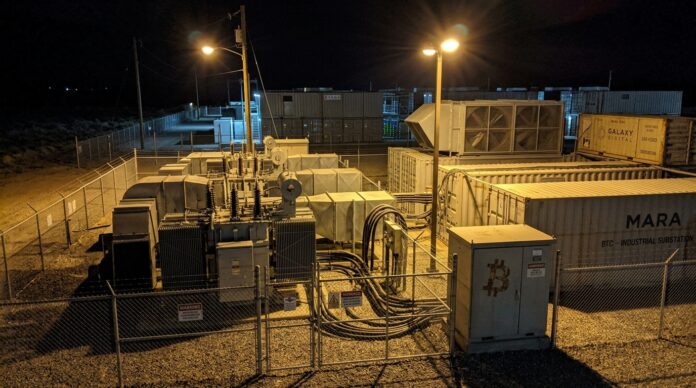
The mining company MARA has transferred $81,1 million worth of bitcoin to Galaxy Digital, marking another significant institutional move in the management of its corporate reserves. While this transaction does not confirm a direct sale on the spot market, it coincides with a continued reduction in its cash reserves.
This balance sheet adjustment occurs in an environment of operational transformation, where major proof-of-work mining firms are exploring ways to diversify into computing infrastructure and artificial intelligence to optimize their energy consumption and strengthen their revenue structure.
Institutional movements and corporate treasury management
The transfer of funds by the listed company represents a significant custody and liquidity maneuver within the institutional ecosystem. MARA formalized the transfer after transfer $81,1 million in bitcoin to Galaxy DigitalThe firm specializes in financial services for digital assets. The transaction generated immediate attention due to the volume transferred and the recipient, a common intermediary in custody, lending, and over-the-counter (OTC) execution services.
It's important to note that a transfer between institutional portfolios doesn't necessarily equate to a liquidation. These entities manage their positions using qualified custody agreements, financial hedges, or collateralization to access credit without selling the underlying assets. If you'd like to learn more about how these corporate assets are held in custody, you can consult training resources at [link to relevant resources]. Bit2Me Academy.
Evolution of bitcoin reserves in MARA's balance sheet
MARA's historical strategy for months was characterized by accumulating as many mined units as possible, a policy commonly referred to as full retention. However, accounting records reflect notable changes over the last few months, showing a lesser reliance on pure accumulation without making regular sales.
In February, the firm's treasury reached 53.822 BTC under direct management. By August, that figure had dropped to 35.577 BTC, confirming a consistent trend of outflows and balance sheet adjustments. This fluctuation in reserves illustrates the capital challenges faced by publicly traded miners, who must finance complex operations, upgrade computing fleets, and respond to their shareholders through dynamic asset management. Bitcoin.
The mining sector's pivot towards artificial intelligence
The increasing difficulty of mining and the periodic fluctuations in energy costs have prompted several operators to reconsider the exclusive use of their data centers. The massive electrical infrastructure and industrial cooling required for cryptocurrency mining are highly compatible with the high-performance computing (HPC) needs of generative artificial intelligence models.
Large mining companies are allocating megawatts of their contracted capacity to hosting agreements with technology companies specializing in AI. By diversifying their revenue streams, they secure long-term leases with more predictable cash flows in dollars, reducing their direct exposure to the cyclical volatility of the crypto market. This shift in strategy explains the need for additional operating liquidity to adapt facilities and acquire specialized processors.
Implications for the market and regulatory environment
For institutional market analysts, the $81,1 million transfer doesn't signal an imminent sell-off, but it does reflect more active working capital management. Institutional providers like Galaxy Digital facilitate complex solutions ranging from lending programs to derivatives management, allowing companies to maintain equity exposure while covering costs in fiat currency.
In Europe, these corporate activities involving digital assets operate under the supervision of the MiCA (Markets in Crypto-Assets) Regulation, which establishes stringent standards for governance, transparency, and prudential custody for crypto-asset service providers. This framework strengthens confidence in professional wealth management by clearly defining the segregation of client assets and solvency obligations in the face of global market volatility.
FAQ
Does this transfer mean that MARA has sold its bitcoin?
Not necessarily. The transfer to a custodian or institutional intermediary like Galaxy Digital may be for secure custody services, the establishment of collateral for credit lines, or internal rebalancing of operating portfolios, without implying a sell order in the spot market.
Why are mining companies exploring data centers for artificial intelligence?
Mining and AI processing share critical requirements: access to massive electrical power, advantageous energy contracts, and advanced cooling infrastructure. AI enables the assurance of recurring revenue in fiat currency, mitigating the volatility of mining rewards.
How does the MiCA regulation influence the custody of these assets in the European Union?
The MiCA Regulation requires that crypto asset service providers in the EU comply with strict solvency requirements, asset segregation and operational security measures, ensuring that the assets held in custody are not mixed with the financial institution's own balance sheet.
MARA's reconfiguration of corporate reserves and its shift towards artificial intelligence infrastructure illustrate the maturity of an industry that no longer relies solely on speculative cycles. Mining firms now operate as sophisticated energy and technology operators, optimizing every available megawatt.
Understanding these treasury dynamics and the impact of current regulatory frameworks is key to monitoring how major players in the crypto ecosystem balance long-term custody with continued commercial viability.
Investing in cryptoassets is not fully regulated, may not be suitable for retail investors due to high volatility and there is a risk of losing all invested amounts.
Generative artificial intelligence tools were used to create this article.