
A lone miner turned $86 into $271.000 worth of Bitcoin by renting hash power. We analyze this statistical anomaly and why experts warn that it's not a reliable investment strategy for those interested.
In a digital financial ecosystem dominated by industrial corporations and massive server farms, a statistically improbable event has captured market attention. On December 17th, an individual miner managed validate a complete block of the Bitcoin network, transforming an operating investment of just $86 into a total reward of approximately $271.000.
This event represents one of the most efficient victories in terms of return on investment (ROI) registered in 2025. While cryptocurrency mining has become professionalized into a high barrier to entry industry, where success often depends on economies of scale and access to cheap energy, this case demonstrates that the Bitcoin protocol maintains its original technical premise intact: any participant, regardless of size, has a mathematical chance, however infinitesimal, of competing for transaction validation.
However, behind the eye-catching headlines and exultant figures, industry analysts urge caution. While the feat validates the technical decentralization of the network, experts emphasize that solo mining using the computing power rental It does not constitute a sustainable business model, but a high-risk gamble comparable to a digital lottery.
Enter and trade Bitcoin on Bit2MeThe mechanism behind the success: NiceHash and the 928.351 block
The protagonist of this event didn't need to acquire expensive hardware, manage cooling systems, or negotiate industrial electricity rates. The transaction was carried out through NiceHash, a marketplace platform that connects sellers of processing power (hashpower) with buyers who want to mine without owning the physical equipment.
The miner used a service known as "Catch the Block" by acquiring a hash power package worth $86. With this temporary resource, their digital "worker" managed to solve the cryptographic puzzle needed to close the block number 928.351 of the Bitcoin blockchain.
The NiceHash platform publicly confirmed the event, detailing that the user earned a block reward of 3,125 BTC—the current network subsidy following the last halving—plus the network transaction fees included in that block. The total amounted to approximately 3,3 BTCAt the time of block validation, the market value of those assets was around $271.000.
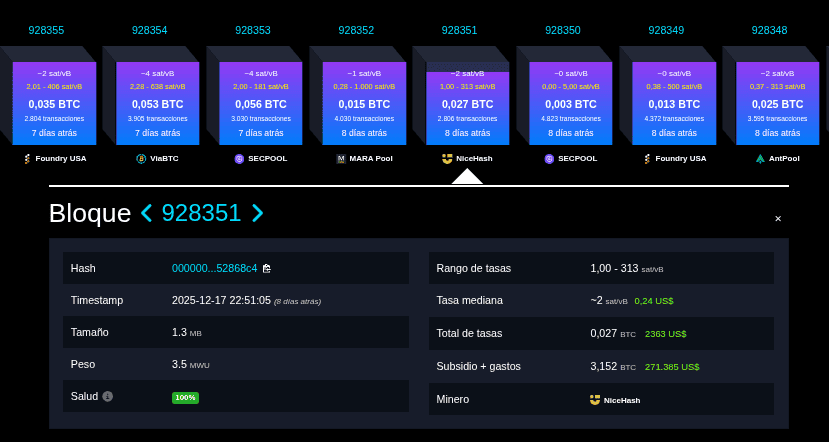
On the other hand, what makes this event technically relevant is that the user was operating in "Solo Mining" mode. Unlike mining pools, where thousands of users combine their mining power to frequently find blocks and share the profits proportionally, a solo miner keeps 100% of the reward if successful. The downside is that if they fail to validate the block within the allotted time, they lose their entire investment without any return.
Access BTC: trade easily from Bit2MeA statistical exception: experts advise against this mining strategy
Although a return on investment exceeding 300.000% is attractive, it is imperative to analyze this case from the perspective of mathematical probability, not emotion. The Bitcoin network is currently operating with an all-time high mining difficulty. This means that the competition to solve a block is fierce. fierce.
Currently, large crypto mining conglomerates and data centers control massive percentages of Bitcoin's global hashrate, so the probability of an individual miner with limited power outperforming these entities in solving a block is, according to technical estimates, less than 0,0001% on any given day.
Blockchain infrastructure experts warn that cases like block 928.351 are positive "black swans." Solo mining with rented hashpower rarely yields results. said Expert Mikhail Drozdov. The reality is that, for the vast majority of users who attempt to replicate this strategy, the result is a net loss of their initial investment. Drozdov emphasized that this is not a reliable accumulation strategy, but rather a random event of extreme luck.
Despite warnings, 2025 has been a peculiar year for such events. To date, multiple cases of independent miners solving blocks have been recorded. In late November, another solo miner validated block 925.380, and throughout the year, at least half a dozen individuals have surpassed the $350.000 mark in solo rewards. Some used specialized home equipment, while others, as in this recent case, opted for renting cloud computing power.
Buy and hold your bitcoins with Bit2MeThe relevance of Bitcoin's technical decentralization
Therefore, the real value of this news lies not in the suggestion that solo mining is profitable for the average user, but in the confirmation of the Bitcoin software integrityThe fact that a tiny actor can, under the right circumstances of randomness, win the race against facilities valued at hundreds of millions of dollars, confirms that the network does not discriminate by size.
The distribution of rewards in Bitcoin continues to depend exclusively on computational proof-of-work. There are no software barriers preventing small players from entering the market, only economic and statistical barriers.
In conclusion, while the transformation of $86 into $271.000 is a verified fact and one of the most impactful financial stories of the year, it should be interpreted as an exception to the rule. Industrial mining remains the standard for network security, and pool participation is still the rational way to generate recurring revenue from BTC mining. According to experts, this lone miner didn't discover a new formula for wealth, but rather was the lucky winner of a highly competitive global lottery.
Access Bitcoin securely: sign up today