

71 leading companies have accumulated over 4,1 million ETH, representing more than 2% of the total supply, highlighting a new phase in institutional adoption of the cryptocurrency.
Ethereum has reached a new milestone in its evolution as an institutional asset. According to recent data, more than 2% of its total supply is locked in corporate treasuries. This figure is equivalent to more than 4,1 million ETH, valued at approximately $ 19.700 millones.
Strategic accumulation by public companies reflects a transformation in the corporate use of cryptoassets, with Ethereum standing out not only for its value but also for its utility as a financial infrastructure. This development is redefining the role of Ethereum and cryptocurrencies in modern business management.
Buy and manage ETH with a business visionEthereum as an institutional asset: beyond its price
The consolidation of Ethereum into corporate treasuries represents a structural shift in how companies manage their strategic reserves. Unlike Bitcoin, whose institutional narrative has focused on inflation hedging and storing value, Ethereum offers a additional layer of utility which makes it a multifunctional tool.
The companies that are integrating ETH into their balance sheets, which total 71, are looking for more than exposure to its price. They are also seeking access to its digital ecosystem, which includes staking, DeFi protocols, governance, and decentralized financial services.
The data updated by Strategy ETH Reserve indicates that the 3,39% of Ethereum's total supply is in corporate hands, which exceeds the symbolic threshold of 2% and marks an acceleration in institutional adoption.
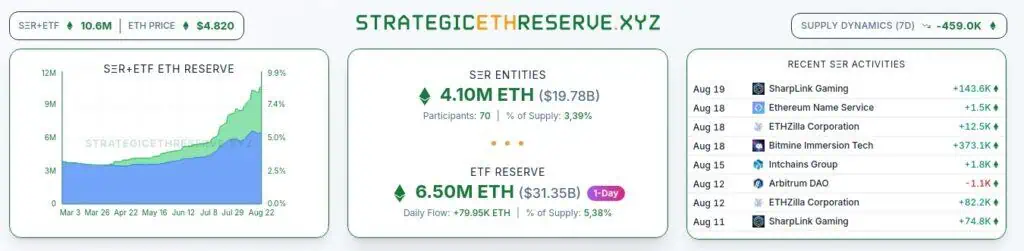
Source: Strategy ETH Reserve
The above figures reflect not only confidence, but also a strategic vision for the role Ethereum can play in the financial architecture of businesses. The ability to generate returns through staking makes ETH a dynamic asset, capable of providing value beyond price appreciation.
Furthermore, Ethereum's interoperability with decentralized applications allows businesses to explore new forms of liquidity, financing, and process automation. In this context, ETH is positioned as an infrastructure that not only stores value, but also activates and multiplies it.
BitMine and the 5% ETH Target: Strategic Concentration
Among the 71 companies currently holding ETH, BitMine Immersion Technologies has emerged as the most aggressive player, with more than 1,5 million ETH units in its treasuryIts stated goal of capturing up to 5% of Ethereum's total supply reveals a strategy of deep positioning in the crypto ecosystem. As mentioned, this accumulation isn't merely a speculative vision, but rather a commitment to the infrastructure that Ethereum represents.
Create your account and accumulate ETH with BitMine and SharpLinkThe concentration of ETH in BitMine's hands also has implications for the circulating supply. Locking up large volumes in treasury reduces availability in secondary markets, reinforcing the narrative of scarcity. But beyond the impact on supply and demand dynamics, what's relevant is the institutional message: Ethereum is perceived as a long-term asset, with operational utility and the ability to integrate into business models.
SharpLink Gaming and The Ether Machine complete the podium of the top three corporate accumulators, with 740.800 and 354.000 ETH, respectivelyThese figures consolidate a trend in which companies are not only adopting cryptoassets, but also building upon them. In this sense, Ethereum, due to its modular design and ability to evolve, becomes one of the preferred cryptoassets for those seeking more than financial exposure.
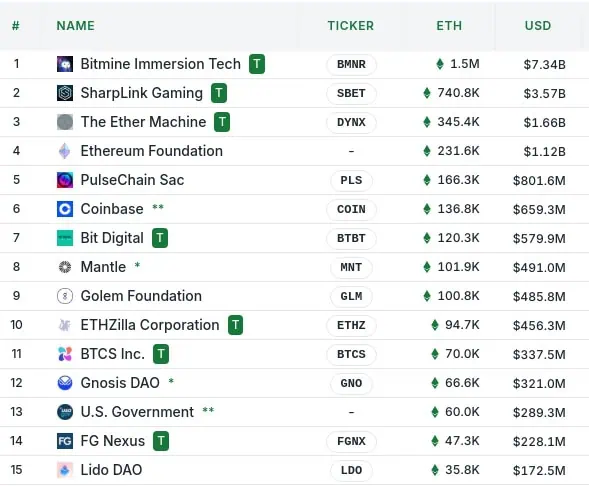
Crypto Treasury: Evolution of the Traditional Model
Historically, crypto treasury management has been dominated by Bitcoin, whose narrative of protection and store of value made it the cryptocurrency of choice for corporate balance sheets. However, Ethereum has begun to redefine that paradigm. Its ability to generate yield through staking, interact with DeFi protocols, and participate in governance has transformed it into an active financial management tool.
For these companies that invest in ETH, the cryptocurrency proposes a dynamic treasury, where assets are not just held, but put to work. Therefore, companies like BitMine can participate in staking, validating blocks and earning rewards, and also access decentralized loans and automate processes through smart contracts. All of this functionality makes Ethereum an operational extension of the corporate balance sheet.
In short, the institutional accumulation of Ethereum not only changes market dynamics but also redefines its role as a financial infrastructure. Companies that integrate ETH into their operations do so not solely for its market value, but for its ability to enable processes, products, and services. Ethereum thus becomes a foundation layer upon which decentralized business solutions are built.
Manage ETH as a multifunctional financial asset