

The world's largest asset manager, BlackRock, is officially seeking a Managing Director of Digital Assets in New York, offering a base salary of up to $350.000 plus bonuses.
This search, according to commentators, is part of an institutional metamorphosis that the firm has been undergoing under the direction of Larry Fink, and in which it has stopped seeing cryptocurrencies as an alternative investment class, to integrate them as a central piece in the modernization of the global financial infrastructure.
Currently, BlackRock dominates the exchange-traded fund (ETF) market with iShares Bitcoin Trust (IBIT)A product that, since its approval by the Securities and Exchange Commission (SEC) in 2024, has reached unprecedented levels of liquidity. However, beyond the success of this Bitcoin-based exchange-traded fund, BlackRock's ambition in the blockchain industry extends to the tokenization of traditional assets through initiatives such as the BUIDL background, seeking to redefine the issuance and settlement of securities in an environment where the convergence between traditional finance (TradFi) and decentralized finance (DeFi) is already a strategic reality for 2026.
Trade Bitcoin on Bit2MeBlackRock accelerates its crypto presence with the search for a new Managing Director
According to the job posting, shared by The Block's founding reporter, Frank Chaparro, the person filling the position of Managing Director of Digital Assets He will lead the firm's efforts in critical areas such as crypto assets, stablecoins, and tokenization.
The compensation, at the top of the company's hierarchy, reflects BlackRock's demand for sophisticated governance and expert execution. The CEO will act as the primary liaison with institutional clients, navigating the technical complexities of blockchain and the stringent regulations of Wall Street. Furthermore, the firm is seeking a profile with more than 15 years of experience capable of solving cross-cutting problems, suggesting that BlackRock is building an in-house advisory capability that rivals native cryptocurrency firms, backed by its $12,5 trillion brand of assets under management.
This professionalization is a necessary step to attract pension funds and family offices that require institutional-level custody frameworks. By appointing a dedicated leader for the digital market, BlackRock is signaling to regulators that digital assets are central to its vision of stability and innovation.
Following the publication of this job posting, experts believe that specialists in this field are gaining importance in guiding developments at the Aladdin technology platform and iShares funds. In its reports, BlackRock has indicated that the 61% of high-net-worth investors already include digital assets in their portfolios. However, it seems that their traditional advisors often lack the right tools to manage this interest. Therefore, BlackRock plans to fill that gap, making it easier to seamlessly integrate these assets into balanced portfolios, always with rigorous risk and return controls.
IBIT: the ETF that brought Bitcoin to the heart of institutional finance
El iShares Bitcoin Trust (IBIT) It has transformed institutional access to Bitcoin by removing the barriers that weighed on the market. As of the end of this month, IBIT is reported as the world's most liquid Bitcoin ETF, with net assets exceeding 51.490 million.
The firm controls approximately 61% of the net volume under custody of Bitcoin ETFs through this fund, giving it massive influence over the asset's liquidity. According to data from the Soso Value platform, iShares' advantage of scale is evident compared to other competitors, including the Fidelity Wise Origin Bitcoin Fund (FBTC). While IBIT managed $51.940 billion as of March 31, FBTC held approximately $12.300 billion in assets under management—a considerable difference, despite having identical expense ratios of 0,25%. IBIT's liquidity depth reduces spreads, making it the primary vehicle for large institutional investors.
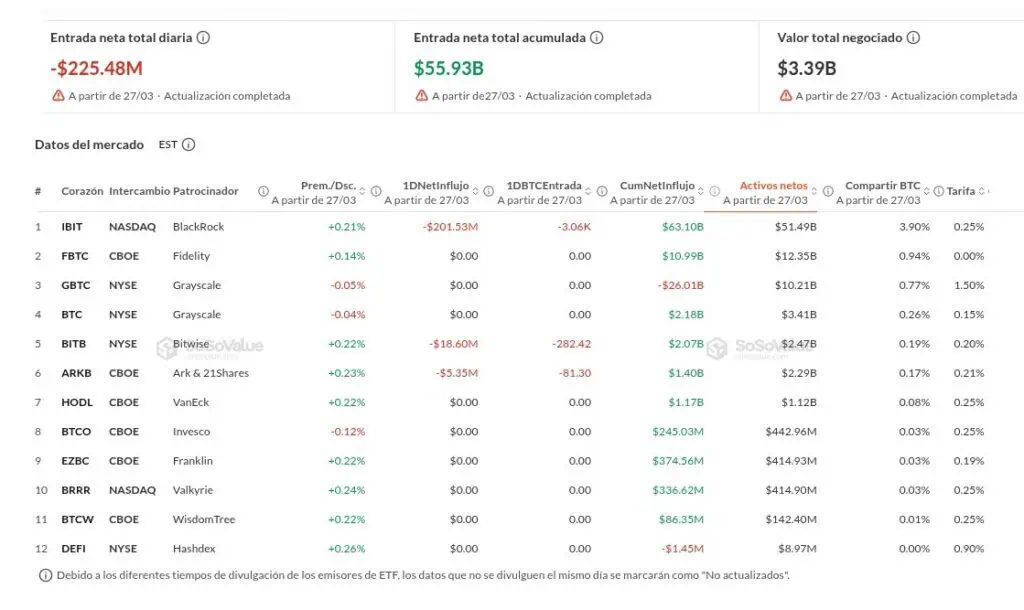
Source: Soso Value
IBIT's resilience has been demonstrated during the volatility seen since the beginning of 2026. Despite the net outflows that affected the sector — estimated at around $4.500 billion —, BlackRock's structure absorbed the shocks without deviations between the market price and the net asset value (NAV).
Institutional investors use the ETF as a hedging tool against fiscal uncertainty and inflation. Furthermore, integration with the Aladdin platform allows for real-time risk simulations, monitoring how Bitcoin's volatility affects the overall correlation. For all these reasons, IBIT is considered the "Trojan horse" which has allowed the acceptance of blockchain in traditional wallets, paving the way for more complex products based on tokenization.
Create your account and trade with BitcoinBlackRock and the silent revolution of tokenization
In fact, for Larry Fink, the true revolution of the blockchain industry is not just in Bitcoin and cryptocurrencies, but in tokenization, defined as the "updating of the plumbing of the financial system".
The fund BlackRock USD Institutional Digital Liquidity Fund, known as BUIDL, is the ultimate exponent of this vision, exceeding $2.000 billion. Its expansion to multiple blockchains, including Ethereum, Aptos, Arbitum, Avalanche, Optimism y PolygonThis marks a milestone in interoperability, enabling instant settlements and reducing transfer costs. The technology also offers greater transparency and programmability, representing a decisive advantage for institutions handling large volumes of transactions.
The impact of this innovation is particularly noticeable in the stablecoin arena. BlackRock manages over $65.000 billion in reserves linked to these assets, and Fink argues that tokenization will pave the way for more agile and equitable access to financial markets. According to his view, moving a stock or bond in the future will be as simple as sending a message, transforming how investors interact with products like private credit.
Even so, despite its potential, the advancement of tokenization faces regulatory hurdles, which is why BlackRock is one of the firms actively engaging with regulators and legislators to adapt the current legal framework, supporting initiatives such as the CLARITY Act. The company argues that the security and traceability inherent in blockchain can offer investors a higher level of protection than current mechanisms, in addition to strengthening anti-money laundering policies.
Buy Bitcoin today at Bit2Me